

 English
 русский
 España
 Portugal
 عربي
عربيWang Yu | Aquarium Products After-Sales Engineer
Home / Author / Wang Yu | Aquarium Products After-Sales Engineer / ZZP Series Variable Frequency Wave Pump: Precision Flow Control for Modern Aquariums
Content
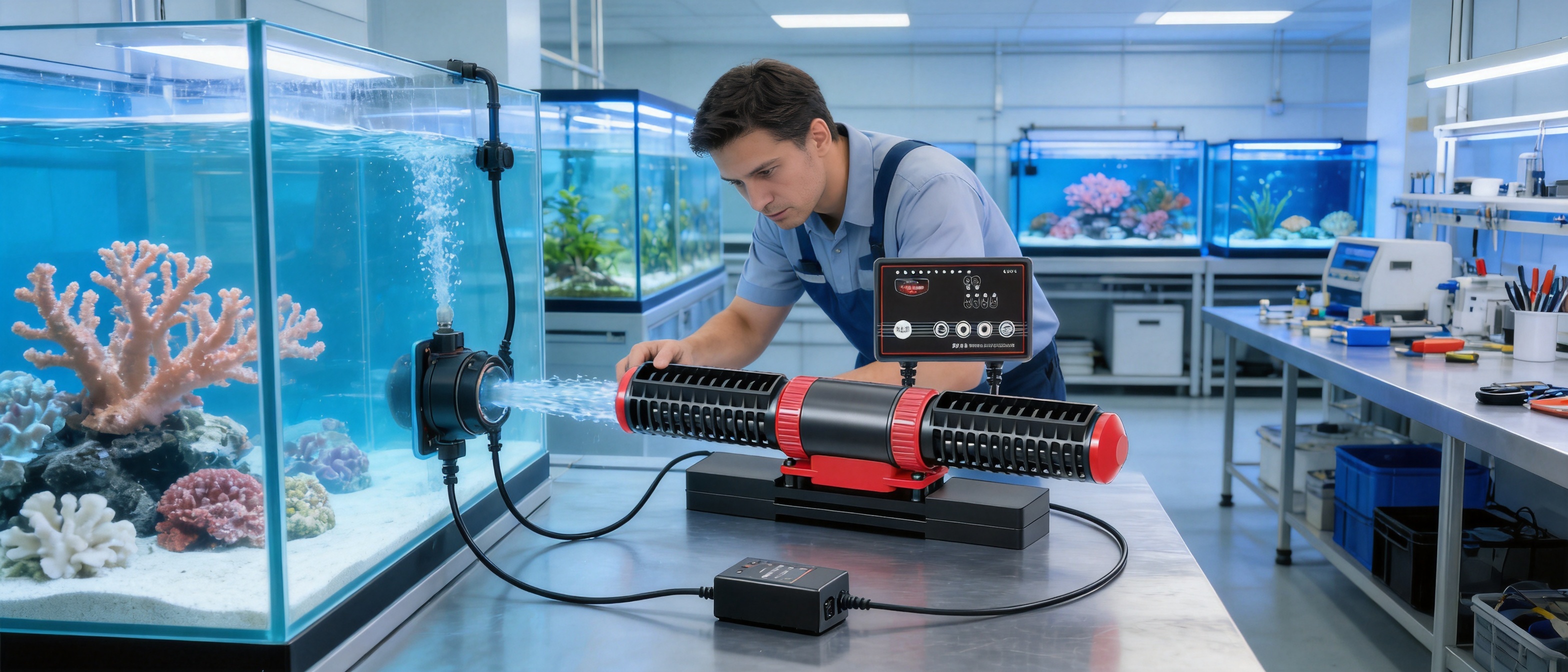
Water movement is one of the most important elements in a successful aquarium. It affects oxygen exchange, waste distribution, temperature consistency, filtration performance, coral health, plant growth, and the overall visual quality of the aquatic environment. A tank may contain high-quality lighting and filtration, but without appropriate circulation, stagnant zones can develop and the aquarium may fail to provide a stable habitat for fish, corals, plants, and other aquatic organisms.
The ZZP Series Variable Frequency Wave Pump is designed to address this central requirement through controlled water movement in medium-sized aquariums. The ZZP-101 model combines a compact body, a 40-watt power rating, DC24V operating voltage, and variable-frequency wave-pump functionality. It is specified for aquariums between 70 and 120 centimeters in length, making it suitable for many residential, display, breeding, and professional aquatic installations.
Rather than relying only on constant-speed circulation, a variable-frequency wave pump is intended to provide adjustable water movement. This approach gives aquarium owners greater control over circulation intensity and enables them to adapt water flow to the requirements of different fish, corals, plants, aquascapes, and filtration systems. The result can be a more balanced aquatic environment with fewer dead spots and more efficient movement of oxygen, nutrients, and suspended waste.
The product is manufactured by Sensen Group Co., Ltd., a long-established enterprise involved in aquarium products, aquaculture machinery, industrial equipment, and related fields. The company’s history, organizational structure, research activity, quality-control functions, and broad production network support the development of specialized aquarium equipment such as the ZZP Series.
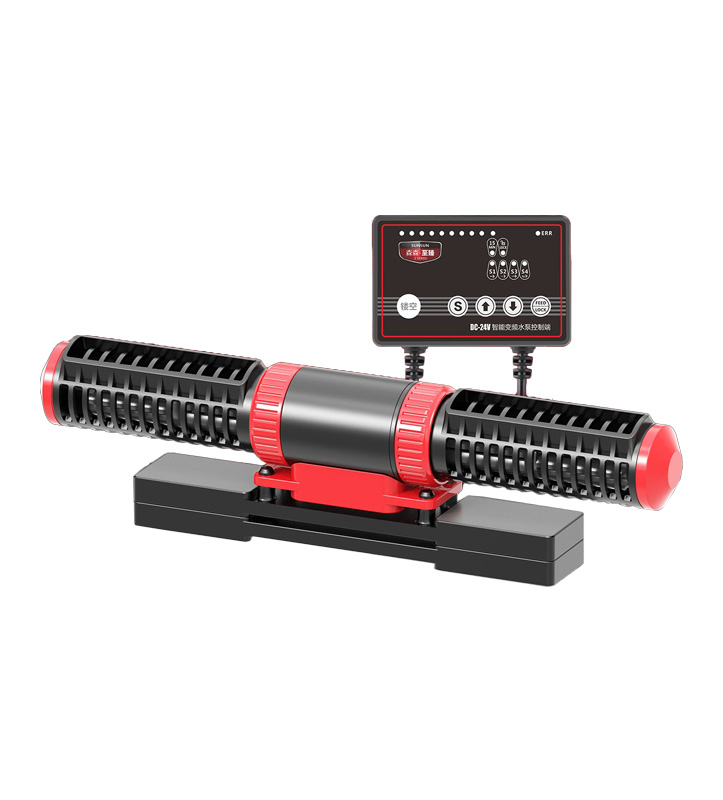
ZZP Series Variable Frequency Wave Pump
Water in a natural aquatic environment is rarely completely still. Rivers, lakes, coastal zones, reefs, and shallow habitats all experience movement caused by wind, tides, temperature differences, biological activity, and changes in depth. Aquarium inhabitants may therefore benefit from circulation that is more deliberate and dynamic than the movement created by a conventional filter outlet alone.
In an aquarium, circulation helps distribute dissolved oxygen throughout the water column. Oxygen is consumed by fish, invertebrates, plants during dark periods, beneficial microorganisms, and organic decomposition. If water movement is insufficient, oxygen-rich water may remain concentrated near the surface while lower areas receive less circulation. A properly selected wave pump can help reduce this uneven distribution.
Water movement also assists with waste management. Uneaten food, fish waste, and other suspended particles can settle in corners, behind decorations, or beneath rocks. Once deposited, these materials may contribute to poor water quality if they are not removed or processed by filtration. A circulation pump can help keep particles suspended long enough for the aquarium’s filtration system to capture them.
Temperature distribution is another important consideration. Aquarium heaters and chillers operate at specific points in the tank, but their effectiveness depends on the movement of water. Strongly isolated areas may become warmer or cooler than the main body of water. Moderate, well-directed circulation helps distribute temperature more evenly, reducing localized variations.
For planted aquariums, water movement carries nutrients and carbon dioxide toward leaves while assisting the removal of metabolic by-products. For reef aquariums, circulation is particularly important because corals rely on water movement to transport oxygen, food particles, and dissolved nutrients. Fish also benefit from an environment that provides activity and exercise without creating an exhausting, uncontrolled current.
The ZZP Series Variable Frequency Wave Pump is a dedicated aquarium circulation device developed for controlled water movement. The available ZZP-101 specification identifies the unit as a 40-watt model with an AC100–240V, 50Hz/60Hz input and DC24V output or operating supply. It is intended for aquariums measuring approximately 70 to 120 centimeters in length.
Its dimensions are 290 × 55 × 40 millimeters, giving the pump a long and relatively slim form. This profile can help reduce the visual impact of the equipment inside a display aquarium. In contrast with bulky circulation devices, a streamlined pump can be positioned with less disruption to the aquascape, provided that the installation location and flow direction are appropriate.
The listed product weight is 2 kilograms. This figure may include the pump and associated components as specified by the product configuration. Aquarium owners should always verify the final package contents, mounting method, and installation instructions before use.
Specification |
ZZP-101 Details |
Product type |
Variable frequency wave pump |
Model |
ZZP-101 |
AC input |
AC 100–240V, 50Hz/60Hz |
DC specification |
DC24V |
Rated power |
40W |
Recommended aquarium size |
70–120cm |
Weight |
2kg |
Dimensions |
290 × 55 × 40mm |
The duplicate “Input Voltage” labels in the source specification appear to represent the AC input and DC24V electrical specifications. The AC100–240V, 50Hz/60Hz input range is useful for compatibility with electrical systems in different markets, while the DC24V specification identifies the low-voltage supply side of the pump system. Users should follow the supplied electrical documentation and should not connect the pump outside its specified operating arrangement.
The central feature of the ZZP Series is its variable-frequency operating concept. A fixed-speed pump generally produces a relatively constant flow rate whenever it is switched on. That arrangement can be appropriate for basic circulation, but it offers limited flexibility. Different aquarium layouts and livestock combinations may require different levels of movement during the day, at night, during feeding, or after changes to the aquascape.
Variable-frequency operation allows the circulation intensity to be adjusted rather than treated as a single permanent setting. This can make it easier to establish a flow pattern that is strong enough to improve oxygen distribution and waste transport while remaining appropriate for the aquarium’s inhabitants. The specific control range and operating interface should be confirmed from the product manual or supplied controller configuration.
Adjustable flow is especially valuable in mixed aquariums. A tank may contain open-water fish that prefer active swimming, slower-moving ornamental fish, soft corals, hard corals, aquatic plants, and areas of fine substrate. Each element responds differently to water movement. A controllable wave pump gives the aquarist more opportunities to divide the aquarium into zones rather than forcing every area to receive the same current.
Flow adjustment can also help during the maturation of a new aquarium. Young plants, newly placed corals, small fish, and recently arranged substrates may require a gentler starting environment. As the biological system develops and the aquascape becomes established, the circulation level can be adjusted. This gradual approach may be more practical than installing a permanently high-output pump and attempting to block or redirect excessive flow.
Variable-frequency control may also assist energy management. A 40-watt rated pump does not necessarily need to operate at maximum intensity at all times. Lower settings during quiet periods may support the desired circulation pattern while reducing unnecessary energy use. Actual consumption depends on the selected operating level, control system, installation conditions, and duration of operation.
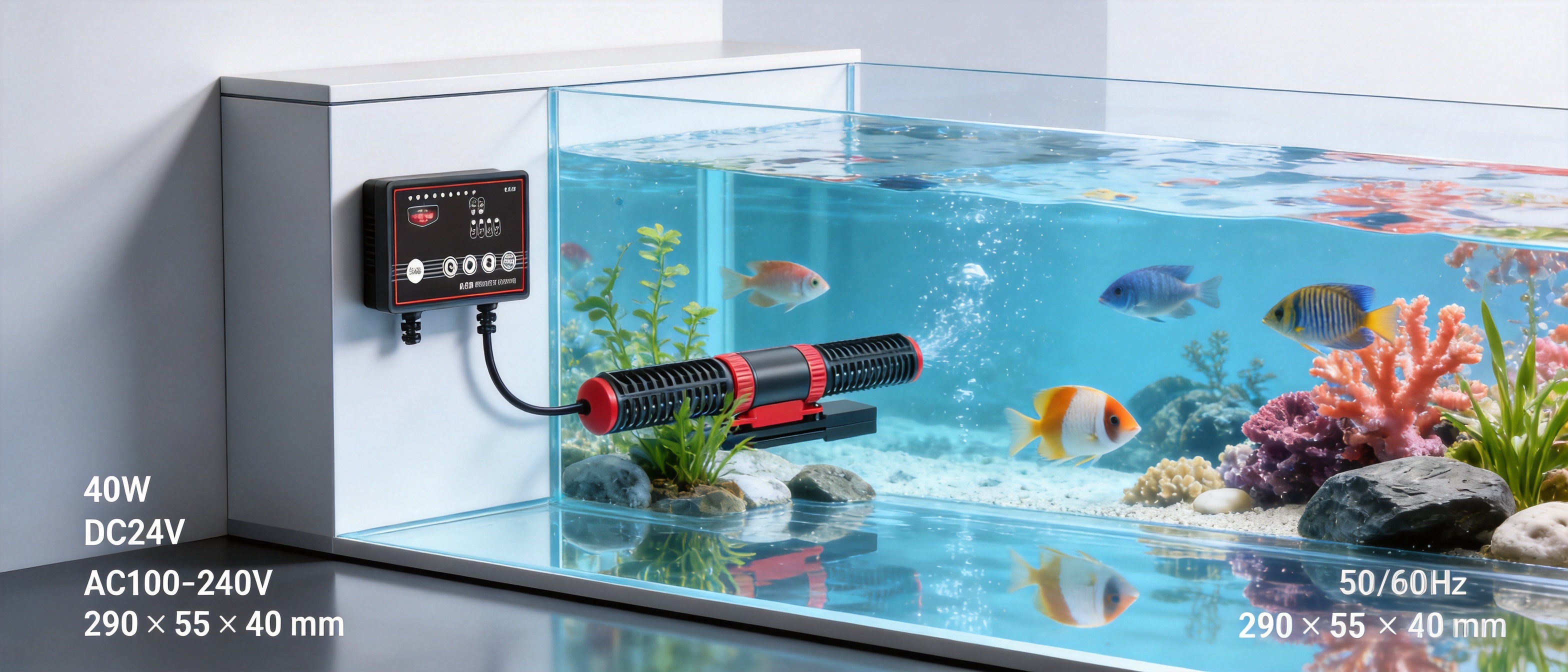
The recommended aquarium range of 70 to 120 centimeters gives the ZZP-101 a clearly defined application. Correct sizing is essential for circulation equipment. A pump that is too weak may fail to move water through the entire aquarium, while an oversized unit can create excessive turbulence, displace substrate, stress livestock, or make the aquarium difficult to manage.
By identifying a target tank length, the product gives installers a useful starting point for equipment selection. The final choice should still consider aquarium depth, width, rockwork, plant density, overflow design, filter output, livestock type, and the desired circulation pattern. Nevertheless, the stated range helps position the ZZP-101 as a practical option for medium-sized display systems rather than an unspecified general-purpose pump.
The 290 × 55 × 40mm dimensions create a relatively narrow body in relation to its length. This can be advantageous in aquariums where visual presentation is important. A pump that occupies less apparent space may be easier to integrate into a carefully designed aquascape, especially when it is mounted near a side panel or behind structural elements.
Compact construction can also simplify planning around other equipment. Aquarium installations often contain heaters, filter inlets, filter outlets, lighting supports, dosing lines, thermometers, sensors, and maintenance tools. A slimmer circulation unit can help reduce congestion and make it easier to position the flow source without obstructing the main viewing area.
The AC100–240V, 50Hz/60Hz input specification supports use across a wide range of electrical markets. Equipment intended for international distribution benefits from a broad input range because it reduces the need for separate electrical versions for different regions. It also gives aquarium businesses and distributors greater flexibility when supplying products to customers in multiple countries.
Electrical compatibility should not be confused with universal installation without accessories. Plugs, adapters, local electrical codes, grounding requirements, and controller arrangements may differ by market. The pump should be installed according to the supplied instructions and used with suitable protection against water exposure.
The DC24V specification is an important part of the product’s electrical configuration. Low-voltage equipment architecture can provide practical advantages for aquarium installations, particularly when the power-conversion arrangement is properly designed and protected. Water and electricity must always be treated as a serious safety concern, so the use of a designated power supply, appropriate cable routing, and residual-current protection is essential.
A DC24V system can also make the pump easier to integrate into a controlled aquarium equipment layout. It may be used alongside a dedicated controller or other compatible devices, depending on the supplied system configuration. Users should not substitute an unrelated power supply merely because it appears to have the same voltage. Current capacity, polarity, connector design, insulation, and manufacturer requirements must all be considered.
The ZZP-101 is listed at 40 watts. This rating places the product in a moderate power category suitable for circulation in the specified aquarium range. A moderate electrical rating can support a balance between meaningful water movement and manageable operating demand. The exact flow performance, however, is influenced by frequency, speed setting, water depth, pump placement, obstructions, and maintenance condition.
Power rating alone should never be used as a substitute for flow data. Aquarists should evaluate the entire system and select settings according to livestock requirements. The value of the ZZP-101 is not simply its wattage, but the combination of its rated power, variable-frequency functionality, compact structure, and intended tank-size range.
Traditional fixed-speed pumps remain useful in many aquarium applications, but their operating model can be limiting. When switched on, a fixed-speed device typically delivers one principal level of circulation. The aquarist may redirect the outlet or use valves and diffusers, but these methods do not always provide the same degree of direct control as a variable-frequency system.
A variable-frequency wave pump is better suited to aquariums that need changing flow conditions. For example, a reef display may require active circulation during the main lighting period, a gentler pattern at night, and reduced flow during feeding. A planted aquarium may need enough movement to distribute nutrients without causing delicate stems or leaves to bend continuously. An ornamental fish tank may require circulation that supports oxygen exchange while preserving calm zones.
The ZZP Series can therefore offer a more adaptable operating experience than a basic constant-output pump. Its advantage is not necessarily that it produces more water movement than every competing device. Instead, its value lies in giving the user greater control over how that movement is delivered. This is a more useful comparison because aquarium performance depends on flow quality, direction, distribution, and suitability—not only maximum output.
Adjustable operation may also reduce the need for improvised flow restrictions. Aquarists sometimes place sponges, valves, decorative barriers, or other obstacles in the path of an oversized pump. Such solutions can create uneven pressure, collect debris, and complicate maintenance. Selecting a pump with an appropriate operating range can provide a cleaner and more deliberate installation.
Another advantage is adaptation over time. Aquarium systems change as fish grow, corals are added, plants become denser, rocks are rearranged, and filtration media are replaced. A variable-frequency pump can be adjusted as these conditions develop. A fixed-output pump may need to be repositioned or replaced when the aquarium’s biological and physical requirements change.
The recommended tank length is only one part of flow planning. A 70-centimeter aquarium with a wide open layout may require a different circulation pattern from a 120-centimeter tank densely filled with rock or plants. The internal structure of the aquarium affects how water travels, where particles collect, and whether a particular zone receives too much or too little movement.
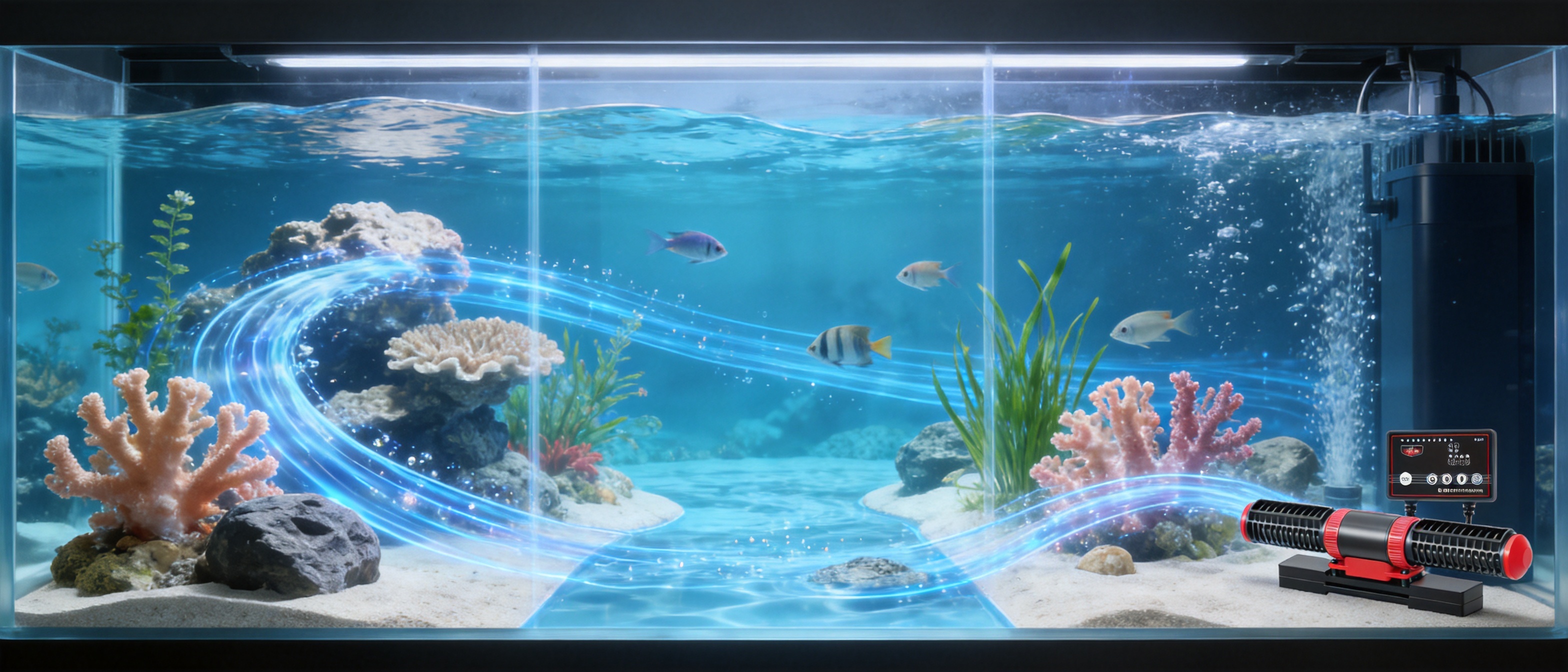
For an open aquascape, the pump can often be aimed along the length of the aquarium to create a broad circulation path. The return flow may travel around the opposite end and move back through the lower portion of the tank. This type of loop can help distribute oxygen and suspended particles without directing a narrow jet at a single object.
In a rock-based aquarium, flow should be planned around the structure. Directing water into openings and behind formations may help prevent debris from settling in hidden areas. At the same time, the aquarist should avoid creating a current that continually strips fine substrate from the base of the display. A variable setting makes it easier to fine-tune the result.
In a planted aquarium, the pump should be positioned so that leaves move gently rather than being forced in one direction. Excessive movement can damage fragile plants or disturb the substrate, while insufficient movement may allow organic material to collect among dense growth. The desired pattern is usually broad and distributed rather than concentrated at one point.
For fish-only systems, the pump can be used to improve oxygen exchange and help direct waste toward the filter intake. Fish behavior should be monitored after installation. If animals constantly avoid a particular area, struggle to maintain position, or remain pressed into corners, the flow may be too strong or poorly directed.
The ZZP-101 is supported by the broader manufacturing and organizational background of Sensen Group Co., Ltd. The company was established in November 1985 and has developed over more than three decades across aquarium pets, aquaculture machinery, industrial equipment, and related product categories. This long operating history provides a foundation for understanding the mechanical, electrical, and practical requirements of aquatic equipment.
Aquarium equipment manufacturing requires more than assembling a motor and housing. Products must be designed for an environment involving continuous operation, water exposure, vibration, temperature changes, mineral deposits, biological residue, and frequent cleaning. Development teams must consider the relationship between pump geometry, motor performance, electrical control, heat generation, noise, mounting, sealing, and user maintenance.
The company’s stated organizational structure includes a Sensen Research Institute and a Quality Control Department. These functions are important because specialized product development depends on both technical improvement and repeatable quality management. Research activity can support the development of new pump structures, motor-control approaches, materials, and aquarium applications, while quality control helps ensure that production remains consistent with defined requirements.
Sensen Group also reports multiple wholly owned subsidiary corporations and an import and export company. Its broader production and marketing network can support the sourcing of components, manufacturing coordination, product distribution, and service to domestic and international markets. For an aquarium equipment product, this kind of network may be valuable when customers require replacement parts, product information, commercial support, or consistent supply.
Advanced manufacturing should be understood as a complete process rather than a single machine or production step. It includes design analysis, material selection, component procurement, assembly control, electrical testing, mechanical inspection, packaging, logistics, and feedback from actual market use. The ZZP Series benefits from being developed within a company whose activities span both aquarium products and machinery-related applications.
Wave pumps are expected to operate for long periods, often continuously. Quality control is therefore essential. A pump may appear simple from the outside, but its reliability depends on the interaction of the motor, impeller or wave-generation mechanism, housing, cables, seals, controller, power supply, and mounting components.
Dimensional control helps ensure that components fit correctly during assembly. Electrical inspection can help identify wiring, connector, and power-supply issues before products leave the factory. Mechanical checks can help confirm that moving parts operate smoothly and that the assembled unit does not produce unnecessary vibration. Packaging inspection is also important because aquarium equipment may travel through multiple handling stages before reaching the final customer.
Quality control is particularly relevant to variable-frequency devices. A controller must respond consistently to input adjustments, and the pump should operate predictably across its intended range. Irregular speed changes, unstable starting behavior, or excessive vibration can reduce user confidence and affect aquarium performance. A structured inspection process helps identify such issues during production.
Although specific test standards and certification details are not included in the available product information, buyers should request the appropriate technical documents for their market. These may include electrical specifications, installation instructions, warranty conditions, spare-parts information, and applicable compliance documentation.
Before installing the ZZP-101, inspect the aquarium, mounting location, power arrangement, and surrounding equipment. The pump should be placed where it can produce useful circulation without striking livestock, lifting substrate, damaging plants, or creating a direct current that overwhelms the aquarium. The position should also allow access for inspection and cleaning.
Electrical connections must remain protected from water. Cables should be routed with a downward loop so that accidental drips do not travel directly toward a power socket or controller. Power should be disconnected before the pump is removed, cleaned, adjusted, or inspected. A suitable residual-current safety device is strongly recommended for aquarium installations.
The initial operating level should be conservative. Start with a lower setting and observe fish, plants, corals, substrate, and suspended particles. Gradually increase the movement until the tank receives broad circulation without visible stress or excessive disturbance. The best setting is determined by the aquarium’s actual conditions rather than by a general assumption that maximum flow is always better.
Flow should be evaluated from multiple viewpoints. Observe the surface for excessive splashing, the substrate for movement, the corners for debris accumulation, and the livestock for changes in behavior. A small adjustment in angle or position may produce a major improvement in circulation. The pump should work with the filtration system rather than against it.
Feeding and maintenance routines may require temporary changes to pump operation. Some aquarists reduce circulation during feeding to help livestock consume food before it enters the filter. After feeding, normal circulation can be restored to support water quality. During maintenance, the pump should be switched off and isolated from the power supply before hands or tools enter the aquarium.
Even a well-designed pump requires maintenance. Mineral deposits, algae, biofilm, sand, plant fragments, and other materials can accumulate on wet components. These deposits may reduce performance, increase noise, and place additional demand on the motor. The maintenance interval depends on water chemistry, aquarium type, operating duration, and the amount of suspended material.
Before cleaning, disconnect the electrical supply and remove the pump according to the manufacturer’s instructions. Rinse removable parts with suitable aquarium-safe water. If mineral deposits are present, a carefully controlled cleaning method may be appropriate, but users should avoid aggressive chemicals that could damage plastics, seals, cables, or aquatic life. All parts should be thoroughly rinsed before the pump is returned to the aquarium.
Inspect the cable, housing, mounting components, and connectors during every service. Cracks, frayed insulation, unusual discoloration, or changes in operating noise should be treated seriously. A pump that produces abnormal vibration or intermittent operation should be removed from service until the cause has been determined.
Regular maintenance also supports more accurate flow control. A clean pump is more likely to respond consistently to variable-frequency adjustments. This is particularly important in aquariums that depend on a stable circulation pattern for coral placement, plant growth, or filtration efficiency.
Marine aquariums often require active, multidirectional circulation. The ZZP-101 can be used to create movement around rock structures and toward the upper water column. Adjustable operation is useful because coral species may differ significantly in their preferred flow conditions. The pump should be positioned according to the needs of the livestock and used in combination with other circulation or filtration equipment when necessary.
Freshwater aquariums containing community fish can benefit from circulation that improves oxygen distribution and directs suspended waste toward filtration. The variable-frequency function allows the aquarist to establish a gentle but effective flow. The pump’s compact dimensions can also help preserve the visual character of a carefully arranged display.
In planted systems, water movement supports the distribution of nutrients and dissolved gases. The pump should not be aimed directly at delicate plants at a level that causes damage or uproots the substrate. A broad flow path across the top or through open spaces may provide better results than a concentrated current.
Some breeding or quarantine environments require adjustable water movement because the occupants may be small, weak, newly introduced, or recovering from transport. The ability to reduce circulation can be valuable in these settings. Operators should evaluate hygiene, cross-contamination risks, and cleaning procedures when moving equipment between aquariums.
Professional aquarium operators often manage multiple systems with different livestock and layouts. A standardized pump family can simplify equipment planning, staff training, inventory management, and maintenance procedures. The ZZP-101’s defined application range and electrical specification provide a practical basis for selecting equipment for medium-sized installations.
Commercial display tanks also place importance on appearance. Equipment that is difficult to conceal may distract from fish, coral, or aquascape presentation. The narrow dimensions of the ZZP-101 can help operators position the pump more discreetly, although the final visual result depends on mounting and aquarium design.
In retail or public-facing environments, controllable circulation can help staff respond to changing conditions. A new aquascape may require a gentler setting, while a mature system with increased biological load may require stronger movement. Variable operation gives technicians an additional adjustment tool without immediately replacing the entire circulation system.
The company’s broad experience in aquarium and aquaculture-related industries also supports applications beyond private home aquariums. Aquaculture environments, ornamental fish facilities, educational displays, and specialist aquatic installations may all require reliable and adjustable water movement. Suitability must be evaluated for each application, especially where stocking density, water chemistry, and duty cycle differ from a standard display aquarium.
Buyers should begin by confirming aquarium dimensions. The ZZP-101 is listed for aquariums between 70 and 120 centimeters, but length alone does not determine whether it is the correct choice. Consider the tank volume, depth, width, livestock, aquascape density, filtration system, and desired flow behavior.
Next, examine the electrical environment. Confirm that the available supply is compatible with AC100–240V at 50Hz/60Hz and that the complete system uses the required DC24V arrangement. Check whether the market requires a particular plug, adapter, safety device, or compliance document.
Buyers should also confirm what is included in the product package. Depending on the sales configuration, a controller, power supply, mounting hardware, cables, or accessories may be supplied separately. Clear confirmation before purchase helps prevent installation delays.
Finally, consider service support. A professional supplier should be able to provide installation guidance, operating instructions, maintenance information, and warranty terms. For commercial users, the availability of replacement components and technical assistance may be just as important as the initial pump specifications.
The ZZP-101 is a variable-frequency aquarium wave pump designed to create adjustable water movement. It is intended for circulation in aquariums approximately 70 to 120 centimeters in length.
The listed rated power is 40 watts. Actual energy use may vary according to the selected operating level and system conditions.
The available specification lists AC100–240V, 50Hz/60Hz input and DC24V. Users should operate the pump with the supplied or approved electrical configuration and should follow all local safety requirements.
It allows the user to adjust circulation intensity for different livestock, aquascapes, feeding periods, lighting periods, and maintenance conditions. This provides more flexibility than a pump that operates at only one fixed speed.
The ZZP-101 is specified for aquariums measuring approximately 70 to 120 centimeters. The final selection should also consider tank depth, width, water volume, aquascape design, livestock, and existing filtration.
The product is an aquarium circulation pump and may be considered for different aquarium categories, but users should verify material compatibility, installation requirements, and maintenance procedures for their specific water type. Marine applications can place additional demands on equipment because of salt and mineral deposits.
No. A wave pump circulates water, but it is not a substitute for biological filtration, mechanical filtration, chemical filtration, water changes, or other essential aquarium-management practices.
Position it to create broad circulation while avoiding direct, excessive flow toward fish, corals, plants, or substrate. Observe the aquarium after installation and adjust the angle and operating level as needed.
The cleaning interval depends on water quality, algae growth, mineral deposits, suspended particles, and operating time. Inspect the pump regularly and clean it whenever deposits or reduced performance become noticeable.
Its variable-frequency design provides adjustable operation. Instead of relying on one constant flow level, the user can adapt circulation to changing aquarium conditions. This is particularly useful for mixed systems and aquariums whose layouts change over time.
The available information identifies the pump specifications but does not list the complete package contents. Buyers should confirm whether the controller, power supply, mounting hardware, and other accessories are included in the selected configuration.
The ZZP Series Variable Frequency Wave Pump is designed around a practical aquarium requirement: controlled, adaptable, and space-conscious water movement. The ZZP-101 combines a 40-watt rating, DC24V specification, broad AC100–240V input compatibility, compact 290 × 55 × 40mm dimensions, and a recommended aquarium range of 70 to 120 centimeters.
Its principal advantage over a basic fixed-speed circulation pump is flexibility. Variable-frequency operation can help users tailor flow to fish, corals, plants, substrate, filtration, feeding routines, and changing aquascapes. The product is not defined only by maximum output; it is defined by the ability to create a more suitable circulation pattern for the aquarium in which it is installed.
The pump is also supported by the manufacturing background of Sensen Group Co., Ltd., an enterprise established in 1985 with activities covering aquarium pets, aquaculture machinery, industrial equipment, and related fields. Its stated research, quality-control, administrative, production, and distribution structure provides a foundation for continued product development and international supply.
For aquarium owners and professional operators, the final performance of any circulation pump depends on correct selection, installation, adjustment, cleaning, and system design. When those factors are properly managed, the ZZP-101 can serve as a valuable circulation component for medium-sized aquarium environments that require controllable movement and an unobtrusive equipment profile.
Sensen Group Co., Ltd. Product Specification Sheet: ZZP Series Variable Frequency Wave Pump, Model ZZP-101.
Sensen Group Co., Ltd. Corporate Information and Company Profile.
International aquarium equipment design principles concerning water circulation, oxygen exchange, temperature distribution, and suspended-particle transport.
General aquarium maintenance guidance concerning electrical safety, pump cleaning, equipment placement, and water-flow management.


 No. 61-79, Baima Street, Maao Town, Dinghai District, Zhoushan City, Zhejiang Province, China.
 0086 580 8082088 / 8081168
 0086 580 8080978
 songhua@sunsun-china.com