

 English
 русский
 España
 Portugal
 عربي
عربيA new tank is not cycled when the water looks clear. It is cycled when ammonia and nitrite both read zero and nitrate starts to appear, and from a dry start that normally takes four to eight weeks. That single result matters more than any bottle of additive, because it decides whether your first fish settles in or spends its first week gasping at the surface.
The aquarium nitrogen cycle is the biological process that turns ammonia from fish waste, uneaten food and decaying plants into nitrite, and then turns that nitrite into nitrate, which is far less harmful at ordinary tank concentrations. Two groups of bacteria do the work, and they live on surfaces such as filter media, gravel, decor and glass rather than in the water itself. Because those colonies take weeks to grow, the cycle sets the pace for everything else you do in the first two months.
Content
- What the Aquarium Nitrogen Cycle Actually Is
- The Three Stages of the Cycle, in Order
- How Long Cycling Takes and What Changes the Timeline
- Fishless Cycling, Step by Step
- The Equipment That Actually Supports the Cycle
- Warning Signs and the Mistakes That Restart the Cycle
- FAQ: Aquarium Nitrogen Cycle Questions
What the Aquarium Nitrogen Cycle Actually Is
The nitrogen cycle is a living filter rather than a chemical one, and its only job is to hold ammonia and nitrite at zero. It keeps doing that as long as the bacteria stay wet, oxygenated and undisturbed.
Ammonia arrives constantly. Fish release most of their nitrogen waste through their gills, and every scrap of uneaten food or dying leaf breaks down into the same family of compounds. Without an established biofilter, that ammonia accumulates until it burns gill tissue and blocks oxygen uptake.
The bacteria that fix the problem are not exotic. Ammonia-oxidising microbes such as Nitrosomonas species convert ammonia into nitrite, and nitrite-oxidising microbes, mainly Nitrospira species, convert that nitrite into nitrate. Both grow far more slowly than the bacteria that cloud a new tank with milky water, which is why the first two weeks so often look like nothing is happening at all.
Why ammonia, not nitrite, decides your stocking limit
Ammonia is the compound that limits how much livestock a tank can carry, because its toxicity depends on pH and temperature. Only the un-ionised form, NH3, is dangerous, and its share of the total climbs sharply as pH rises: roughly half a percent of total ammonia at pH 7.0 and 25 °C, approaching five percent at pH 8.2. Nitrite is simpler, binding to haemoglobin so fish cannot carry oxygen, and it stays dangerous while it is measurable. Nitrate is the end product, far less toxic, and it is managed through water changes and plants rather than by bacteria.
The Three Stages of the Cycle, in Order
The cycle runs through three recognisable stages, and a liquid test kit will show them in sequence if you measure ammonia, nitrite and nitrate every few days. No stage can be skipped: the bacteria that consume nitrite cannot establish until the first group is producing nitrite for them.
| Stage | What the bacteria are doing | Typical readings | Usual duration |
|---|---|---|---|
| 1. Ammonia peak | Ammonia-oxidising bacteria attach to media and begin consuming ammonia | Ammonia 2–4 ppm, nitrite 0, nitrate 0 | Days 1–7 |
| 2. Nitrite peak | Nitrite-oxidising bacteria colonise, and ammonia now clears within a day | Ammonia falling to 0, nitrite 1–5 ppm, nitrate rising | Weeks 2–5 |
| 3. Nitrate build-up | Both colonies are large enough to handle the daily ammonia load | Ammonia 0, nitrite 0, nitrate 5–20+ ppm | Weeks 4–8 |
The finish line is a dose test, not a calendar date. If a tank clears 2–4 ppm of ammonia to zero within 24 hours while nitrite stays at zero, the cycle is complete, even when nitrate is already high.
How Long Cycling Takes and What Changes the Timeline
Budget four to eight weeks, with a fishless cycle held at 26–28 °C usually finishing nearer four. Cold water, no starter culture and an ammonia level above roughly 5 ppm will each push it past eight weeks.
The variables that matter most:
- Temperature. Nitrifying bacteria work fastest between 25 and 30 °C and slow to a crawl below 20 °C.
- pH and carbonate hardness. Nitrification consumes alkalinity and drives pH down, so a KH below 3 dKH can let pH crash mid-cycle and stall both colonies.
- Oxygen. Oxidising one milligram of ammonia-nitrogen consumes roughly 4.5 milligrams of oxygen, which is why surface agitation does real work.
- Surface area. Coarse sponge, sintered glass and ceramic rings hold far more bacteria than a thin plastic cartridge.
- Ammonia concentration. Two to four ppm feeds the colony; much above 5 ppm begins to inhibit it.
- Chlorine and chloramine. Untreated tap water kills biofilm on contact, so condition every drop that goes in.
Water changes during cycling are a correction, not a routine. Change 30 to 50 percent of the volume if ammonia or nitrite climbs above about 5 ppm; otherwise leave the tank alone and let the bacteria get on with it.
Fishless Cycling, Step by Step
Fishless cycling is the safest route, because the colony is fully built before any animal meets ammonia, and it is usually faster than cycling with a few hardy fish. The order of the steps matters more than the speed, and the same sequence is laid out in our guide to cycling a new tank before introducing fish.
- Fit the hardware first: run the filter, set the heater to 26–28 °C, add substrate and decor, fill with conditioned water and check for dead spots.
- Record a baseline of pH, KH, ammonia, nitrite and nitrate so you can see changes rather than guess at them.
- Raise ammonia to 2–4 ppm with pure ammonium chloride, or use a small pinch of fish food if you prefer a gentler method.
- Test every two to three days and top ammonia back to 2 ppm whenever it falls to zero.
- Expect the nitrite peak. Do not add more ammonia while nitrite sits above 5 ppm; a partial water change is the fix.
- Confirm the cycle with a dose test: 2–4 ppm of ammonia should clear to zero within 24 hours while nitrite stays at zero.
- Change 50 to 80 percent of the water to strip nitrate, then add about a quarter of your planned stock and wait two weeks before adding more.
The Equipment That Actually Supports the Cycle
Three things decide how quickly bacteria colonise a new aquarium: surface area, oxygen and flow. Additives can help, but none of them replaces those three.
Biological media and filters
A filter is a bacterial apartment block, not a water polisher. Look for media with a high specific surface area, such as sintered glass, ceramic rings or coarse sponge, and aim for a flow rate that turns the tank volume over four to six times an hour. A hang-on or canister filter with a dedicated bio-chamber gives the colony far more room than a slim replacement cartridge.
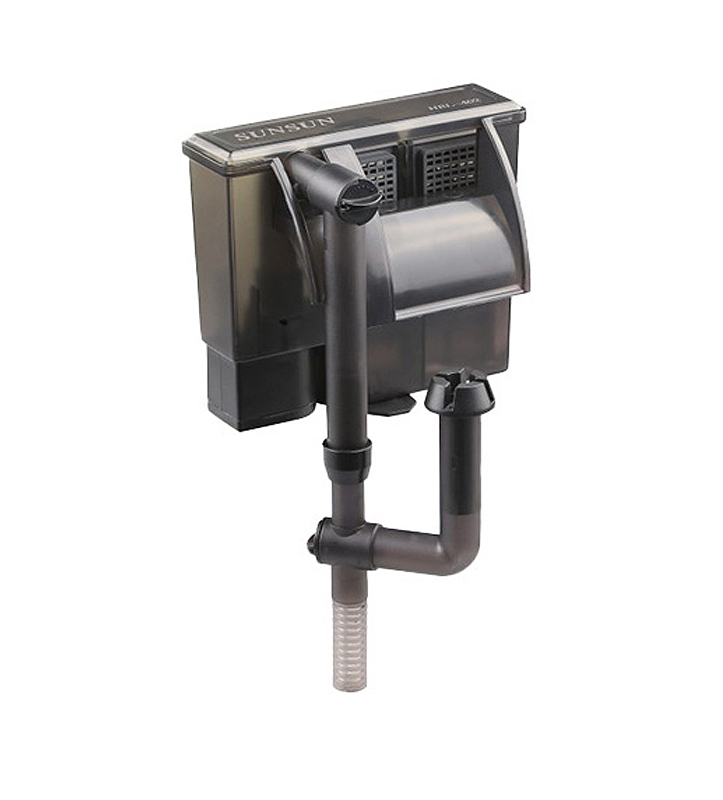 HBL Series Hang-On Filter for Aquarium FiltrationHang-on aquarium filter series with multiple model options, intended for filtration setups where biological media capacity and water turnover are considered.View Product →
Oxygen and water movement
Nitrification is oxygen-hungry, and warm water holds less of it, so aeration is not a luxury. An air pump driving a sponge filter or airstone keeps the biofilm supplied and adds a second, independent biofilter that keeps working while the main filter is switched off for maintenance.
 ACO Series Electromagnetic Air Pump for Aquarium AerationElectromagnetic air pump series with multiple models, relevant when planning aeration for aquarium filtration and biofilm support.View Product →
Bacterial starters and water conditioners
A live nitrifying bacteria product can shorten the first stage by one to two weeks, but only when it has been stored correctly and is dosed while ammonia is present as food. Pair it with a conditioner that neutralises chlorine and chloramine, because both will kill the culture you have just paid for. If you are assembling the whole setup at once, the wider range of aquarium filters, air pumps and water treatments is a sensible starting point.
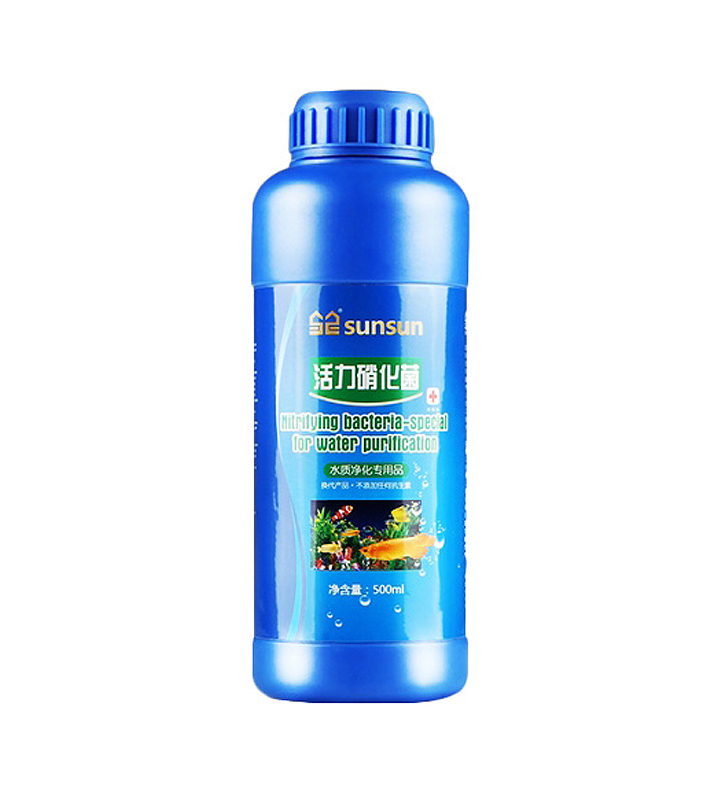 Nitrifying Bacteria Water Purification Treatment for AquariumsAquarium nitrifying bacteria treatment in 500ml and 1000ml bottles, useful when establishing or restoring biofiltration after ammonia or nitrite concerns.View Product →
Warning Signs and the Mistakes That Restart the Cycle
A mature tank can crash within a day, and the earliest reliable signal is a test result that read zero yesterday. Ammonia or nitrite reappearing after months of stability, fish hanging at the surface, or a sudden white bacterial bloom all point to biofilm that has lost oxygen, food or water quality.
- Adding a full load of fish at once. A colony can only process what it has been fed, so stock in stages two weeks apart.
- Rinsing media under the tap. Chlorine and chloramine kill the colony in minutes; rinse in water taken from the tank instead.
- Replacing cartridges monthly. That throws the biofilter away. Reuse media until it physically falls apart.
- Overfeeding. Every gram of uneaten food becomes ammonia within days.
- Skipping dechlorinator. Chloramine is the worse offender, because it leaves residual ammonia after it breaks down.
- Treating the main tank with antibiotics or copper. Both knock back nitrifying bacteria along with the problem you were targeting.
FAQ: Aquarium Nitrogen Cycle Questions
Can a tank cycle in 24 hours?
Not from scratch. A bottled culture plus filter media squeezed from a mature tank can seed a new filter within a day, but the colony still needs time to attach and multiply. You can shorten the first stage, not skip the cycle, so test before you trust it.
Does the nitrogen cycle ever finish?
No. It reaches a steady state rather than an ending. The bacteria consume ammonia every day, and the size of the colony rises and falls with how much you feed and how many fish you keep.
Do water changes wash out the beneficial bacteria?
Almost none of them. The bacteria live in biofilm on surfaces, so a 25 percent water change removes water, nitrate and a few free-floating cells, not the colony inside your filter.
Which test kit is worth buying?
Liquid reagent kits beat dip strips on accuracy, and you need ammonia, nitrite, nitrate, pH and KH to read the cycle properly. Check the ammonia label as well: Nessler-based tests can read falsely high in water treated with some conditioners, so a salicylate kit is the safer choice.
Cycling rewards patience more than equipment. Feed the bacteria before you feed the fish, hold ammonia between 2 and 4 ppm while the colony builds, change water only when a reading tells you to, and wait for the dose test rather than the calendar. A tank reading ammonia 0, nitrite 0 and a modest nitrate level is ready; everything after that is routine maintenance.

 No. 61-79, Baima Street, Maao Town, Dinghai District, Zhoushan City, Zhejiang Province, China.
 0086 580 8082088 / 8081168
 0086 580 8080978
 songhua@sunsun-china.com