

 English
 русский
 España
 Portugal
 عربي
Aquarium water quality is not a feeling about how clean the tank looks. It is a short list of measurable values: ammonia, nitrite, nitrate, pH, carbonate hardness, temperature and dissolved oxygen. The short answer is this — test ammonia, nitrite and nitrate every week, hold pH steady instead of chasing a perfect number, change 15 to 25 percent of the water weekly, and keep the surface moving so oxygen stays high.
Clear water proves none of that. A tank can look crystal clear at 4 ppm ammonia and kill every fish in it overnight, because the compounds that harm fish are dissolved and invisible. That is why experienced keepers trust a test tube, not their eyes.
The rest of this article explains what each number means, how the nitrogen cycle holds the whole system together, where filtration and oxygen fit in, and what a realistic maintenance routine looks like for tanks from a 20-liter desktop model up to a large display aquarium.
Content
The Numbers That Define Aquarium Water Quality
Four parameters decide the majority of aquarium outcomes: ammonia, nitrite, nitrate and pH. Temperature, hardness and oxygen sit just behind them, and they interact — a warm tank consumes oxygen faster, and soft water loses pH stability more easily.
| Parameter | Target | What it indicates | First sign of trouble |
|---|---|---|---|
| Ammonia | 0 ppm at all times | Fish waste and uneaten food before bacteria convert it | Gasping at the surface, clamped fins |
| Nitrite | 0 ppm at all times | Mid-stage of the nitrogen cycle; blocks oxygen transport in blood | Listless fish, rapid gill movement |
| Nitrate | 5 to 20 ppm | End product of the cycle, removed by water changes and plants | Algae blooms, slow growth above 40 ppm |
| pH | 6.5 to 7.5 for most community fish | Acidity or alkalinity; sudden movement matters more than the value | A visible drop after a large water change |
| Carbonate hardness | 4 to 8 dKH | Buffering capacity that keeps pH from crashing | pH sliding below 6.0 between water changes |
| Dissolved oxygen | 6 mg/L or higher | Gas exchange driven by surface movement and plants | Fish hanging near the surface in the early morning |
| Temperature | Species-specific, within roughly 1 °C per day | Metabolic rate, oxygen demand and disease resistance | White spot outbreaks after a cold night |
Why Stability Beats the Perfect Number
A tank sitting at pH 7.4 all month is safer than one swinging between 6.6 and 7.8, even though the second tank spends time closer to an "ideal" value. Fish and nitrifying bacteria both adapt to a steady environment; they do not adapt well to repeated swings. This is also why liquid test kits are worth the extra cost over strips: a liquid kit reading ammonia to 0.25 ppm resolution will show a problem building, while a strip often reads zero until the spike is already severe.
The Nitrogen Cycle Is the Whole Story
Almost every water quality failure in a running tank traces back to one interrupted process: the nitrogen cycle. Ammonia from fish waste, uneaten food and decaying plant matter is converted by nitrifying bacteria into nitrite, and nitrite is converted into nitrate, which you remove with water changes or consume with plants. Break any link in that chain and the compounds upstream of it accumulate.
The practical consequences are simple. A new tank needs roughly four to six weeks to grow enough bacteria to process a full fish load, and adding fish faster than the colony grows produces the classic new-tank ammonia spike. In an established tank, the bacteria live mainly in the filter media and substrate, so rinsing all media under chlorinated tap water or replacing it in one go can reset the cycle overnight. When a cycle stalls — after medication, a deep clean or a long power outage — a bacterial starter shortens the recovery window considerably.
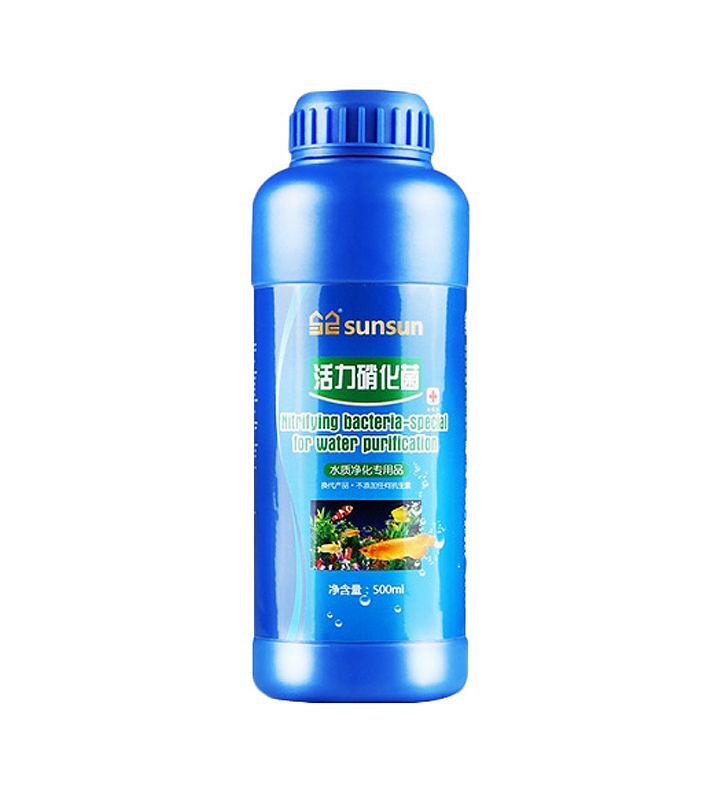 Custom Nitrifying Bacteria for Aquarium Water PurificationSupplied in 500 ml and 1000 ml bottles, this customizable nitrifying bacteria product targets aquarium water purification and bacterial cycle support.View Product →
Oxygen and Surface Movement: Why Still Water Fails
The fastest way to lose water quality is to stop the water surface from moving. Gas exchange happens at the surface, so a tank with a still surface accumulates carbon dioxide, loses oxygen, and drifts toward lower pH — and the problem gets worse at night, when plants stop producing oxygen and start consuming it.
Aeration is not only about oxygen. Rising bubbles drive circulation that carries oxygenated water into the filter media, where the nitrifying bacteria need it, and pushes debris toward the intake. Warm water holds less oxygen than cool water, which is why a heavily stocked tank at 28 °C can struggle even when everything else looks fine. Running an air pump continuously is standard practice; a properly sized electromagnetic air pump is designed for exactly that kind of 24/7 duty, with the output adjusted through the valve rather than by switching the unit on and off.
 ACO Series Electromagnetic Air Pump for Aquarium AerationMultiple ACO models run on 220V/50Hz with outputs from 20 to 450 L/min, suited to continuous aquarium aeration and water circulation.View Product →
Filtration: What Each Type Actually Removes
No single filter removes everything. A reliable setup stacks mechanical, biological and chemical stages in sequence, and each stage has a different maintenance rhythm.
- Hang-on back filters: easy media access, good mechanical capture, workable on tanks up to roughly 100 liters.
- Internal multi-function submersible pumps: combine circulation and filtration in one unit, useful where there is no space behind the tank, but they take up volume inside the aquarium.
- Outside pressure filters: the largest biological media volume per unit of flow, best for heavily stocked or large tanks, and quiet because the pump sits outside the water.
- Sponge filters driven by an air pump: gentle flow, excellent for fry and shrimp, and almost impossible to clog catastrophically.
- UV filtration pumps: do not remove waste; they reduce free-floating algae and pathogens, which helps clarity but not ammonia.
Matching Filter Flow to Tank Volume
Aim for four to six tank turnovers per hour on a community aquarium and eight to ten on large cichlids or koi. Treat published flow figures as a ceiling, not a promise: ratings are measured at zero head height, without media, and a real installation with a 60 cm lift, elbows and loaded media typically delivers 30 to 40 percent less. For large systems, a pressure filter with a generous media chamber gives more margin than a high-flow pump pushing through a thin cartridge.
 HW Series External Aquarium Filter with UV SterilizationMultiple HW models offer external filtration for fresh and marine aquariums, with 1000-2000 L/h output and 9W UV sterilization on B versions.View Product →
For a deeper look at holding parameters steady in bigger aquariums, this guide on keeping water quality stable in large fish tanks covers load calculations and turnover in more detail.
A Weekly Routine That Holds Water Quality Steady
Consistency beats intensity. A short routine performed every week costs less time than a rescue operation, and it catches drift before fish show symptoms.
- Test ammonia and nitrite first. Both should read 0 ppm. Anything above 0.25 ppm means an immediate 30 to 50 percent water change and a pause on feeding.
- Test nitrate and keep it between 5 and 20 ppm. Above 40 ppm, increase the water change volume rather than the frequency.
- Check pH and KH together. If pH moves by more than 0.4 in a week, raise KH with a buffer instead of adjusting pH directly.
- Change 15 to 25 percent of the water weekly; go to 30 to 50 percent for heavily stocked tanks. Match the new water temperature within 1 °C and dechlorinate before it enters the tank.
- Rinse mechanical media in a bucket of old tank water. Never rinse biological media under the tap, and replace only one third of it at a time.
- Verify surface agitation and air output. If bubbles have slowed noticeably, clean the air stone and check the tubing for salt creep or kinks.
- Record the readings. A written log makes a slow nitrate climb or a gradual pH slide obvious weeks before it becomes a crisis.
Mistakes That Quietly Ruin Water Quality
Most water quality problems are self-inflicted, and they usually come from good intentions applied too aggressively.
- Replacing all filter media at once, which removes the bacterial colony along with the dirt.
- Rinsing media under tap water, where chlorine and chloramine kill nitrifying bacteria on contact.
- Overfeeding. Uneaten food decays into ammonia, and most tanks need less food than owners expect.
- Filling up with untreated tap water, then wondering why the cycle stalls after every water change.
- Skipping water changes because nitrate "looks acceptable" without testing it.
- Adding a group of fish at once, which multiplies the bioload faster than bacteria can respond.
- Ignoring KH in soft-water regions until pH crashes.
- Switching off aeration at night, when oxygen demand is highest.
Frequently Asked Questions
How often should I test aquarium water?
Weekly for ammonia, nitrite and nitrate in any established tank, and every two to three days during the first six weeks of a new setup or after adding fish. pH and KH need checking weekly as well, ideally at the same time of day so the readings are comparable.
Does clear water mean good water quality?
No. Ammonia and nitrite are colorless and dissolve completely, so a tank can be perfectly transparent and still toxic. Clarity tells you about suspended particles and algae, not about dissolved compounds.
Can I use tap water for water changes?
Yes, provided you treat it with a dechlorinator first. Chlorine and chloramine damage gills and wipe out filter bacteria. If your tap water is very hard or high in nitrate, mixing it with reverse-osmosis water gives more control over hardness and nitrate levels.
Do I need an air pump if I already run a filter?
Not always, but it is cheap insurance. A canister filter returning water above the surface can provide enough gas exchange on its own, while a heavily stocked or warm tank benefits from the extra movement and from the oxygen supply that keeps filter bacteria working efficiently. Water conditioners and bacteria cultures used alongside a solid routine are the other half of the equation, and a range of aquarium water care accessories covers both.
How long does a new tank take to become safe?
Four to six weeks at typical tropical temperatures, sometimes longer in cool water. The tank is ready when ammonia and nitrite both read zero within 24 hours of a small ammonia dose, and nitrate is rising. Adding fish slowly after that point protects the colony you just spent a month growing.
Good aquarium water quality is a maintenance habit, not a product you add once. Test ammonia, nitrite, nitrate and pH on a fixed schedule, keep the surface moving, size your filtration against the real bioload rather than the label on the box, and change water in modest, regular amounts. Do those four things and the invisible chemistry inside the tank stays boring — which is exactly what healthy fish need.

 No. 61-79, Baima Street, Maao Town, Dinghai District, Zhoushan City, Zhejiang Province, China.
 0086 580 8082088 / 8081168
 0086 580 8080978
 songhua@sunsun-china.com