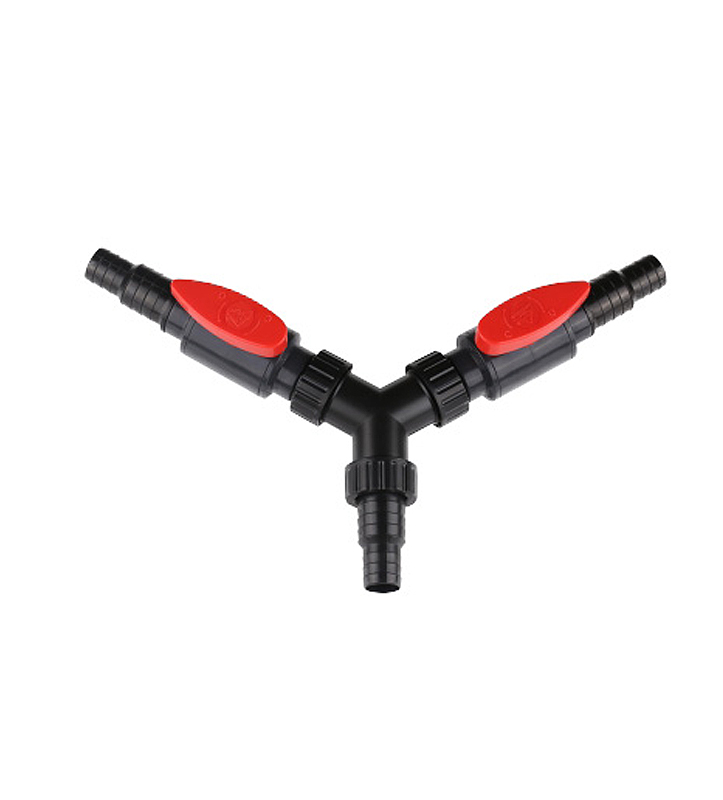
The CST series is a compact aquarium connection solution designed to help aquarium keepers, retailers, installers, and equipment manufacturers manage different outlet and hose sizes with greater convenience. Available in four configurations—CST-01, CST-02, CST-01F, and CST-02F—the series addresses common connection requirements involving aquarium filtration systems, water pumps, return lines, and related aquatic equipment.
Although a connector may appear to be a small component, it has a direct effect on the usability and reliability of an aquarium system. A connection that is difficult to match, incorrectly sized, or poorly selected can complicate installation and maintenance. By offering multiple connection options within one product family, the CST series provides a more organized approach to aquarium plumbing. Its stated outlet-size range covers several common dimensions, including approximately 20 mm, 25 mm, 32 mm, and 38 mm applications.
The purpose of the CST range is not to replace every type of aquarium fitting or create an unnecessarily complicated plumbing system. Instead, it provides a focused selection of connection components for users who need to connect equipment with different outlet requirements. The four-model structure makes it easier to identify a suitable product according to the required diameter and product configuration.
For aquarium retailers and professional installers, this model structure can simplify product selection and inventory management. For hobbyists, it can reduce uncertainty when preparing a filtration system or replacing a worn connection component. For equipment producers, the series represents an example of how a specialized accessory can support the broader performance and usability of aquarium equipment.
CST
Content
The CST product family consists of four listed models. CST-01 is identified for outlet sizes of ¾ to 1 inch, corresponding approximately to 20 to 25 mm. CST-02 is identified for 1 to 1¼ to 1½ inch outlet sizes, corresponding approximately to 25, 32, and 38 mm. CST-01F covers the ¾ to 1 inch range, while CST-02F covers the 1 to 1½ inch range and the corresponding 25, 32, and 38 mm dimensions.
| Model | Stated Outlet Size | Approximate Metric Range | Typical Selection Consideration |
|---|---|---|---|
| CST-01 | ¾ to 1 inch | 20 to 25 mm | Suitable for smaller connection requirements within the listed range |
| CST-02 | 1 to 1¼ to 1½ inch | 25 to 32 to 38 mm | Suitable for larger connection requirements within the listed range |
| CST-01F | ¾ to 1 inch | 20 to 25 mm | Alternative configuration for the smaller size group |
| CST-02F | 1 to 1¼ to 1½ inch | 25 to 32 to 38 mm | Alternative configuration for the larger size group |
The model names create a straightforward division between smaller and larger connection ranges. The 01 and 01F models are associated with the smaller size group, while the 02 and 02F models serve the larger size group. This classification is useful because aquarium plumbing often combines equipment from different product categories. A pump may have one outlet dimension, a filter another, and a hose or pipe a third. Selecting a connector based on a clearly defined size family can make the installation process more systematic.
The available product information distinguishes the models by their listed outlet sizes and configuration codes. Users should always confirm the exact fitting structure, connection direction, hose compatibility, and installation instructions before purchase or installation. Nominal inch and metric dimensions should not be treated as interchangeable without checking the actual equipment specifications. A measurement of 25 mm, for example, may be described in product literature using a nominal inch designation, but the physical connection must still be verified.
Aquarium systems depend on the controlled movement of water. Filtration, circulation, drainage, water changes, cooling, and certain aquatic cultivation applications all require water to travel through hoses, pipes, pumps, or equipment outlets. The connection point between these components is therefore an important part of the complete system.
A connection component must support practical installation while helping the user maintain a stable water route. It should be selected according to the relevant dimensions and used in a way that is appropriate for the operating conditions of the aquarium. The connection should also be easy to inspect during routine maintenance, since aquarium systems are commonly opened for cleaning, filter-media replacement, pump servicing, or water-quality management.
The CST series is valuable because it concentrates on this interface between equipment and tubing. Instead of requiring users to improvise with mismatched parts, the range provides designated models for specific outlet-size groups. This can help reduce installation guesswork and encourage a more deliberate approach to aquarium system planning.
In a small aquarium, a connection problem may cause inconvenience, leakage, or interruption of filtration. In a large aquarium or commercial aquatic installation, the consequences of unsuitable components can be more significant because the system may contain greater water volume and more equipment. Correct component selection is therefore important at every scale, even though the actual connector may be physically small.
One of the clearest advantages of the CST series is its coverage of multiple common outlet dimensions. The smaller models address the ¾ to 1 inch group, while the larger models address the 1 to 1½ inch group. In metric terms, the stated ranges extend from approximately 20 mm to 38 mm across the complete series.
This coverage gives the product family practical flexibility. A retailer does not need to offer only one universal connector and hope that it will suit every application. Instead, the retailer can organize the CST products by model and size range. A technician can also determine the correct product category before beginning installation, provided that the equipment measurements and instructions have been checked.
Compared with a narrowly specified connector that supports only one dimension, the CST series offers a broader selection within a controlled family. Compared with an improvised combination of unrelated fittings, the series can provide a more consistent purchasing and installation experience. This does not mean that every CST model fits every aquarium system. Its advantage is that the range gives users several defined options rather than a single limited choice.
The overlap at the 1 inch or approximately 25 mm point is also useful when comparing equipment specifications. Some aquarium products use nominal inch measurements, while others use metric terminology. The CST series recognizes both forms in its product information, helping users relate the model to the terminology used by their equipment suppliers.
Nevertheless, size matching must remain the first consideration. Users should measure the relevant outlet or hose, review the equipment documentation, and confirm whether the stated dimension refers to an internal diameter, external diameter, or nominal connection size. Correct selection is essential for achieving a suitable connection.
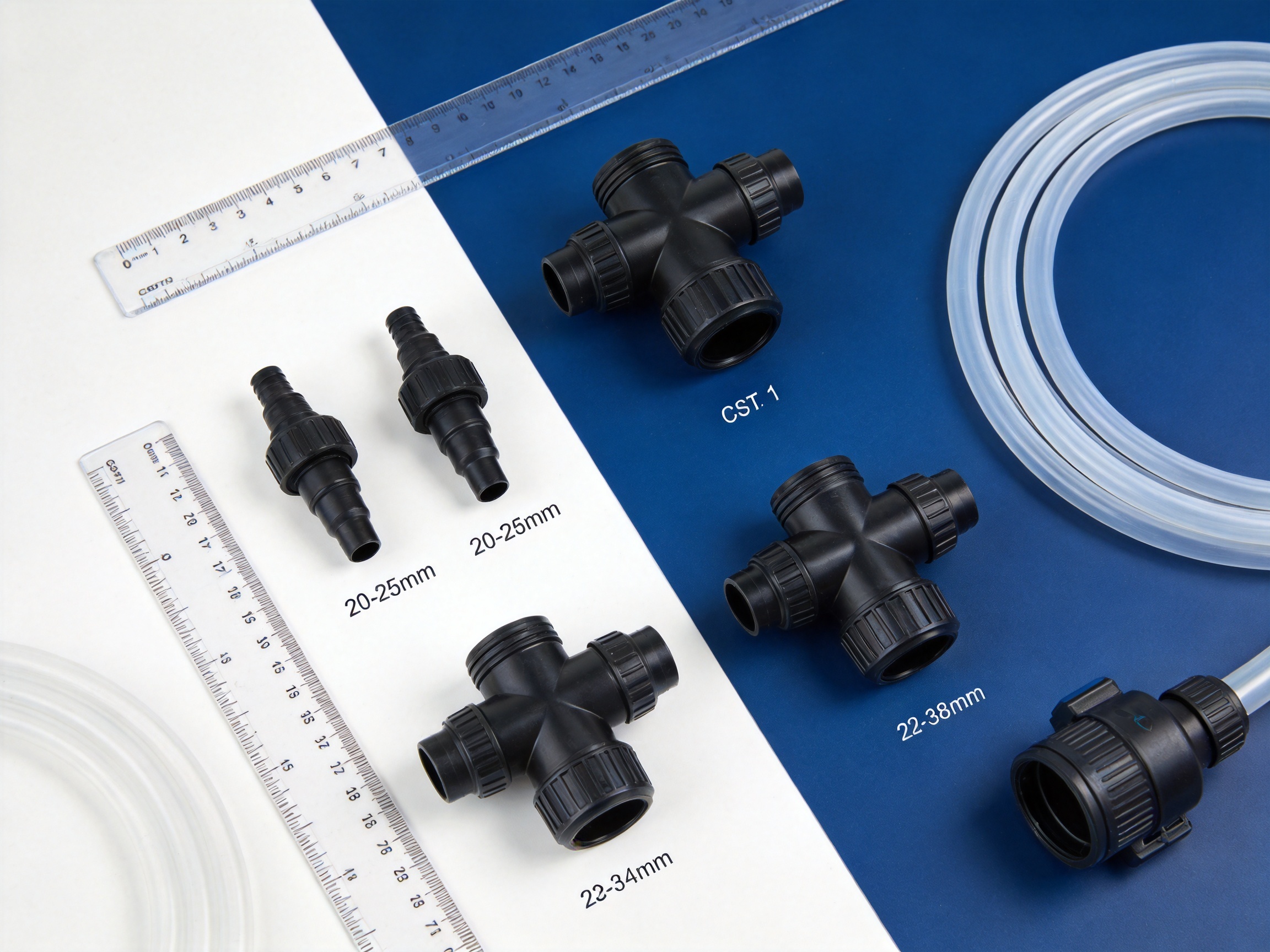
CST-01 is listed for outlet sizes from ¾ to 1 inch, with an approximate metric range of 20 to 25 mm. It is the basic smaller-size option in the product family. This model may be considered when the aquarium equipment, hose, or outlet falls within the smaller stated range.
The main benefit of CST-01 is selection clarity. When a user identifies a connection requirement within the 20 to 25 mm group, the model name provides an immediate starting point. Retailers can present it as part of the smaller-size category, and installers can compare it against the equipment specification before ordering.
CST-02 is listed for 1, 1¼, and 1½ inch outlet sizes, corresponding approximately to 25, 32, and 38 mm. It is the larger-size counterpart to CST-01. The model is intended for connection requirements that fall within the larger stated size group.
The principal advantage of CST-02 is its relevance to larger aquarium plumbing applications. Larger tanks, higher-capacity filtration systems, and more substantial water pumps may use larger outlets than those found on compact aquarium equipment. A dedicated larger-size model helps users avoid attempting to adapt a large outlet using components designed for smaller systems.
CST-01F is listed for the same smaller outlet-size range as CST-01: ¾ to 1 inch, or approximately 20 to 25 mm. The “F” configuration should be selected according to the actual equipment arrangement and the installation requirements. Since the available information identifies the size range but does not provide a complete technical drawing, users should consult the applicable product documentation before determining whether the standard or F configuration is appropriate.
Offering two configurations in the same size group can be beneficial when different equipment layouts require different connection approaches. It allows the product family to serve more than one installation situation without forcing users to select a larger or smaller model simply because only one configuration is available.
CST-02F is the larger-size F configuration. It is listed for 1 to 1½ inch outlets, with approximate metric dimensions of 25, 32, and 38 mm. This model should be considered when the larger connection range is required and the F configuration matches the installation arrangement.
As with CST-01F, the exact choice should be based on the equipment interface, not only on the general size range. The user should confirm the intended connection direction, the applicable hose or pipe, and any installation requirements supplied with the product.
Aquarium hobbyists often purchase equipment from several sources. A tank may be paired with a filter from one manufacturer, a pump from another, and tubing selected from a local aquarium supplier. Although this creates flexibility, it can also create connection challenges. Different products may use different terminology or nominal sizes.
The CST series can help hobbyists approach these challenges with a defined product family. The first step is to identify the outlet size required by the aquarium equipment. The second step is to compare that measurement with the CST-01, CST-02, CST-01F, and CST-02F ranges. The third step is to verify that the chosen configuration is appropriate for the physical installation.
This approach is more reliable than selecting a connector by appearance alone. A component may look similar to an existing fitting but still have a different internal or external diameter. Clear model classifications help direct attention toward measurement and compatibility.
The compact nature of a connector also makes storage convenient. Aquarium owners who maintain multiple tanks or keep spare maintenance parts can organize smaller and larger CST models separately. Keeping an appropriate replacement available may shorten maintenance downtime when an existing fitting needs to be changed.
The product family may also be useful when upgrading an aquarium. A hobbyist who replaces a pump or filter may not need to redesign every hose route. If the new equipment falls within one of the supported connection ranges, an appropriate CST model may help integrate the new component into the existing arrangement. Compatibility must still be confirmed, but the availability of multiple sizes increases the likelihood of finding a practical match.
Retailers benefit from products that are easy to explain and organize. The CST series has four identifiable models with a clear division between smaller and larger size ranges. This structure can make stock management more manageable than a collection of unrelated connectors with inconsistent naming.
A retailer can present the range using a simple decision path: select the smaller or larger size group, then determine whether the standard or F configuration is required. This method supports clearer communication with customers. It also helps reduce the possibility of supplying a connector that is obviously outside the required size range.
For installers, model consistency can be valuable across repeated projects. Aquarium shops, maintenance teams, and aquatic equipment service providers often perform similar tasks on multiple systems. A recognizable product family can simplify training, purchasing, and replacement planning. Installers can record the model used on a particular system and refer to that information during future maintenance.
The CST range may also assist with project preparation. Before visiting a customer site, an installer can ask for the existing outlet size and determine whether the smaller or larger product group is likely to be relevant. The required components can then be prepared in advance, reducing unnecessary delays.
In professional settings, component organization is part of operational efficiency. A connector that is easy to identify and categorize can contribute to faster service, although overall performance will still depend on correct installation, suitable tubing, equipment condition, and operating conditions.
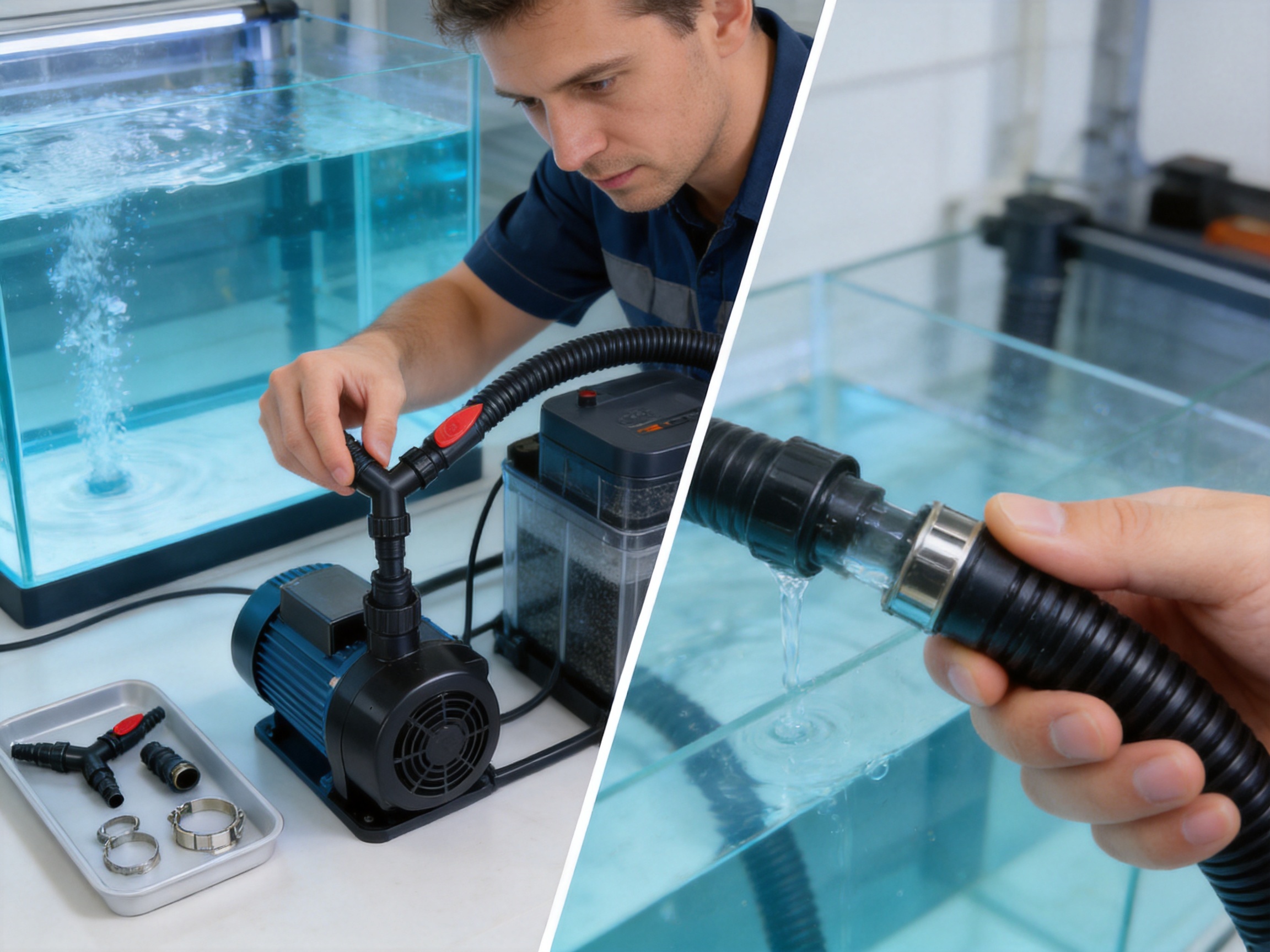
The advantages of the CST series become clearer when it is compared with common alternative approaches. One alternative is to use a single connector size for every application. This approach is simple in theory but limited in practice. Aquarium systems vary considerably, and a single size cannot properly address the full range of 20 to 38 mm requirements identified for the CST family.
A second alternative is to combine several unrelated adapters. This may provide a temporary solution, but every additional joint creates another point that must be assembled, inspected, and maintained. A chain of mismatched adapters can also make the system more difficult to understand. By offering a family of designated models, the CST range supports a more controlled selection process.
A third alternative is to select a fitting based on nominal labeling without checking the physical dimensions. This can lead to incorrect purchases when inch and metric descriptions are interpreted differently. The CST product information lists both inch and approximate metric references, giving users more than one way to compare the product with their equipment documentation.
A fourth alternative is to use an improvised connection that was not designed for aquarium equipment. Such a solution may not provide the expected fit or long-term convenience. Aquarium environments involve water exposure, regular cleaning, and repeated equipment handling. A purpose-oriented aquarium connector is preferable to an improvised component when a suitable product is available.
The CST series should not be described as universally superior in every application. Specialized systems may require specialized fittings, valves, threaded adapters, or manufacturer-specific components. Its competitive strength lies in offering a practical, clearly divided range for the stated outlet sizes and in supporting a more organized approach to aquarium connections.
The product is supplied by Sensen Group Co., Ltd., an established manufacturer whose corporate history dates to November 1985. According to the provided company information, the group has developed through more than three decades of continuous effort and now operates across aquarium pets, aquaculture machinery, industrial equipment, and related fields.
This broad industry background is relevant to a connector series because aquarium accessories are part of a larger equipment ecosystem. A company involved in pumps, filtration-related products, aquaculture machinery, and other aquatic applications can develop a wider understanding of water movement, equipment integration, and user requirements. The CST series benefits from being positioned within this broader product environment rather than being treated as an isolated accessory.
The company states that it has established several functional departments at its headquarters, including a research institute, a business school, a quality control department, personnel and administrative information functions, and financial operations. The presence of a dedicated research and quality-control structure indicates an organizational approach in which product development and inspection are treated as formal responsibilities.
For a product such as CST, manufacturing strength is not only about producing a large quantity of components. It also involves maintaining consistent model identification, size classification, production coordination, and quality expectations across the product range. A defined quality-control function can support these goals by helping the manufacturer manage standards and inspection procedures.
The company also reports a network of wholly owned subsidiary corporations and an import and export company, together with interests in several trading companies. This organizational scale can support production, distribution, and market access. For international customers, a developed export structure may be especially valuable because product availability and communication are important parts of the purchasing experience.
It is important to distinguish between documented corporate capabilities and assumptions about a particular product. The available material does not specify the CST material grade, pressure rating, automated molding system, dimensional tolerance, or laboratory test results. Those details should be obtained from the relevant technical documentation. However, the company’s stated research, quality-control, manufacturing, and distribution organization provides a credible foundation for producing and supplying a standardized aquarium accessory.
Innovation in aquarium equipment does not always require a highly complex electronic system. It can also involve making a basic component easier to select, integrate, maintain, and distribute. A connection product that addresses several common dimensions and provides multiple configurations can represent practical innovation through product-system thinking.
The CST family demonstrates this approach by grouping four models around two major size ranges. The design of the product line considers the fact that aquarium systems are rarely identical. Some use smaller outlets, some use larger outlets, and some require different connection configurations within the same general diameter range.
The company describes its development direction as involving industrial technicalization, marketing globalization, and brand internationalization. In the context of CST, industrial technicalization can be understood as the effort to support aquarium applications with organized equipment and accessories. Marketing globalization is relevant because inch and metric size references are both useful in international markets. Brand internationalization reflects the goal of serving customers beyond a single domestic market.
A product family that communicates dimensions in both measurement systems can be easier to introduce across different regions. It can also help distributors compare local requirements with the manufacturer’s specifications. Clear product information does not eliminate the need for technical verification, but it improves the starting point for selection.
Before installing a CST component, users should identify the equipment outlet, hose, or pipe that will be connected. The measurement should be taken carefully and compared with the model information. If the existing connection is difficult to measure, the equipment manual or original specification should be consulted.
The user should then determine whether the required size belongs to the smaller group or the larger group. CST-01 and CST-01F are associated with ¾ to 1 inch, approximately 20 to 25 mm. CST-02 and CST-02F are associated with 1 to 1½ inch, approximately 25 to 38 mm.
After the size group has been identified, the configuration should be selected. The provided information differentiates the standard and F model codes, but it does not describe every physical feature of those configurations. Therefore, users should check the product drawing, packaging, or supplier instructions to determine which configuration matches the intended connection.
All connected equipment should be switched off before installation. Water should be drained or controlled as necessary, and the working area should be kept stable and accessible. Hoses should not be sharply bent or placed under unnecessary tension. If a hose is forced into an unsuitable position, the strain may affect the connection even when the nominal dimensions are correct.
Once installed, the connection should be checked before the aquarium system is returned to normal operation. A gradual test is preferable to immediately running the system unattended. The user should observe the connection for signs of leakage, movement, or unusual stress. If a problem appears, the equipment should be switched off and the connection reviewed.
These installation principles apply to aquarium connectors generally. The specific instructions supplied with the CST product and the connected equipment should take priority over general guidance.
Aquarium maintenance often requires repeated removal and reconnection of hoses and equipment. Filters need cleaning, pumps may require inspection, and tubing can accumulate deposits over time. A connection component should therefore be treated as part of a serviceable system rather than as a permanent installation that is never examined.
Users should inspect the connection during routine maintenance. Look for visible damage, deformation, unusual looseness, deposits, or signs that the hose is no longer held in the intended position. Cleaning should be carried out using methods suitable for aquarium equipment. Strong chemicals should not be introduced into the aquarium system unless their use is specifically approved for that purpose and the system is properly rinsed afterward.
When reconnecting the system, users should avoid forcing components together. If a connection does not fit as expected, the size and configuration should be checked again. Forcing an incorrectly matched component can damage the fitting, the hose, or the equipment outlet.
Replacement planning is particularly important for commercial aquariums, public displays, aquatic retailers, and aquaculture-related facilities. Maintaining a record of the model used on each system can simplify future service. Because the CST range is divided into recognizable model codes, it can support more orderly maintenance documentation.
Although the component is designed for aquarium-related use, its service life will depend on installation quality, water conditions, handling frequency, equipment vibration, and other operating factors. No connector should be considered maintenance-free merely because it is small or mechanically simple.

The CST series is primarily relevant to aquarium systems. It may be considered for connections involving filtration equipment, water pumps, circulation arrangements, and other equipment that uses compatible outlet dimensions. The product may also be relevant to aquatic cultivation machinery and related water-handling installations, provided that the size, configuration, and operating conditions are suitable.
In home aquariums, the series can support equipment replacement and system modification. In aquarium stores, it can help connect display tanks and maintenance equipment. In larger aquatic facilities, it may be included in a broader inventory of fittings and replacement parts. The exact application depends on the technical requirements of the system.
The product should not automatically be used for every industrial fluid-handling situation. Aquarium connectors are selected for their intended application, and industrial systems may require different materials, certifications, temperature limits, pressure specifications, or chemical-resistance properties. Customers should request complete technical information before extending use beyond the stated application.
The company behind the CST series states that it operates in aquarium pets, aquaculture machinery, industrial equipment, and related industries. This range of activity can strengthen product development because different equipment categories often share practical challenges involving water movement, component integration, durability, and distribution.
The company also reports a large domestic sales network and the development of retail and service initiatives. A broad network can provide feedback from retailers, installers, and end users. Such feedback is useful for identifying recurring compatibility problems and improving product families over time.
In addition, the company describes a structure that includes research, quality control, education, administration, finance, subsidiaries, and trading operations. A full organizational structure can support continuity from product planning through manufacturing and sales. For international buyers, this may offer advantages in communication, sourcing, and product availability.
The company’s stated philosophy emphasizes professional capability, product quality, innovation, sincerity, and customer relationships. These principles are particularly relevant to aquarium accessories because customers often judge a product not only by its purchase price but also by the convenience of obtaining the correct replacement, understanding the model, and receiving appropriate support.
The combination of manufacturing scale and product specialization is one of the CST series’ important competitive advantages. A small fitting can be produced by many suppliers, but a manufacturer with experience across pumps, aquarium equipment, aquaculture machinery, and international distribution may be better positioned to understand how the fitting functions as part of a complete water system.
Before purchasing a CST product, the buyer should identify the exact equipment that will be connected. The outlet size should be confirmed using the manufacturer’s documentation or a careful physical measurement. The buyer should determine whether the requirement is within the approximately 20 to 25 mm range or the approximately 25 to 38 mm range.
The buyer should also verify whether the standard or F configuration is needed. Product photographs can assist with recognition, but a technical drawing or supplier confirmation should be used when the physical configuration is critical.
The intended hose or pipe should be checked for compatibility. A nominal size alone may not provide enough information if the hose wall thickness, internal diameter, or connection method differs. The buyer should also consider whether clamps, seals, or additional accessories are required for the installation.
Operating conditions should be reviewed. If the connection will be exposed to unusual temperature, pressure, chemicals, outdoor conditions, or continuous commercial operation, the supplier should be asked for relevant specifications. The information provided for the CST range identifies outlet-size compatibility but does not state all operating limits.
Finally, customers should purchase through a reliable supplier who can provide the correct model, current documentation, and after-sales assistance. Correct sourcing is especially important when several models have similar names or overlapping nominal dimensions.
The CST series is an aquarium connection product family intended to help connect equipment or tubing with compatible outlet sizes. It is associated with aquarium filters, pumps, circulation systems, and related aquatic equipment.
Four models are listed: CST-01, CST-02, CST-01F, and CST-02F.
CST-01 and CST-01F are listed for ¾ to 1 inch outlets, corresponding approximately to 20 to 25 mm.
CST-02 and CST-02F are listed for 1 to 1½ inch outlets, corresponding approximately to 25, 32, and 38 mm.
No. The available information gives them the same general outlet-size range but identifies them as different configurations. The installation arrangement and technical documentation should be checked before choosing between them.
No. They share the larger size range in the product information, but the different model codes indicate different configurations. Buyers should confirm the physical connection requirements with the supplier.
Not necessarily. The product information provides approximate metric references alongside nominal inch sizes. Users should confirm the actual physical dimensions and the meaning of the measurement in the equipment documentation.
No product can be assumed to suit every aquarium. The correct model depends on the outlet size, hose or pipe dimensions, connection configuration, and operating conditions. Compatibility should be confirmed before installation.
The company operates in industrial equipment and aquaculture machinery, but the available CST information is focused on aquarium-related connection sizes. Industrial users should obtain complete specifications and confirm material, pressure, temperature, and chemical requirements before use.
Its main advantage is the organized coverage of several common aquarium outlet sizes through four identifiable models. This gives users more choice than a single-size product while avoiding the confusion of selecting from unrelated fittings.
A dedicated quality-control function can support consistent production, model identification, and inspection. The provided company information also describes research and manufacturing resources, which may strengthen the ability to develop and supply standardized aquarium components.
Users should check the outlet size, hose or pipe compatibility, model configuration, installation direction, and any required seals or clamps. The connected equipment should be switched off, and the completed connection should be tested for leakage before normal operation.
The connection should be inspected during routine aquarium maintenance. Users should look for damage, looseness, deformation, deposits, and signs of leakage. Components should be handled carefully and replaced if their condition no longer appears suitable.
The CST series provides a practical approach to aquarium connection requirements by combining four models with two main size groups and two configuration options. CST-01 and CST-01F serve the approximately 20 to 25 mm range, while CST-02 and CST-02F serve the approximately 25 to 38 mm range. This organization makes the product family easier to understand, stock, compare, and use in maintenance planning.
Its competitive value comes from flexibility within defined limits. Rather than offering only one connector size or encouraging users to build complicated combinations of unrelated adapters, the series presents a coordinated selection for common aquarium outlet requirements. The dual inch-and-metric references also support international product comparison, although actual dimensions must always be verified.
The manufacturer’s long operating history, research structure, quality-control department, subsidiary network, aquarium expertise, and international distribution organization provide additional strength behind the product. These capabilities can support consistent product development, production management, supply, and customer service.
For the best result, users should select the CST model according to measured dimensions and the correct physical configuration. They should also follow installation instructions, inspect the connection regularly, and request technical information when the product will be used under demanding conditions. Used in this careful and systematic way, the CST series can contribute to more organized, serviceable, and adaptable aquarium equipment installations.
Sensen Group Co., Ltd. Corporate information supplied for product and company presentation.
CST Series Product Information. Model descriptions and stated outlet-size ranges for CST-01, CST-02, CST-01F, and CST-02F.
Aquarium Equipment Selection Principles. General guidance on measuring outlets, matching hoses, and checking connection compatibility.
Aquarium System Maintenance Practices. General guidance on inspection, cleaning, replacement, and safe equipment servicing.
International Product Specification Conventions. General reference to nominal inch sizing and approximate metric conversion in equipment catalogs.



 English
 русский
 España
 Portugal
 عربي
عربي
 No. 61-79, Baima Street, Maao Town, Dinghai District, Zhoushan City, Zhejiang Province, China.
 0086 580 8082088 / 8081168
 0086 580 8080978
 songhua@sunsun-china.com