For a tank under about 60 litres, the filter that works best is a hang-on-back or internal power filter rated at four to six tank turnovers per hour, loaded with a coarse sponge, a layer of fine floss and a bag of biological media, with an outlet you can turn down. Compact canisters earn their price once you pass roughly 60 litres; air-driven sponge filters remain the safest choice for fry, shrimp and bare quarantine tanks.
That is the short answer. What follows explains why media volume and contact time matter more than the size of the filter box, which types physically fit a small rimmed tank, and where buyers most often get it wrong.
Small tanks fail faster than large ones. A 40-litre tank holds a fraction of the water in a 600-litre system, so one missed feeding, one dead snail or one over-cleaned filter moves ammonia much further in a single day. Filtration at this scale is less about raw power and more about steady, continuous biological contact.
Content
In a small tank, filtration is a biological service first and a cleaning service second.
Three jobs run at once, and each one needs a different kind of media:
The biological job keeps fish alive, and it depends on two things a spec sheet rarely states clearly: how much media surface the filter holds, and whether water passes through that media slowly enough to make contact. A 500 L/h pump pushing water through a thin cartridge does less for water quality than a 250 L/h pump moving water through a stacked sponge and a small bag of sintered media.
Practical rule: pick the filter with the most usable media volume you can fit, then adjust the flow rather than the other way around.
Four filter types realistically suit tanks between 10 and 120 litres, and each one trades space, noise or media capacity for something else.
| Filter type | Tank range | Flow guide | Cleaning interval | Main trade-off |
|---|---|---|---|---|
| Hang-on-back (HOB) | 20–80 L | 200–500 L/h, adjustable | Rinse pre-filter weekly | Needs rear clearance and a lid cutout |
| Internal power filter | 20–60 L | 150–450 L/h | Every 2 weeks | Occupies tank space and adds a little heat |
| Air-driven sponge | 10–60 L | Gentle, air-pump driven | Squeeze monthly | Weak mechanical capture, low flow |
| Compact canister | 60–120 L | 300–800 L/h | Every 3–4 weeks | Current can be too strong in short tanks |
Hang-on-back units are the default for 30–60 litre setups: media sits outside the water, servicing takes two minutes, and the chambers accept custom media bags. The cost is behind the tank, where most models need 6–8 cm of clearance.
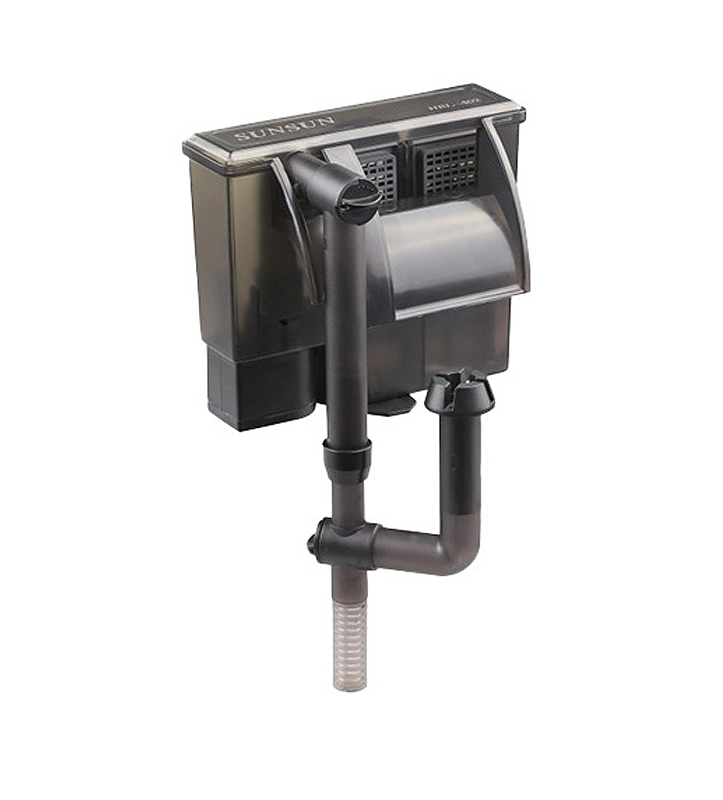 HBL Series Hang-On Aquarium FilterNine hang-on models with external media chambers and 300–800 L/h output, suited to 30–60 litre tanks where rear clearance is available.View Product →
Internal filters suit tanks with no rear access at all, but they take up swimming space and shed heat into the water — worth remembering in a 25-litre tank during a warm week.
 HJ Series Multi-Function Submersible Filtration PumpCombines aquarium filtration, water pumping and oxygen supply across models from 200 to 1200 L/h; ceramic components and included biochemical cotton.View Product →
Size the filter by turnover rather than by the tank label: aim for four to six complete passes of the tank volume per hour, then reduce flow for long-finned or shy fish.
Turnover is simply rated flow divided by tank volume. A 240 L/h filter on a 40-litre tank gives six turnovers; the same filter on a 100-litre tank gives 2.4 and is under-sized.
| Tank volume | Target turnover | Target flow | Practical note |
|---|---|---|---|
| 20 L | 4–6x per hour | 80–120 L/h | Use the lowest setting; sponge filters work well here |
| 40 L | 4–6x per hour | 160–240 L/h | The most common small-tank size; an adjustable HOB fits |
| 60 L | 5–6x per hour | 300–360 L/h | Room for two-stage media |
| 80 L | 5–6x per hour | 400–480 L/h | A compact canister becomes practical |
| 100 L | 5–6x per hour | 500–600 L/h | Borderline between small and medium systems |
Two corrections matter more than the number. Rated flow assumes clean media, so a clogged sponge can halve real output within a month. And short tanks under 40 cm front-to-back turn high flow into a washing machine: spread the outlet across the surface or aim it at the glass.
Water should meet mechanical media first, biological media second and chemical media last — in that order, every time.
Rinse biological media in water taken out during a water change, never under the tap. Replace no more than a third of the media at any one time, and keep the intake strainer clear so the flow you paid for actually arrives.
 JF Series Biochemical Filter with Adjustable Expansion PipeThree submersible biochemical filter models, each 3W and 350 L/h, with adjustable expansion pipe; measure dimensions before fitting a small tank.View Product →
Most small-tank filter returns are about fit and noise rather than filtration performance, so measure before ordering.
Tank shape drives these decisions as much as the filter does, because open-top and curved-front models restrict where a clip-on unit can sit. Browse small and desktop aquariums with the filter footprint in mind, or plan the filter around the tank you already own.
Small filters need frequent light cleaning, not occasional deep cleaning: five minutes a week beats a rebuild every two months.
The same discipline applies if you move up in size: external canister filters hold more media but punish neglect with a slow, invisible decline in flow.
These five missteps account for most disappointing results reported with small-tank filters.
Yes. Above roughly eight turnovers per hour in a tank under 40 litres, fish spend energy fighting current instead of feeding. Choose an adjustable model or add a spray bar.
Not always. A hang-on-back or internal filter already moves the surface. An air pump earns its place when you want a sponge backup or when surface film builds up under a tight lid.
Fine floss every two to four weeks; biological media almost never, only when it crumbles. Replacing bio media on a schedule throws away the bacteria the tank depends on.
For a lightly stocked tank with a betta or shrimp, yes, provided weekly water changes happen. Its mechanical capture is weak, so it suits bare-bottom or plant-heavy setups better than gravel-heavy ones.
No. It converts ammonia to nitrite and then nitrate, and nitrate still leaves through water changes and plant growth. Filtration buys time; it does not replace maintenance.
Choose a small-tank filter by media volume and adjustable flow, confirm rear clearance and lid fit before ordering, and clean it little and often. Get those three right and a 40-litre tank will hold stable water for years without a single emergency purchase.



 English
 русский
 España
 Portugal
 عربي
 No. 61-79, Baima Street, Maao Town, Dinghai District, Zhoushan City, Zhejiang Province, China.
 0086 580 8082088 / 8081168
 0086 580 8080978
 songhua@sunsun-china.com