The HBL Series Hang On Filter is designed for aquarium keepers who need dependable filtration, practical installation, and stable water circulation without sacrificing space inside the tank. As a hang-on-back filtration system, it provides a clean and convenient alternative to bulky internal filters, allowing hobbyists, retailers, and aquarium maintenance professionals to improve water quality while keeping the aquascape open, attractive, and easy to maintain.
This series covers multiple models, from compact low-power units for small aquariums to higher-output models suitable for larger home tanks and display systems. With rated power from 2W to 8W and output capacities listed from 300 L/h to 800 L/h, the HBL Series offers flexible choices for different aquarium volumes, stocking densities, and filtration requirements. Its 1.5 m cable length, multi-voltage compatibility, lightweight structure, and practical dimensions make it suitable for a wide range of markets and aquarium setups.
Content
The HBL Series Hang On Filter belongs to the category of aquarium external hanging filters. Its purpose is simple but essential: to draw water from the aquarium, pass it through filtration media, and return cleaner, better-circulated water to the tank. This continuous cycle supports a healthier aquatic environment by helping remove visible debris, improving water movement, and supporting biological filtration when appropriate filter media are used.
Unlike internal filters that occupy valuable swimming and aquascaping space, a hang-on filter is installed on the rim of the aquarium. This design keeps most of the filter body outside the tank, reducing visual clutter and making routine maintenance more convenient. For aquariums where appearance is important, such as living-room tanks, office display aquariums, retail showroom tanks, and aquascaped layouts, this is a major advantage.
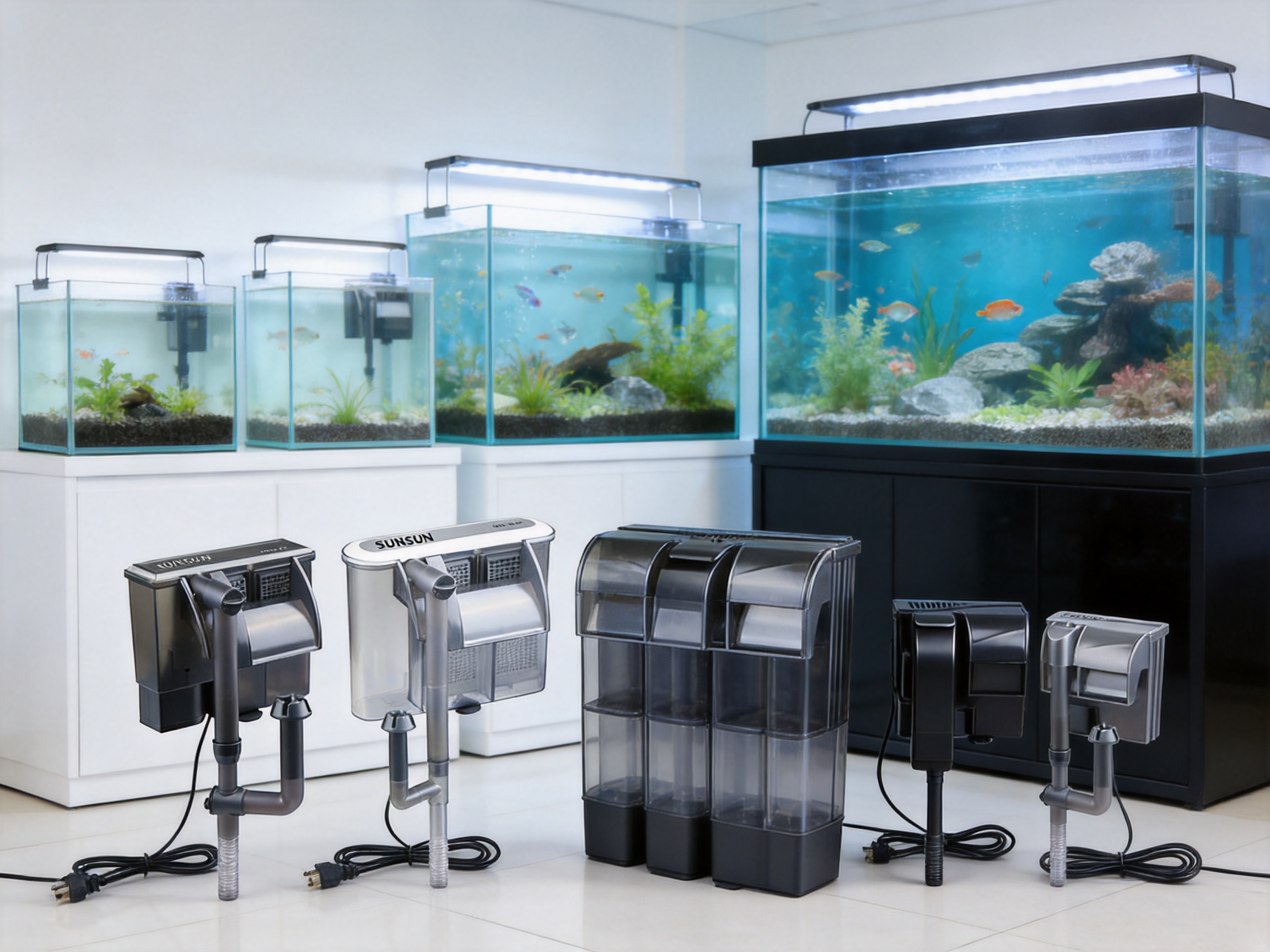
The HBL Series includes several models, each designed with a specific balance of flow rate, energy consumption, body size, and filtration capacity. This range allows users to choose a model based on aquarium size and practical needs rather than relying on a one-size-fits-all solution. Smaller units such as HBL-301 and HBL-402 offer low power consumption and compact dimensions, while higher-flow models such as HBL-702 provide increased circulation for larger or more demanding systems.
From the product specifications, all listed models support 110V, 220V, and 240V voltage options, as well as 50Hz and 60Hz frequency compatibility. This makes the series suitable for different regional electrical standards, which is particularly important for international distributors, aquarium stores, and commercial buyers. A product line that can adapt to multiple electrical markets simplifies procurement, inventory planning, and after-sales service.
The following table summarizes the core specifications of the HBL Series Hang On Filter. The output values are presented as listed product flow ratings in liters per hour.
Model |
Voltage |
Frequency |
Power |
Output |
Cable Length |
Weight |
Dimensions L×W×H |
HBL-301 |
110V/220V/240V |
50Hz/60Hz |
2W |
300 L/h |
1.5 m |
0.3 kg |
85×100×105 mm |
HBL-501 |
110V/220V/240V |
50Hz/60Hz |
5W |
400 L/h |
1.5 m |
0.45 kg |
120×120×130 mm |
HBL-701 |
110V/220V/240V |
50Hz/60Hz |
8W |
600 L/h |
1.5 m |
0.7 kg |
85×130×155 mm |
HBL-302 |
110V/220V/240V |
50Hz/60Hz |
3W |
350 L/h |
1.5 m |
0.3 kg |
144×95×212 mm |
HBL-303 |
110V/220V/240V |
50Hz/60Hz |
3W |
350 L/h |
1.5 m |
0.6 kg |
178×100×212 mm |
HBL-402 |
110V/220V/240V |
50Hz/60Hz |
2W |
300 L/h |
1.5 m |
0.5 kg |
95×95×150 mm |
HBL-403 |
110V/220V/240V |
50Hz/60Hz |
5W |
400 L/h |
1.5 m |
0.7 kg |
150×95×190 mm |
HBL-502 |
110V/220V/240V |
50Hz/60Hz |
4W |
500 L/h |
1.5 m |
0.5 kg |
163×95×170 mm |
HBL-702 |
110V/220V/240V |
50Hz/60Hz |
7W |
800 L/h |
1.5 m |
0.7 kg |
255×118×185 mm |
The first major advantage of the HBL Series is its space-saving hang-on design. Many aquarium filters are placed inside the tank, where they occupy volume, interrupt the layout, and may distract from plants, rocks, driftwood, fish, and ornamental features. The HBL Series minimizes this issue by locating the main filter chamber outside the aquarium while maintaining active water intake and return. This is especially useful for small aquariums, where every centimeter of internal space matters.
The second advantage is energy efficiency. The series includes models rated at only 2W, 3W, 4W, 5W, 7W, and 8W, depending on the selected version. For aquarium keepers who operate filtration continuously, power consumption matters because a filter usually runs all day and all night. A low-wattage unit can help reduce long-term operating costs while still supporting regular circulation. This combination of practical flow and modest energy demand gives the series a strong position against less efficient filters.
The third advantage is model variety. Competitor products sometimes offer only a few sizes, forcing users to accept either too little circulation or excessive flow. The HBL Series provides several output levels, including 300 L/h, 350 L/h, 400 L/h, 500 L/h, 600 L/h, and 800 L/h. This allows a better match between filter selection and aquarium requirements. A small planted tank may need gentle circulation, while a larger community aquarium may require stronger turnover. The model range supports both conditions.
The fourth advantage is broad electrical adaptability. With support for 110V, 220V, and 240V options and 50Hz/60Hz frequency compatibility, the series can meet the needs of different regions. This is valuable not only for individual consumers but also for wholesalers and international aquarium equipment distributors. A product line designed for multiple electrical environments reduces complexity in sourcing and allows easier market expansion.
The fifth advantage is easier maintenance compared with many enclosed or fully submerged filtration systems. Since the filter body is positioned on the aquarium rim, users can access the filtration chamber without placing their hands deep inside the aquarium. This can make cleaning media, checking water flow, and performing routine maintenance faster and less disruptive to fish. For retailers maintaining many tanks, even small time savings per aquarium can become significant.
The sixth advantage is balanced weight and compact sizing. The listed models range from approximately 0.3 kg to 0.7 kg. This lightweight design supports easier installation, easier handling during cleaning, and lower shipping burden. Compact packaging and manageable product weight are also helpful for e-commerce sales, retail display, and international distribution.
Aquarium filtration normally involves three related functions: mechanical filtration, biological filtration, and sometimes chemical filtration. Mechanical filtration captures floating particles such as leftover food, fish waste, plant fragments, and suspended debris. Biological filtration supports beneficial bacteria that help process nitrogen compounds. Chemical filtration, when used, may involve media such as activated carbon or other specialized materials to help manage odor, discoloration, or targeted impurities.
The HBL Series is well suited for everyday aquarium filtration because its hang-on chamber can hold suitable media while the pump maintains regular water movement. The exact media arrangement may depend on the model and user preference, but the operating principle remains practical: water is drawn from the aquarium, passes through the filter area, and returns to the tank. This constant motion helps prevent stagnant zones and contributes to more stable water conditions.
Clear water is one of the most visible benefits of an effective filter. However, the deeper value of filtration is long-term environmental stability. Fish, shrimp, aquatic plants, and beneficial microorganisms all depend on consistent water quality. A filter that is easy to operate and maintain is more likely to be cleaned and serviced properly, and this supports better aquarium health over time.
The HBL Series is particularly appropriate for aquarists who want dependable filtration without the complexity of larger canister systems. Canister filters can be powerful, but they may require more installation space, more tubing, and more involved maintenance. Internal filters can be simple, but they take up tank space. The HBL Series offers a practical middle ground: accessible, compact, external hanging filtration for common freshwater and ornamental aquarium applications.
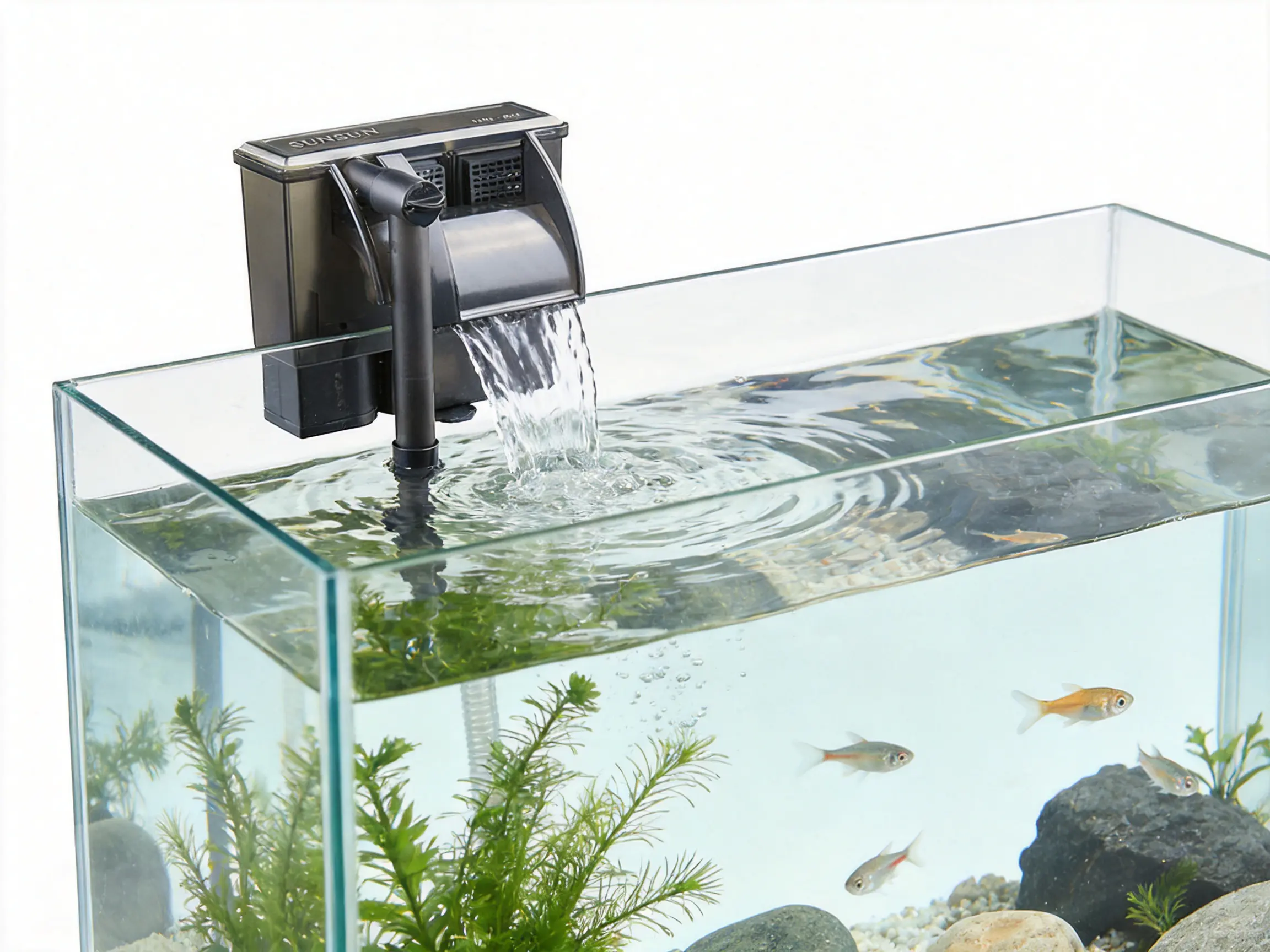
Selecting the correct model depends on tank size, livestock load, aquascape layout, desired water movement, and maintenance habits. In general, users should consider both flow rate and physical dimensions. A filter should provide enough circulation to help keep water clean, but it should not create excessive current for slow-moving fish or delicate aquascapes.
HBL-301 and HBL-402 both list 2W power and 300 L/h output. These models are practical choices where low energy use and compact filtration are priorities. HBL-301 has dimensions of 85×100×105 mm and weighs about 0.3 kg, making it one of the most compact units in the series. HBL-402 has dimensions of 95×95×150 mm and weighs about 0.5 kg, offering a different form factor for users who prefer that body shape.
These models can be attractive for small aquariums, desktop tanks, beginner setups, quarantine tanks, and light community aquariums. Their low power rating can be especially valuable in situations where multiple tanks are operated at once, such as small retail displays or breeding rooms.
HBL-302 and HBL-303 list 3W power and 350 L/h output. They provide a step up from the 300 L/h models while maintaining modest power consumption. HBL-302 measures 144×95×212 mm and weighs about 0.3 kg, while HBL-303 measures 178×100×212 mm and weighs about 0.6 kg. Their taller structure may allow a different filtration chamber arrangement and can suit users who want slightly stronger circulation.
These models are suitable for aquariums where a little extra water movement is useful, such as planted tanks with moderate stocking or small community tanks with active fish. They may also appeal to users who want a balance between compact operation and improved turnover.
HBL-501 and HBL-403 both list 400 L/h output, with 5W power. HBL-501 measures 120×120×130 mm and weighs about 0.45 kg, while HBL-403 measures 150×95×190 mm and weighs about 0.7 kg. These models occupy the middle of the range and provide useful capacity for many common home aquariums.
The 400 L/h category is often attractive to hobbyists who want stronger filtration than entry-level units but do not need the highest-flow option. These models can serve as dependable everyday filters for community aquariums, ornamental fish tanks, and retailer display tanks where clean water and easy access are important.
HBL-502 lists 4W power and 500 L/h output, giving it a strong flow-to-power relationship within the series. With dimensions of 163×95×170 mm and a weight of about 0.5 kg, it offers increased output while remaining manageable in size and weight. This model can be a good choice for users who need more circulation but still want energy-conscious operation.
For aquariums with active fish, moderate feeding, or a need for improved surface movement, HBL-502 can provide a useful upgrade. It may also be appropriate as a supplemental filter in tanks that already use another filtration method but require additional water polishing or circulation.
HBL-701 lists 8W power and 600 L/h output, while HBL-702 lists 7W power and 800 L/h output. These models are designed for users who need stronger filtration performance. HBL-701 measures 85×130×155 mm and weighs about 0.7 kg. HBL-702 measures 255×118×185 mm and weighs about 0.7 kg, making it the largest and highest-output model in the listed series.
HBL-702 is especially notable for its 800 L/h rated output combined with 7W power. For buyers comparing product lines, this specification can be a strong selling point because it offers high circulation with controlled energy use. Users with larger tanks, heavier stocking, or higher water movement needs may find these models suitable, provided the flow is appropriate for the aquarium inhabitants.
Aquascaping depends on visual balance. Rocks, plants, substrate slopes, driftwood, and open swimming space all contribute to the overall design. Internal equipment can interrupt this appearance, especially in smaller tanks where a filter may be highly visible. The HBL Series helps solve this problem by keeping the main filter body outside the aquarium.
This external hanging format can also simplify plant care. Aquatic plants need light, water movement, and room to grow. A large internal filter can block light, collect plant leaves, or limit design options. By placing filtration on the tank rim, the HBL Series allows the aquarist to preserve more interior space for plants and hardscape features.
For display aquariums in offices, hotel lobbies, shops, classrooms, and homes, equipment appearance matters. A clean-looking aquarium is easier to appreciate and can create a more professional impression. The HBL Series supports this goal by reducing visible equipment inside the glass box while still providing circulation and filtration.
Convenience is one of the strongest reasons to choose a hang-on filter. Routine maintenance should not feel difficult, because neglected filters can lose performance. With a hang-on system, the filtration area is more accessible than many fully submerged alternatives. Users can remove or rinse media with less disturbance to the aquarium environment.
The 1.5 m cable length listed for all models supports flexible placement near common aquarium stands and power outlets. While users should always follow safe electrical practices and keep drip loops where appropriate, a practical cable length helps reduce installation frustration. Multi-voltage availability further improves user experience across different markets.
Lightweight construction is another convenience factor. A filter weighing between 0.3 kg and 0.7 kg is easy to handle during installation and cleaning. This is useful for individual hobbyists and even more useful for professional aquarium service providers who may maintain many tanks in one day.
The model range also improves the buying experience. Instead of forcing customers to choose between only “small” and “large,” the HBL Series gives more intermediate options. This allows retailers to recommend a more accurate product based on the aquarium’s size, fish load, and user expectations.
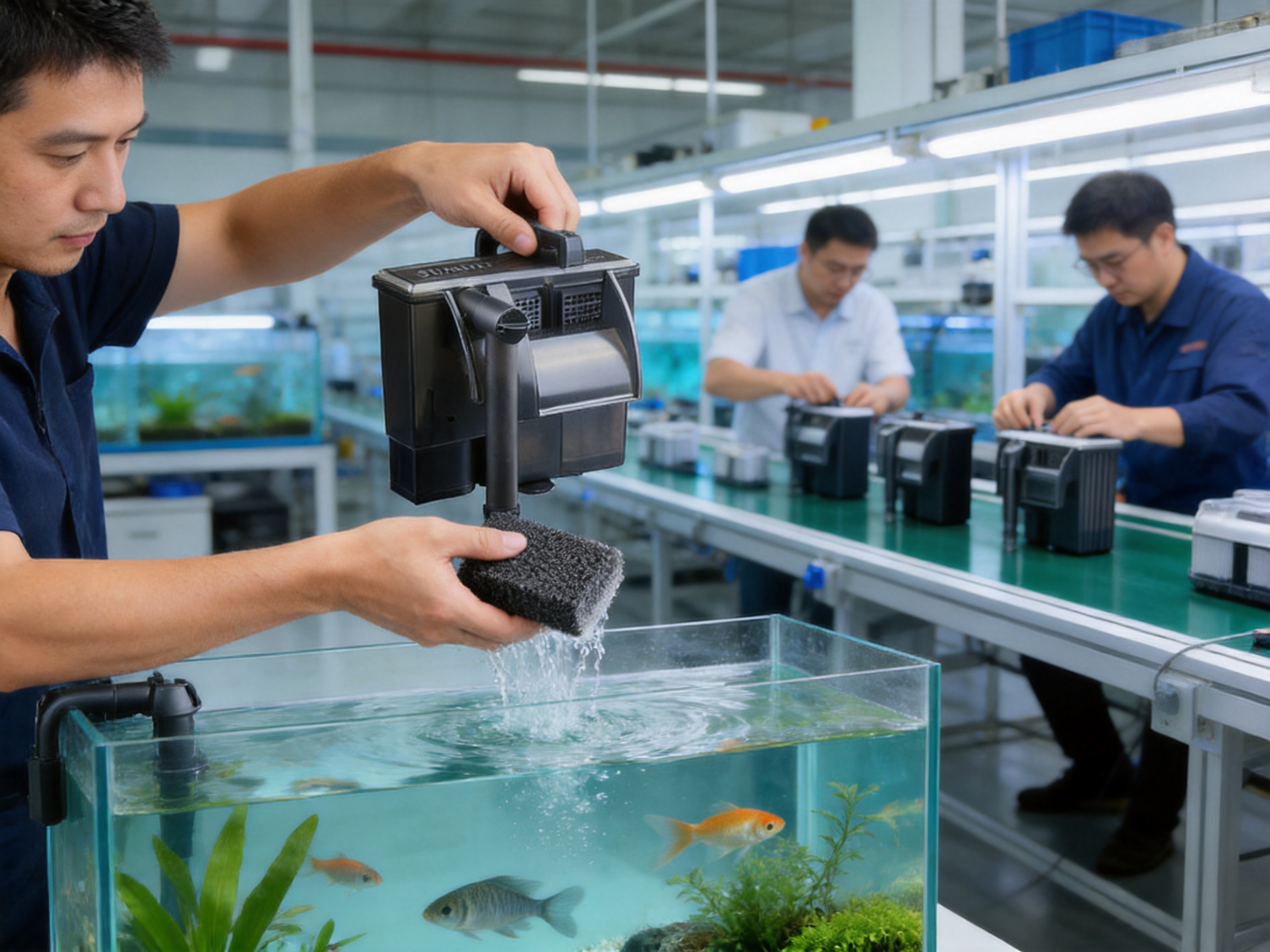
The HBL Series is supported by a manufacturer with decades of experience in aquarium pets, aquaculture machinery, and industrial equipment. Established in 1985, the company has developed through continuous innovation and large-scale production. This background matters because aquarium equipment must combine electrical safety, water resistance, stable operation, molded component accuracy, pump performance, and long-term reliability.
A mature manufacturer can support a product line not only through assembly but also through research, quality control, process management, supply chain integration, and market feedback. The company structure includes functional departments such as a research institute, business school, quality control department, personnel and administrative information department, and financial department. This organizational foundation helps maintain product development, internal training, standardized management, and service consistency.
Advanced manufacturing strength is reflected in several practical areas. First, product design must match real aquarium use. The HBL Series is not a single filter but a complete range, showing that the product development process considers different aquarium sizes and customer needs. Second, production must ensure consistent dimensions, stable motor performance, and proper fit between parts. Third, quality control must verify that each unit can perform under intended electrical and water-contact conditions.
The company’s broad industrial involvement also contributes to technical capability. Experience in aquarium equipment, aquaculture machinery, and related systems can strengthen understanding of pumps, water movement, filtration principles, and durable plastic components. This gives the manufacturer an advantage over smaller competitors that may lack integrated engineering experience or diversified production knowledge.
Aquarium filters operate in a demanding environment. They are electrical devices used near water, often running continuously for long periods. This means reliability is not optional; it is fundamental. A well-manufactured hang-on filter must maintain stable water flow, resist common operating wear, and remain convenient for users to service.
The presence of a dedicated quality control department is important because it indicates systematic attention to product consistency. Quality control can involve incoming material inspection, component dimensional checks, motor performance testing, assembly verification, electrical testing, water flow assessment, packaging inspection, and final sampling. While specific factory procedures may vary by product and market requirements, a structured quality system helps reduce defects and improve user confidence.
For distributors and retailers, reliability affects more than customer satisfaction. It influences return rates, warranty handling, brand reputation, and repeat orders. A filter that is easy to sell but difficult to support is not a strong long-term product. The HBL Series benefits from being part of a manufacturing ecosystem built around large-scale aquarium equipment production and continuing product innovation.
Continuous innovation is a central strength of the manufacturer behind the HBL Series. A research institute within the company structure supports product improvement, technology development, and market adaptation. In aquarium equipment, even modest design refinements can have a meaningful impact: better impeller efficiency, quieter operation, improved casing design, easier media access, better water return distribution, and more stable fit on aquarium rims.
The HBL Series reflects this practical development philosophy through its variety of sizes and ratings. The models are not merely cosmetic variations. They differ in output, wattage, dimensions, and weight, indicating that the series was developed to serve different applications. This makes it easier for sellers to target specific customer groups and for users to find an appropriate match.
Product development in aquarium filtration must also account for changing consumer expectations. Modern aquarium keepers increasingly want efficient equipment that is compact, attractive, easy to maintain, and suitable for planted tanks. The HBL Series aligns well with these expectations because it supports external placement, low energy use, accessible maintenance, and multiple flow options.
Large-scale manufacturing capability is an important competitive advantage. The company has developed a wide production and marketing network, with multiple subsidiary corporations and trading companies supporting domestic and international business. For buyers, this scale can translate into more stable supply, better order handling, wider product availability, and stronger long-term cooperation.
Aquarium equipment distributors often need consistent product supply across seasons. Retailers need dependable replenishment. E-commerce sellers need stable packaging, recognizable models, and accurate specifications. A manufacturer with broad production experience and established market channels is better positioned to meet these needs than a small workshop-style producer.
The company’s business approach emphasizes technical development, marketing globalization, and brand internationalization. This orientation supports export markets and helps products such as the HBL Series reach customers with different electrical standards, usage habits, and retail expectations. Multi-voltage product availability is one direct example of this market awareness.
The aquarium filter market is crowded, and buyers often compare products based on price, flow rate, size, noise, energy consumption, maintenance, and manufacturer credibility. The HBL Series competes strongly because it provides a well-balanced combination of specifications and practical benefits.
Compared with many basic internal filters, the HBL Series offers better visual integration because it keeps the main body outside the tank. Compared with larger external systems, it offers easier installation and simpler maintenance. Compared with products that have limited model choices, it offers a wider selection of flow rates and sizes. Compared with less efficient filters, its wattage ratings are attractive for continuous operation.
The HBL-702, for example, lists 800 L/h output at 7W, which is a compelling specification for users seeking higher circulation without high power demand. At the compact end, HBL-301 provides 300 L/h output at only 2W, a useful choice for small tanks and energy-conscious users. This range allows the series to compete across multiple customer segments rather than being limited to one niche.
Manufacturer strength further improves competitiveness. Buyers are not only purchasing a plastic filter body and pump; they are purchasing the results of engineering, tooling, assembly, quality control, packaging, and service capability. A company with more than three decades of development, dedicated functional departments, and broad aquarium industry experience can provide stronger confidence than suppliers with limited background.
For home users, the HBL Series provides a convenient solution for keeping ornamental fish tanks clearer and better circulated. Its hang-on design is easy to understand, and the range of models makes it possible to choose a filter that fits the tank size and fish load. Home aquariums benefit from equipment that is not overly complicated, and this series offers that simplicity.
In planted tanks, preserving internal space is especially important. Plants need room to grow and should not be crowded by bulky equipment. A hang-on filter helps maintain a cleaner layout while supporting circulation around leaves and hardscape. Users should choose a flow level that does not uproot delicate plants or disturb fine substrate.
Aquarium stores may operate many tanks at once, making easy maintenance and low power consumption very important. The HBL Series supports fast access to filtration media and offers low-wattage models that can help control operating costs. Its broad model range also allows stores to demonstrate different filters for different customer needs.
Office aquariums and decorative tanks need to look clean and professional. Equipment should be effective but not distracting. The HBL Series helps maintain a tidy appearance by keeping most of the filter outside the aquarium, making it suitable for reception areas, classrooms, restaurants, and public-facing interiors.
Some aquariums use more than one filtration system. The HBL Series can serve as supplemental filtration to improve mechanical polishing or increase circulation. For example, a user may add a hang-on filter to support an existing sponge filter or internal filter, especially during periods of higher feeding or increased livestock density.
Proper installation begins with selecting a suitable location on the aquarium rim. The filter should hang securely and sit level. The intake should be positioned to draw aquarium water effectively without interfering with fish, plants, or decorations. Users should ensure that the aquarium water level is appropriate for stable operation.
Before operation, filtration media should be installed correctly according to the filter structure and intended use. Mechanical media can help capture visible particles, while biological media can support beneficial bacteria if used and maintained properly. When cleaning biological media, aquarium water is often preferred over untreated tap water to help preserve beneficial bacterial colonies.
Routine maintenance should include checking water flow, rinsing or replacing clogged mechanical media, inspecting the intake area, and ensuring that the filter remains securely mounted. If water flow decreases, the most common causes are clogged media, debris in the intake, or accumulated buildup around moving parts. Regular care helps maintain performance and extends service life.
As with all aquarium electrical equipment, safe operation is essential. Users should follow the product instructions, avoid operating damaged equipment, keep electrical connections protected from splashing, and use safe cable routing. A drip loop is commonly recommended in aquarium setups to prevent water from running along the cable toward the electrical outlet.
Energy-efficient aquarium equipment provides both economic and environmental value. Because aquarium filters usually run continuously, even small differences in wattage can affect long-term electricity consumption. The HBL Series includes several low-wattage options, allowing users to select a model that meets filtration needs without unnecessary power use.
Efficient filtration can also reduce waste by helping maintain a stable aquarium environment. When water quality is better controlled, fish stress may be reduced, maintenance becomes more predictable, and the aquarium can remain attractive for longer periods between cleanings. Equipment that is easy to maintain is less likely to be neglected, which supports better outcomes for aquatic life.
From a business perspective, lightweight and compact products can reduce logistics burden. Lower weight helps with shipping and handling, while multiple model sizes allow retailers to stock a range of products without excessive storage demand. For international buyers, multi-voltage compatibility can reduce the need for entirely separate product lines.
Distributors and retailers should evaluate the HBL Series not only as individual filters but as a complete product family. A complete range makes it easier to serve customers with different aquariums. Entry-level hobbyists may choose compact models, while experienced users may select higher-output versions. This tiered structure supports upselling and better customer matching.
Clear specifications also help sales staff explain differences between models. Power, output, dimensions, and weight are easy comparison points. A retailer can guide customers by asking about aquarium size, fish quantity, desired flow, and available space behind the tank. The HBL Series gives enough options to make those recommendations meaningful.
For wholesalers, the manufacturer’s scale and established export orientation are significant advantages. Product consistency, supply stability, and after-sales communication all matter in long-term procurement. A company with a broad production base, quality control structure, and decades of industry development is positioned to support repeat orders and market expansion.
Sensen Group Co., Ltd. is located in Zhoushan City, Zhejiang Province, China, and has developed since 1985 through continuous effort in aquarium pets, aquaculture machinery, industrial equipment, and related fields. This long history provides valuable manufacturing experience and technical accumulation. The company has built functional departments and subsidiary operations that support product research, quality management, production coordination, and market service.
The company’s development model emphasizes professional production, innovation, customer sincerity, and capable talent. These principles are relevant to the HBL Series because aquarium filters require dependable engineering and consistent manufacturing. A filter must not only look good in a catalog; it must perform reliably in daily aquarium use.
The manufacturer’s broad sales network and experience with online and offline retail models also help it understand end-user needs. Feedback from stores, distributors, and consumers can guide product refinement. In competitive equipment markets, this market connection is a major advantage because products must evolve with user expectations.
The HBL Series Hang On Filter offers long-term value through its combination of practicality, efficiency, and choice. A good aquarium filter should become part of the daily background of fishkeeping: always working, easy to access, and dependable enough that the user can focus on enjoying the aquarium. This series supports that experience.
For beginners, the product is approachable because it does not require complex external plumbing. For experienced aquarists, the model range provides flexibility and potential supplemental filtration. For retailers, the series is easy to explain and suitable for different tank sizes. For distributors, it is supported by an established manufacturer with extensive aquarium equipment experience.
The HBL Series is not merely a filtration accessory; it is a practical water-management tool for ornamental aquariums. Its hang-on design, efficient power ratings, multi-voltage availability, and varied model lineup make it a competitive choice in the aquarium filtration market.
The main purpose is to provide continuous aquarium filtration and water circulation while keeping the main filter body outside the tank. This helps maintain clearer water and saves internal aquarium space.
HBL-702 has the highest listed output in the series, with a rated flow of 800 L/h and power consumption of 7W.
HBL-301 and HBL-402 are both rated at 2W with 300 L/h output, making them attractive options for compact tanks and energy-conscious users.
The listed models support 110V, 220V, and 240V voltage options as well as 50Hz and 60Hz frequency compatibility, which makes the series suitable for many regional electrical standards.
A hang-on filter keeps most of the equipment outside the aquarium, preserving swimming space and improving the visual appearance of the tank. It is also generally easier to access for maintenance.
Users should consider aquarium size, fish load, desired water movement, available installation space, and maintenance needs. Smaller tanks may use compact models, while larger or more heavily stocked aquariums may benefit from higher-output models.
Yes, it can be suitable for planted aquariums because the hang-on design saves internal space and supports water circulation. Users should choose a flow rate that does not disturb delicate plants or substrate.
The product is supported by a manufacturer with decades of experience, research and quality control departments, broad production capability, and a developed sales network. These strengths help support product consistency, innovation, and supply stability.
The HBL Series Hang On Filter is a strong solution for aquarium users who want compact installation, effective circulation, easy maintenance, and energy-conscious performance. With multiple models covering outputs from 300 L/h to 800 L/h, the series offers practical choices for small aquariums, medium tanks, display systems, planted layouts, and supplemental filtration needs.
Its advantages over many competing filters include a space-saving external hanging design, low wattage options, broad voltage compatibility, accessible maintenance, and a complete model range. These benefits are strengthened by the manufacturing background of Sensen Group Co., Ltd., whose long industry history, research capability, quality control structure, and large-scale production experience support product reliability and market competitiveness.
For aquarium hobbyists, retailers, service professionals, and distributors, the HBL Series represents a balanced and dependable filtration product family. It combines practical aquarium performance with manufacturing strength, making it a valuable option in the modern aquarium equipment market.
Product specification materials for HBL Series Hang On Filter.
Company profile information for Sensen Group Co., Ltd.
General aquarium filtration principles from ornamental fishkeeping and aquaculture equipment practice.
Standard aquarium maintenance guidance concerning mechanical filtration, biological filtration, water circulation, and electrical safety.



 English
 русский
 España
 Portugal
 عربي
عربي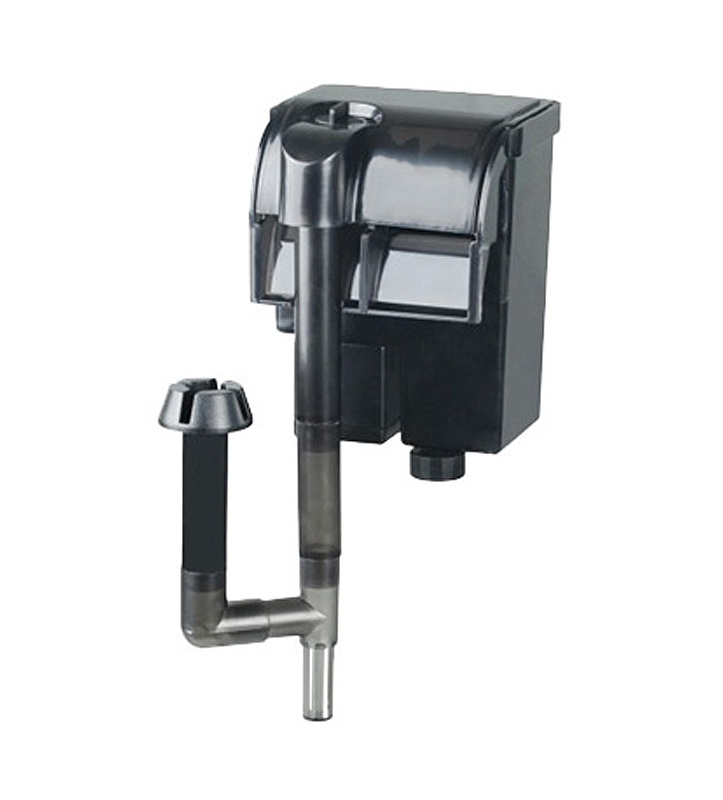

 No. 61-79, Baima Street, Maao Town, Dinghai District, Zhoushan City, Zhejiang Province, China.
 0086 580 8082088 / 8081168
 0086 580 8080978
 songhua@sunsun-china.com