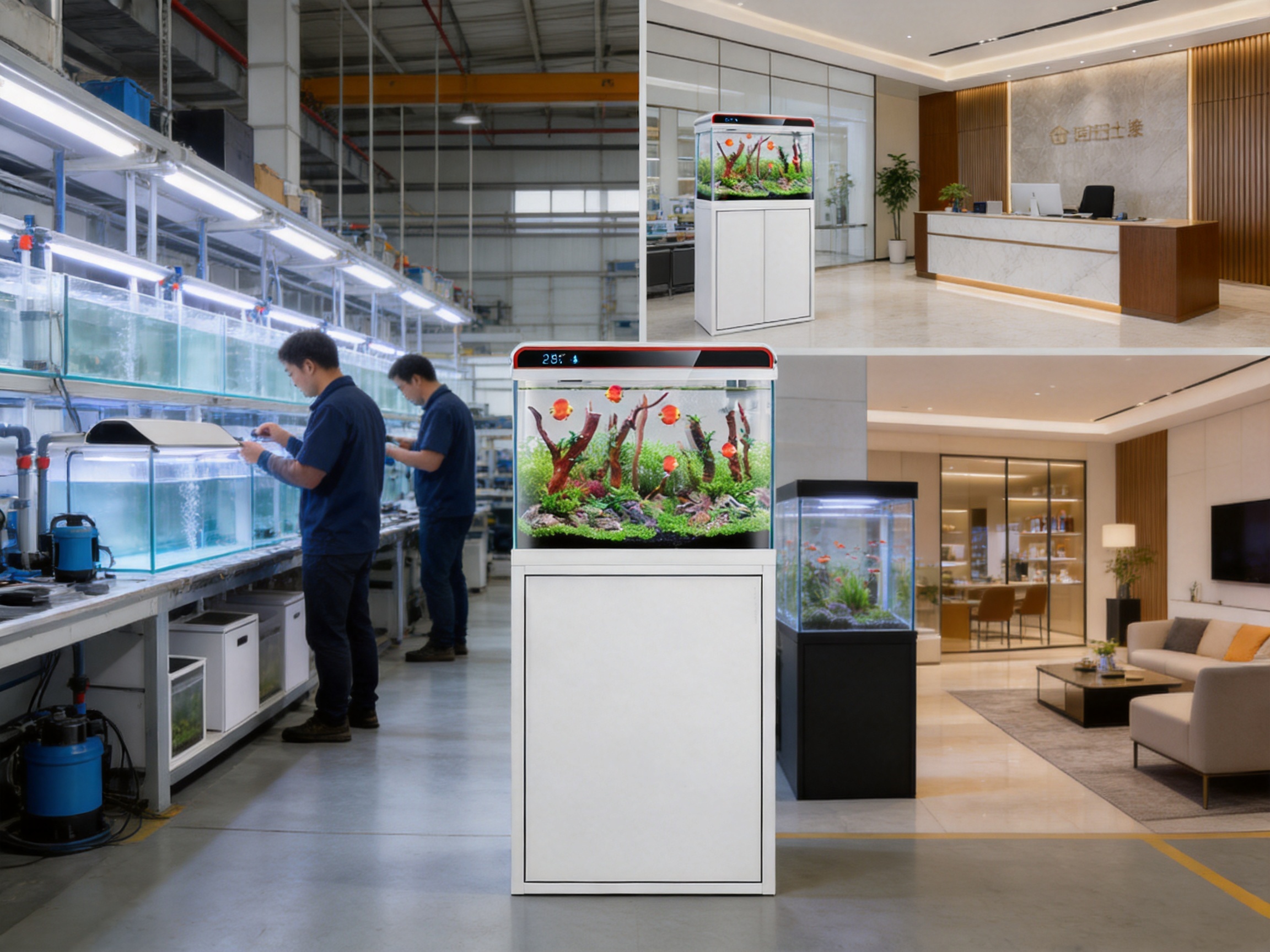
The HE Series side filter aquarium fish tank is designed for aquarists who want a complete, attractive, and manageable aquatic environment rather than a simple glass container. By combining a display tank, integrated filtration, lighting, feeding access, and temperature sensing support, the series addresses many of the everyday challenges associated with aquarium ownership. It is suitable for homes, offices, retail environments, hospitality spaces, and other interior settings where appearance, convenience, and stable water conditions are important.
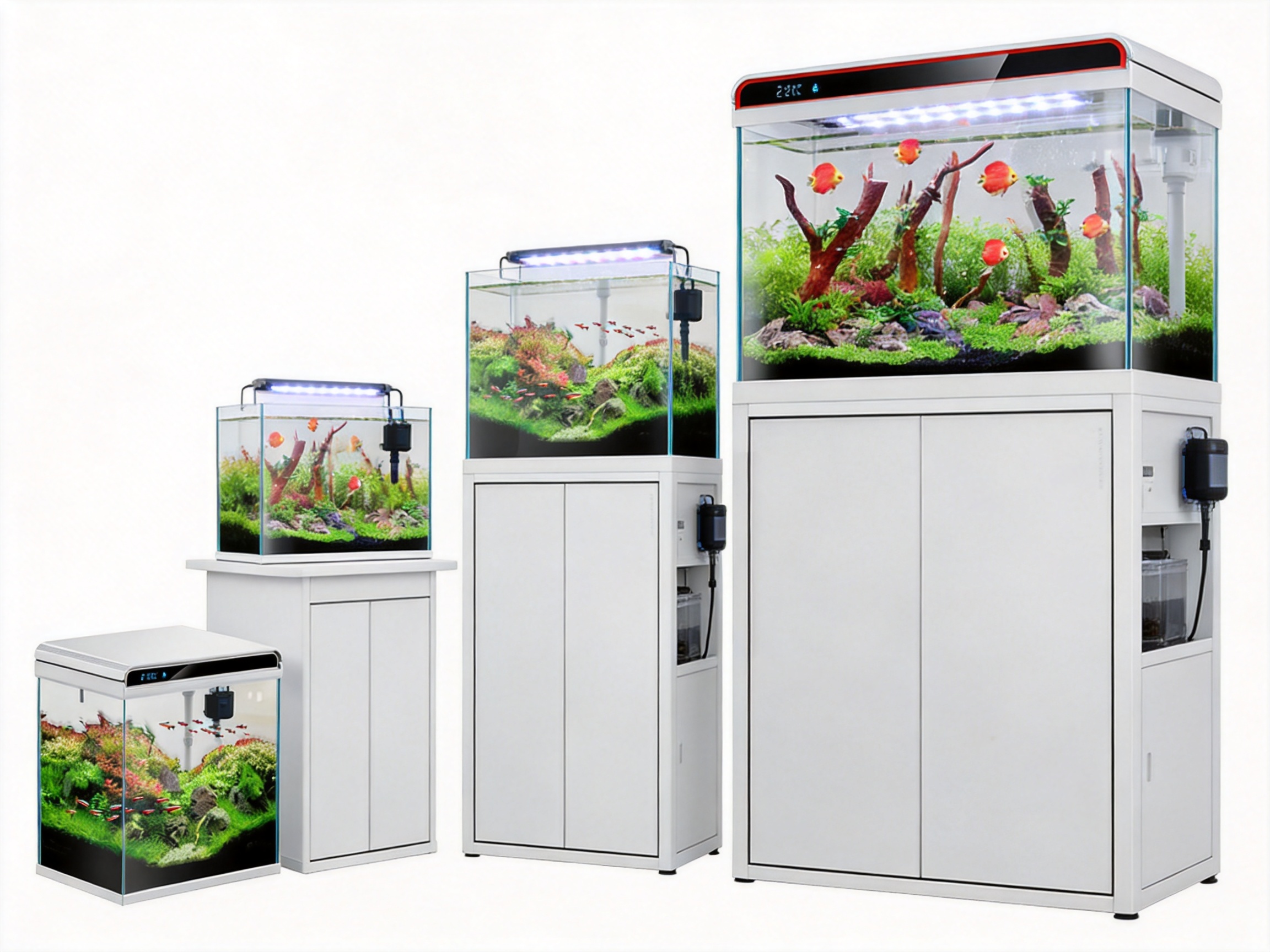
Available in four principal models—HE-300, HE-380, HE-480, and HE-600—the series covers compact and medium-capacity aquarium requirements. The smallest models are suited to limited spaces, desks, counters, and small living areas, while the larger models provide more internal volume for a broader selection of ornamental fish and aquatic arrangements. Each version follows the same central design philosophy: provide a coordinated aquarium system with practical equipment already integrated into the structure.
The product is manufactured and supplied by Sensen Group Co., Ltd., a Chinese enterprise with a long operating history in aquarium products, aquaculture machinery, industrial equipment, and related fields. The group’s research, production, quality control, administration, import and export, and subsidiary-company structure supports a product development approach that extends beyond individual components. This organizational foundation helps the company coordinate tank design, equipment matching, manufacturing, quality inspection, and market service.
Content
Many conventional aquariums require the user to purchase a tank, filter, lamp, pump, lid, heater or temperature accessory, cabinet, and other items separately. While this approach can offer flexibility, it also creates several practical difficulties. Components may not match visually, equipment may be difficult to install, cables can become untidy, and the final system may require considerable trial and adjustment before it operates correctly.
The HE Series takes a more integrated approach. The aquarium is designed around a coordinated structure in which the main operating features are considered together. The lighting, feeding access, water circulation equipment, and filtration arrangement are not treated as unrelated accessories. Instead, they form part of a unified product that is easier to understand, position, and use.
This integrated concept is especially valuable for first-time aquarium owners. A new user does not need to begin by comparing numerous unrelated pump and filter models. The supplied configuration gives the user a defined starting point, while the aquarium’s internal features make ordinary tasks such as feeding and observing fish more convenient.
The design is also beneficial for experienced aquarists who value a clean installation. A coordinated aquarium can reduce visual clutter and make the display area look more intentional. In commercial or public-facing spaces, such as hotel reception areas, offices, restaurants, and retail counters, this neat appearance can be as important as technical performance.
The series includes a lifting lid with an integrated design. This feature supports routine access to the aquarium while helping preserve a unified exterior appearance. A built-in lid can also help reduce unwanted evaporation, limit the chance of fish jumping from the tank, and prevent dust or other airborne particles from entering the water as easily as they might in a completely open aquarium.
Water temperature is one of the most important environmental parameters in an aquarium. Fish and aquatic organisms respond to temperature changes, and sudden fluctuations can cause stress or influence feeding, activity, and general health. The HE Series includes a water temperature sensing probe as one of its highlighted practical features.
A dedicated sensing probe allows the aquarist to pay closer attention to the water environment rather than relying only on room temperature. This is useful during seasonal changes, in rooms with air conditioning, or in locations where the aquarium is near a window, radiator, ventilation outlet, or other source of temperature variation.
The temperature-sensing feature does not replace responsible aquarium management. Users should still select suitable livestock, avoid overcrowding, maintain the correct water chemistry, and follow the care requirements of the fish being kept. However, convenient temperature awareness makes regular observation easier and supports more informed decisions.
Daily feeding is a simple task, but it becomes less convenient when the entire aquarium lid must be removed. Removing a large cover repeatedly can disturb lighting, move decorative objects, release more humidity, and create unnecessary handling of the aquarium structure.
The HE Series includes a feeding hole intended to make feeding easier. The opening provides direct access to the water surface while allowing the main lid to remain in place. This small design detail can significantly improve the routine user experience, particularly in homes and workplaces where fish are fed frequently and the aquarium must remain clean and orderly.
A feeding opening also encourages more controlled feeding. Users can add an appropriate quantity of food without fully opening the aquarium. Responsible feeding remains essential because uneaten food can decompose, increase organic waste, and place additional pressure on the filtration system.
The side filter arrangement is a defining characteristic of the HE Series. Instead of relying exclusively on a separate external filter that occupies space beside or behind the aquarium, the filtration area is incorporated into the aquarium configuration. This helps create a more compact installation and can make the system easier to position in areas where surrounding space is limited.
An integrated side filter can also improve the visual presentation of the aquarium. External hoses, separate filter bodies, and exposed connections are reduced or organized within the overall design. The result is a more finished appearance, which is particularly helpful when the aquarium is placed in a living room, reception area, showroom, or office.
The supplied product information describes the HE Series as a high-end bottom filter or side filter aquarium, while the model specification table identifies the filtration system as a top filter. This indicates that the series may be presented according to different structural or market descriptions. Buyers should confirm the exact configuration, installation method, and included filter media with the supplier before placing an order, especially when selecting a specific model or purchasing in volume.
Each model is supplied with a LED lighting configuration designed for aquarium illumination. The lighting is described as discoloration lighting, indicating a color-changing or color-adjustable presentation intended to enhance the appearance of fish and the aquarium environment.
Lighting has both functional and aesthetic importance. It allows the fish and internal arrangement to be observed clearly, while also helping create an attractive focal point in the room. LED technology is commonly valued for its compact size, relatively low power consumption, and long operating life compared with older lighting technologies, although actual service life depends on operating conditions and component quality.
The specified lamp configurations range from 5 watts in the HE-300 to 15 watts in the HE-600. The increase in lighting power corresponds with the increasing dimensions of the models. Users should still consider the requirements of the selected fish, plants, and decorative materials. Not every aquatic plant requires the same light intensity, and excessive lighting may encourage algae if the aquarium is not balanced through appropriate maintenance.
The four models give distributors, commercial buyers, and individual users a practical selection of sizes. The HE-300 and HE-380 are compact units, while the HE-480 and HE-600 provide greater capacity and include a 740-millimeter cabinet height in the supplied specifications.
| Model | Tank Specification | Cabinet Height | Capacity | LED Lighting | Water Pump | Filtration System |
|---|---|---|---|---|---|---|
| HE-300 | 300 × 200 × 320 mm | Not specified | 12 L | LED, 5 W, discoloration | JP-230G, 2.5 W | Top filter |
| HE-380 | 380 × 260 × 375 mm | Not specified | 26 L | LED, 10 W, discoloration | HQJ-500G, 2.5 W | Top filter |
| HE-480 | 480 × 300 × 405 mm | 740 mm | 42 L | LED, 11 W, discoloration | HQJ-700G, 8 W | Top filter |
| HE-600 | 575 × 335 × 480 mm | 740 mm | 70 L | LED, 15 W, discoloration | HQJ-700G, 8 W | Top filter |
The dimensions supplied for the models are expressed as length, width, and height. Capacity increases from 12 liters in the HE-300 to 70 liters in the HE-600. This range allows the purchaser to balance available floor or countertop space, livestock requirements, visual scale, and maintenance expectations.
The water pump specifications also vary by model. The HE-300 uses the JP-230G at 2.5 watts, and the HE-380 uses the HQJ-500G at 2.5 watts. The HE-480 and HE-600 use the HQJ-700G at 8 watts. The pump selection is matched to the model range in the supplied specification table, helping the aquarium operate as a coordinated package rather than as a collection of randomly selected components.
Electrical specifications and regional requirements should be confirmed before installation. The lighting table references a 220-volt configuration. Buyers in regions using other voltage standards should verify compatibility, available versions, plug types, safety requirements, and any necessary electrical adaptations with the supplier.
One of the clearest advantages of the HE Series is its compact, coordinated format. A separate aquarium and external filter may require additional clearance behind or beside the tank. In small homes, offices, shops, or reception spaces, that extra clearance can be inconvenient.
The integrated filter approach helps make the aquarium easier to position. By bringing key equipment into the product structure, the system can occupy a more predictable footprint. This is valuable for interior designers and commercial purchasers who need to plan furniture layouts, counters, display areas, or office partitions accurately.
Compared with a basic open tank accompanied by loose accessories, the HE Series can also reduce the amount of visible technical equipment. A cleaner arrangement helps the aquarium function as a decorative feature rather than appearing like a temporary installation.
Many competing aquarium solutions depend on components purchased from several manufacturers. Although this can provide customization, it often results in differences in color, finish, proportions, and styling. The tank, filter, lighting unit, cabinet, and lid may appear unrelated.
The HE Series is conceived as a unified product family. Its integrated lid, lighting, filter arrangement, and cabinet options are intended to work together visually. The available colors are white and red, giving customers a choice between a neutral appearance and a more distinctive decorative accent.
This visual coordination is useful in spaces where the aquarium is part of the interior design. White can support contemporary, minimalist, and bright environments, while red can create a stronger focal point. The final color appearance should be confirmed with the supplier because product finishes and regional availability may vary.
Convenience is a practical competitive advantage. A product may have good technical specifications, but if routine tasks are inconvenient, the owner may neglect maintenance. The HE Series addresses ordinary use through the feeding hole, integrated lid, temperature-sensing feature, and coordinated filtration system.
The feeding hole minimizes the need to open the whole aquarium. The integrated lid gives the product a finished appearance while providing access when needed. The water temperature probe supports routine monitoring, and the pump and filter configuration provides the basic circulation foundation required for aquarium operation.
These features are particularly valuable for families, offices, and beginner aquarists. They reduce the number of decisions required during daily use and make the aquarium more approachable without eliminating the need for responsible care.
Some aquarium product lines focus only on very small desktop tanks or large furniture-style aquariums. The HE Series offers a progression from 12 liters to 70 liters, allowing the user to choose a size according to location and intended aquatic arrangement.
The smaller HE-300 may be appropriate where space is highly restricted, although stocking must remain conservative because small water volumes can change rapidly. The HE-380 provides additional volume while retaining a compact footprint. The HE-480 and HE-600 are more suitable for users who want a larger visual presence and greater water volume.
A larger aquarium is not automatically maintenance-free, but greater water volume can provide more stability when the system is properly stocked and maintained. Users should select livestock based on adult size, behavior, compatibility, filtration capacity, and available swimming space rather than choosing fish only according to their size at the time of purchase.
Filtration is central to aquarium stability. A functional filtration system supports mechanical removal of suspended particles, biological processing of aquarium waste, and, depending on the media used, additional chemical filtration. Water circulation also distributes oxygen and helps reduce stagnant areas.
The HE Series uses model-specific water pumps. The JP-230G and HQJ-500G are specified for the smaller versions, while the HQJ-700G is used for the HE-480 and HE-600. The pump wattage and model selection indicate that the system has been configured according to aquarium size rather than using one identical pump for every product.
Good filtration depends on more than pump power. Filter media must be installed correctly, the intake must remain unobstructed, and the system must be cleaned according to the aquarium’s biological load. Cleaning should avoid unnecessarily destroying beneficial bacterial colonies. In many cases, filter media should be rinsed with removed aquarium water rather than untreated tap water, although the exact procedure depends on the media and local water conditions.
The integrated arrangement can make equipment matching easier than assembling a tank and filter independently. With a separately selected filter, the user must judge flow rate, hose size, connection compatibility, filter volume, noise, and available space. The HE Series reduces some of these compatibility concerns by presenting the aquarium and pump as a planned configuration.
Nevertheless, all aquariums require correct setup. The system should be placed on a stable, level surface or on its designated cabinet. Water should be added gradually, connections should be checked, and the pump should never be operated without sufficient water. Before fish are introduced, the aquarium should be prepared and biologically matured according to responsible aquarium practices.
The LED lighting system contributes to the visual appeal of the HE Series. Color-changing illumination can make fish colors appear more vivid and can give the aquarium a different atmosphere at different times. This is helpful for residential displays as well as commercial environments where the aquarium is intended to attract attention.
The lighting power is scaled across the models. The HE-300 uses 5 watts, the HE-380 uses 10 watts, the HE-480 uses 11 watts, and the HE-600 uses 15 watts. This progression reflects the increasing tank dimensions and viewing area.
Lighting should be operated on a consistent schedule. Excessive illumination can contribute to algae growth, while insufficient or irregular lighting may reduce the visual quality of the display. A timer can help establish a predictable day-and-night cycle, provided that the electrical arrangement and product instructions support such use.
For planted aquariums, users should verify the actual light spectrum and intensity rather than assuming that decorative discoloration lighting is sufficient for demanding aquatic plants. The product is suitable for a variety of display concepts, but livestock and plants should be selected according to the specific conditions that the aquarium can provide.
The HE-480 and HE-600 specifications include a cabinet height of 740 millimeters. This height allows the aquarium to be positioned at a comfortable viewing level when used as a floor-standing installation. A cabinet can also help organize equipment and create a more stable visual base for the tank.
For the HE-300 and HE-380, the cabinet height is listed as not specified. This suggests that these compact models may be intended for tabletop, counter, or alternative support arrangements, or that the cabinet information may depend on the order configuration. Customers should clarify whether a cabinet is included, optional, or unavailable for the selected model.
A suitable support structure is essential. Aquarium water is heavy, and the total installation weight includes the glass, substrate, decorations, equipment, and cabinet or table. The support must be level, stable, and capable of carrying the complete load. The aquarium should not be placed on an unsuitable shelf simply because the empty tank appears lightweight.
The cabinet height and color options also allow the product to function as furniture. This is an important distinction from a basic aquarium tank. The HE Series can be planned as part of a room’s layout, with the aquarium serving both an aquatic function and a decorative role.
The company behind the HE Series has operated since November 1985 and has developed activities across aquarium pets, aquaculture machinery, and industrial equipment. More than three decades of activity provide a substantial foundation for understanding water circulation, equipment production, product distribution, and the practical requirements of aquatic environments.
The group has established multiple functional departments, including a research institute, business school, quality control department, personnel and administrative information department, financial department, and import and export operations. This departmental structure indicates that product development is supported by more than a sales function alone.
A dedicated research institute can support product improvement, equipment matching, structural development, and investigation of user requirements. For an integrated aquarium, this type of technical coordination is important because the tank, lid, lighting, pump, filter, and cabinet must work together. A change to one component can influence the others, so cross-functional product development is more effective than treating each part in isolation.
The quality control department is another important manufacturing strength. Aquarium products operate in contact with water and electricity, which means that material selection, assembly accuracy, sealing, electrical protection, pump operation, and packaging all require attention. A quality-oriented production process should include inspection of components, assembly checks, operational testing, and final review before shipment.
The group’s wholly owned subsidiaries include ZHOUSHAN GRECH, ZHEJIANG JIALU, JIANGSU SENSEN, CHONGQING SENSEN, ZHONGSHAN SENSEN, TIANJIN SENSEN, ROLL-TAIL PET COMPANY, and MARINE ORIGANISM. The company also maintains import and export operations and holds interests in several trading companies. This broader corporate network can support sourcing, manufacturing specialization, logistics, market access, and after-sales coordination.
For international buyers, a developed export structure is valuable because aquarium products often need to be packed securely, documented accurately, and adapted to different electrical and market requirements. A company with dedicated import and export capabilities is better positioned to coordinate overseas orders than a small supplier with limited international experience.
The HE Series demonstrates the value of coordinated component planning. The pump, light, lid, filter, tank dimensions, and cabinet proportions are presented as a product family. This reduces the risk of designing a visually attractive tank that cannot accommodate the required equipment.
In a well-managed production process, component specifications can be reviewed together before mass production. The manufacturer can assess whether the pump is appropriate for the water volume, whether the lighting fits the lid, whether the filter access is practical, and whether packaging protects the finished product.
This approach can provide an advantage over low-cost aquarium assemblies that combine generic parts without sufficient system-level coordination. The customer receives a more coherent product, while distributors can present a clearer catalog with defined models and configurations.
Consistency is particularly important for wholesalers, retailers, property developers, and commercial projects. A buyer ordering multiple aquarium units expects the dimensions, colors, pump models, lighting configurations, and accessories to remain consistent across the shipment.
A structured quality control function can help establish inspection procedures for these points. The manufacturer can check glass or tank construction, cabinet appearance, lid movement, lighting operation, pump operation, filter fit, and packaging condition. The exact inspection standards and test records should be confirmed during commercial negotiations, but the existence of a dedicated quality control department is a positive organizational indicator.
Consistency also improves the retailer’s ability to stock replacement parts and explain products to customers. When models are clearly defined, staff can identify the appropriate pump, lighting component, or filter accessory more easily.
The company describes continuous innovation as a central part of its development across aquarium pets, aquaculture machinery, and industrial equipment. For aquarium manufacturers, innovation does not always mean adding unnecessary electronic complexity. It can also mean improving ease of maintenance, space efficiency, appearance, equipment matching, durability, packaging, and user safety.
The HE Series reflects practical innovation through its combined features. The feeding hole addresses convenience, the temperature probe supports monitoring, the integrated lid improves access and appearance, the LED system enhances presentation, and the filter design helps organize circulation and filtration equipment.
These improvements are meaningful because they focus on the actual ownership experience. A technically advanced product that is difficult to clean or operate may not deliver lasting value. Practical innovation balances performance, usability, aesthetics, and manufacturing feasibility.
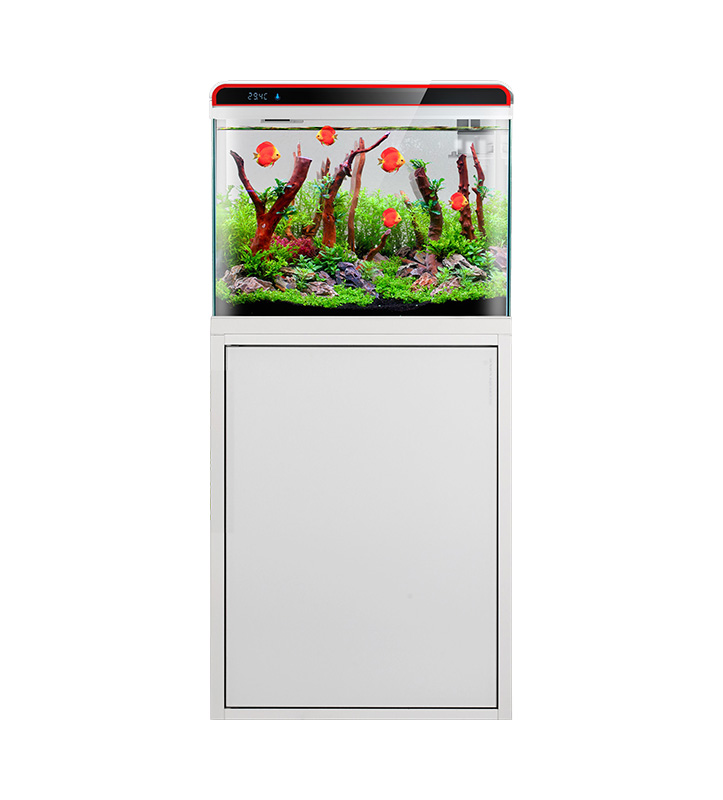
HE Series side filter aquarium fish tank
The HE Series can serve as a decorative feature in living rooms, bedrooms, studies, entrance areas, and family spaces. Its integrated appearance is suitable for homes where the aquarium should complement the surrounding furniture rather than appear as a collection of exposed equipment.
The smaller models may be useful for apartments, desks, and rooms with limited floor area. The HE-480 and HE-600 can provide a more prominent display where the owner wants the aquarium to become a central visual element.
An aquarium can contribute to the atmosphere of a reception area, meeting room, executive office, or employee lounge. The coordinated design of the HE Series can help maintain a professional appearance, while the LED lighting allows the display to remain visually engaging throughout the day.
Office users should assign responsibility for feeding, water changes, equipment inspection, and cleaning. A clear maintenance schedule is necessary because an aquarium cannot remain healthy through occasional attention alone.
Pet stores, aquarium retailers, restaurants, hotels, salons, and other public-facing businesses may use the HE Series as an ornamental display or demonstration unit. The color options and integrated design can be matched with different interior concepts.
For commercial installations, buyers should consider the expected viewing distance, customer traffic, electrical access, cleaning access, drainage arrangements, and protection against accidental contact. Larger orders may also benefit from confirming packaging specifications, replacement components, warranty terms, and delivery schedules in advance.
Before installation, select a location that can support the filled aquarium and that provides adequate electrical access. The surface should be level and stable. Avoid placing the tank where it will receive strong direct sunlight, because direct sunlight can raise water temperature and encourage algae growth.
Inspect the aquarium, cabinet, lid, lighting unit, pump, and filter components after unpacking. Report visible transport damage before filling the tank. Check that the filter area is correctly positioned and that all supplied accessories are present according to the order confirmation.
Rinse appropriate aquarium materials before installation, but do not use household detergents or chemical cleaners inside the tank. Arrange substrate, decorations, and plants so that they do not block the intake, interfere with the pump, or create sharp contact points that could damage the aquarium structure.
Fill the aquarium gradually and observe all connections. The pump must remain submerged or supplied with water according to its operating instructions. Do not operate a water pump dry, because this can cause overheating or premature wear.
Before introducing fish, allow the aquarium to complete an appropriate biological cycling process. Beneficial microorganisms need time to establish themselves in the filter media and aquarium environment. Introducing too many fish too quickly can overload a new system, even when the pump and filter are operating correctly.
Routine maintenance should include checking water level, observing fish behavior, removing visible waste, monitoring temperature, cleaning the glass, and inspecting the pump and filter. Water changes should be performed according to stocking levels, test results, and the needs of the aquarium inhabitants.
Filter maintenance should be gentle and regular. Excessive cleaning or replacement of all biological media at once can reduce beneficial bacterial populations. The filter should also be checked for blockages, because reduced flow may indicate accumulated debris or incorrectly positioned media.
LED lighting should be kept dry and operated in accordance with the product instructions. Electrical connections should be protected from splashing and arranged with suitable drip loops where applicable. Any unusual noise, overheating, flickering, leakage, or loss of water circulation should be investigated immediately.
Professional buyers should identify the required model, quantity, color, voltage configuration, cabinet requirement, packaging method, and destination market before confirming an order. The supplied information lists white and red as optional colors, but availability and minimum order quantities should be verified with the manufacturer.
Buyers should also confirm the precise filtration terminology for the order. The product title identifies a side filter aquarium, the information section describes a high-end bottom filter or side filter aquarium, and the specification table states top filter. This may reflect differences in product presentation, translation, or configuration. Written confirmation will help prevent misunderstandings in catalog production and customer communication.
Electrical compatibility is another important consideration. The supplied lamp configuration references 220 volts. Importers should verify whether the intended destination uses the same voltage and frequency, and whether plugs, switches, cables, and safety documentation meet local requirements.
Packaging should be discussed because aquariums contain glass or other fragile structural materials. Buyers may request information about carton construction, protective inserts, palletization, container loading, drop-testing practices, and spare parts. These details are especially important for long-distance transport.
For retail programs, it is useful to request product photographs, dimensional drawings, instruction manuals, replacement-pump information, filter-media recommendations, and warranty procedures. A complete information package helps retailers train staff and provide accurate guidance to end users.
The company’s import and export experience and broader sales network can support international cooperation. However, each project should still establish clear terms for inspection, delivery, documentation, payment, warranty, technical support, and responsibility for local installation.
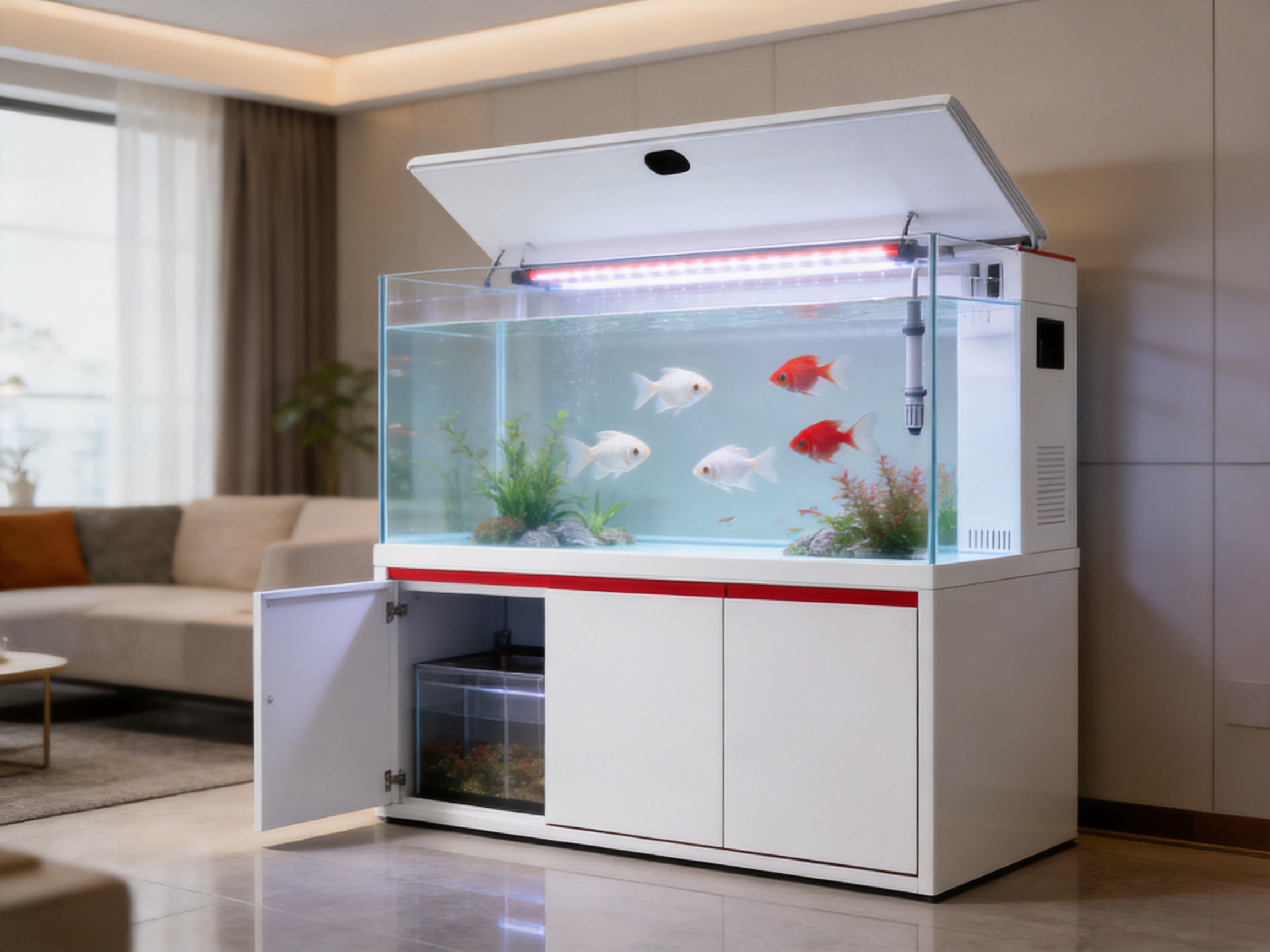
The market value of an aquarium is determined by more than its water capacity. Buyers also consider appearance, reliability, maintenance effort, space requirements, equipment compatibility, and the reputation of the manufacturer. The HE Series addresses these factors in a single product family.
Its integrated design can reduce the complexity associated with assembling a complete aquarium system. Its model range makes it easier to serve different customer groups. Its LED lighting and color choices support decorative applications. Its feeding access and temperature-sensing feature improve routine interaction. Its pump and filtration specifications provide a defined technical starting point.
Compared with very basic aquarium tanks, the HE Series offers more built-in functionality. Compared with highly customized installations, it can be faster to specify and easier to reproduce across multiple locations. Compared with loosely matched equipment packages, it offers a more consistent relationship between tank size, water pump, lighting, lid, and filter design.
The product is not intended to eliminate the need for aquarium knowledge. Instead, it provides a more organized platform on which responsible aquarium care can be built. This balance between convenience and practical operation makes the series suitable for both new users and buyers who need a presentable, repeatable aquarium solution.
The HE Series is designed for residential, office, retail, hospitality, and other indoor aquarium applications. It combines a display tank with integrated lighting, filtration-related equipment, a feeding hole, an integrated lifting lid, and a water temperature sensing probe.
The supplied product information lists four models: HE-300, HE-380, HE-480, and HE-600. Their stated capacities are 12 liters, 26 liters, 42 liters, and 70 liters respectively.
The HE-600 is the largest listed model. Its stated tank dimensions are 575 × 335 × 480 millimeters, its capacity is 70 liters, its LED configuration is 15 watts, and its water pump is the HQJ-700G at 8 watts.
Yes. Each listed model includes an LED lighting configuration. The stated wattages are 5 watts for the HE-300, 10 watts for the HE-380, 11 watts for the HE-480, and 15 watts for the HE-600. The lighting is described as discoloration lighting.
The feeding hole allows food to be added without lifting the entire aquarium lid. This makes daily feeding more convenient and helps keep the main cover in position during ordinary use.
The probe helps users monitor water temperature, an important aquarium condition. Regular temperature observation can help identify environmental changes and support better care decisions for fish and other aquatic organisms.
The product title identifies the aquarium as a side filter model, while the information section describes it as a high-end bottom filter or side filter aquarium. The model table lists the filtration system as a top filter. Because these descriptions differ, buyers should confirm the exact configuration for the selected model and order before purchase.
The supplied information lists white and red as optional colors. Availability, finish, minimum order quantity, and production lead time should be confirmed with the manufacturer.
The specifications list a cabinet height of 740 millimeters for the HE-480 and HE-600. The information for the HE-300 and HE-380 does not specify a cabinet height. Buyers should confirm whether a cabinet is included or optional for each model.
Its integrated design can make it easier for beginners to start because major components are coordinated. However, beginners must still learn about cycling, stocking levels, feeding, water changes, temperature, filtration, and species compatibility.
The aquarium can be arranged with aquatic plants, but plant selection should match the actual lighting and water conditions. The decorative LED system may not provide the intensity or spectrum required by demanding plant species, so buyers should confirm plant-lighting requirements before creating a specialized planted aquarium.
The supplied table references a 220-volt lamp configuration. International buyers should confirm voltage, frequency, plug type, and electrical safety requirements for their destination market.
The buyer should inspect the tank and accessories for transport damage, confirm that the aquarium is on a level and stable support, check the filter and pump arrangement, protect electrical connections from water, and ensure that the pump will operate with sufficient water.
Sensen Group Co., Ltd. was established in November 1985 and has developed business activities in aquarium pets, aquaculture machinery, and industrial equipment. Its organization includes research, quality control, import and export, and several wholly owned subsidiaries and trading-company interests.
An importer should request final technical specifications, drawings, color availability, voltage details, packaging information, spare-parts support, warranty terms, inspection procedures, delivery schedules, and confirmation of the exact filter configuration.
The HE Series side filter aquarium fish tank provides a well-organized alternative to assembling an aquarium from unrelated components. Its combination of integrated filtration-related design, LED lighting, feeding access, temperature sensing, lifting lid, model variety, and optional colors gives it broad practical appeal.
The series is especially strong where space efficiency, clean appearance, and everyday convenience are priorities. The HE-300 and HE-380 serve compact applications, while the HE-480 and HE-600 offer larger capacities and 740-millimeter cabinet-height configurations. The specified pump and lighting selections create a defined product structure for each size.
Its competitive value also comes from the manufacturer’s broader capabilities. A history extending back to 1985, a dedicated research institute, a quality control department, multiple subsidiaries, and an import and export organization provide a foundation for coordinated product development and international supply.
As with any aquarium, performance depends on correct installation, suitable stocking, regular maintenance, and proper electrical and water management. Buyers should verify configuration details where the supplied descriptions use different filtration terms. With those points confirmed, the HE Series can serve as an attractive and practical aquarium solution for consumers, retailers, commercial spaces, and international distributors.
1. Product specification sheet for the HE Series side filter aquarium fish tank, including model dimensions, capacities, lighting configurations, water pumps, and filtration descriptions.
2. Product feature information for the HE Series, including the water temperature sensing probe, feeding hole, side filter design, integrated lifting lid, cabinet height, and optional colors.
3. Manufacturer company profile describing the establishment of Sensen Group Co., Ltd. in November 1985 and its activities in aquarium pets, aquaculture machinery, and industrial equipment.
4. Manufacturer organizational information describing the research institute, quality control department, import and export company, subsidiaries, and related trading-company interests.
5. General aquarium husbandry principles concerning water temperature monitoring, biological filtration, responsible stocking, feeding control, aquarium cycling, and routine water changes.



 English
 русский
 España
 Portugal
 عربي
عربي
 No. 61-79, Baima Street, Maao Town, Dinghai District, Zhoushan City, Zhejiang Province, China.
 0086 580 8082088 / 8081168
 0086 580 8080978
 songhua@sunsun-china.com