A high-end aquarium is more than a glass container for aquatic life. It is a carefully coordinated environment that must combine reliable filtration, stable water circulation, suitable lighting, safe electrical operation, attractive furniture, and convenient daily maintenance. The HAT Series high-quality high-end bottom-filter aquarium fish tank is designed around this complete approach. It integrates a display aquarium, a concealed filtration area, a lifting cover, lighting, a circulation pump, controller compatibility, and a dedicated base cabinet into one coordinated system.
For home aquarists, offices, hotels, restaurants, retail stores, and professional display areas, an integrated aquarium can provide a cleaner appearance and a more predictable installation process than a collection of unrelated components. Instead of selecting a tank, cabinet, pump, light, filtration chamber, and cover separately, the user receives a matched system with model-specific dimensions and operating components. This reduces visual clutter and makes it easier to plan the aquarium as part of an interior environment.
The HAT Series is available in several lengths and two principal depth configurations. The ED models provide a more compact front-to-back footprint, while the ID models offer greater depth and consequently greater water volume. Across the range, the tank height remains 818 millimeters, while the base cabinet height is specified as 740 millimeters. This consistent vertical format supports coordinated placement in residential or commercial spaces while allowing buyers to select capacity according to available floor area and livestock requirements.
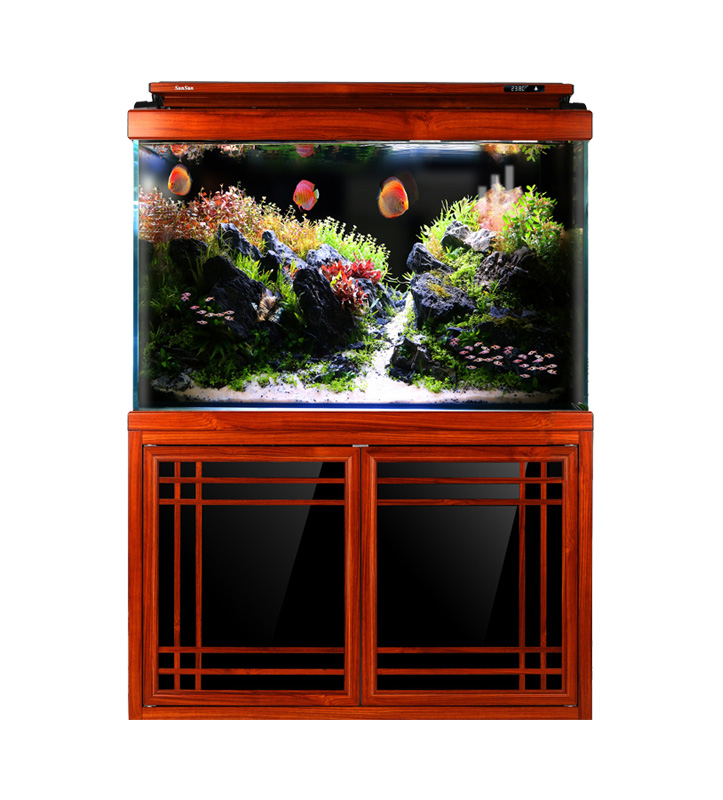
HAT Series High-quality High-end bottom filter aquarium fish tank
Content
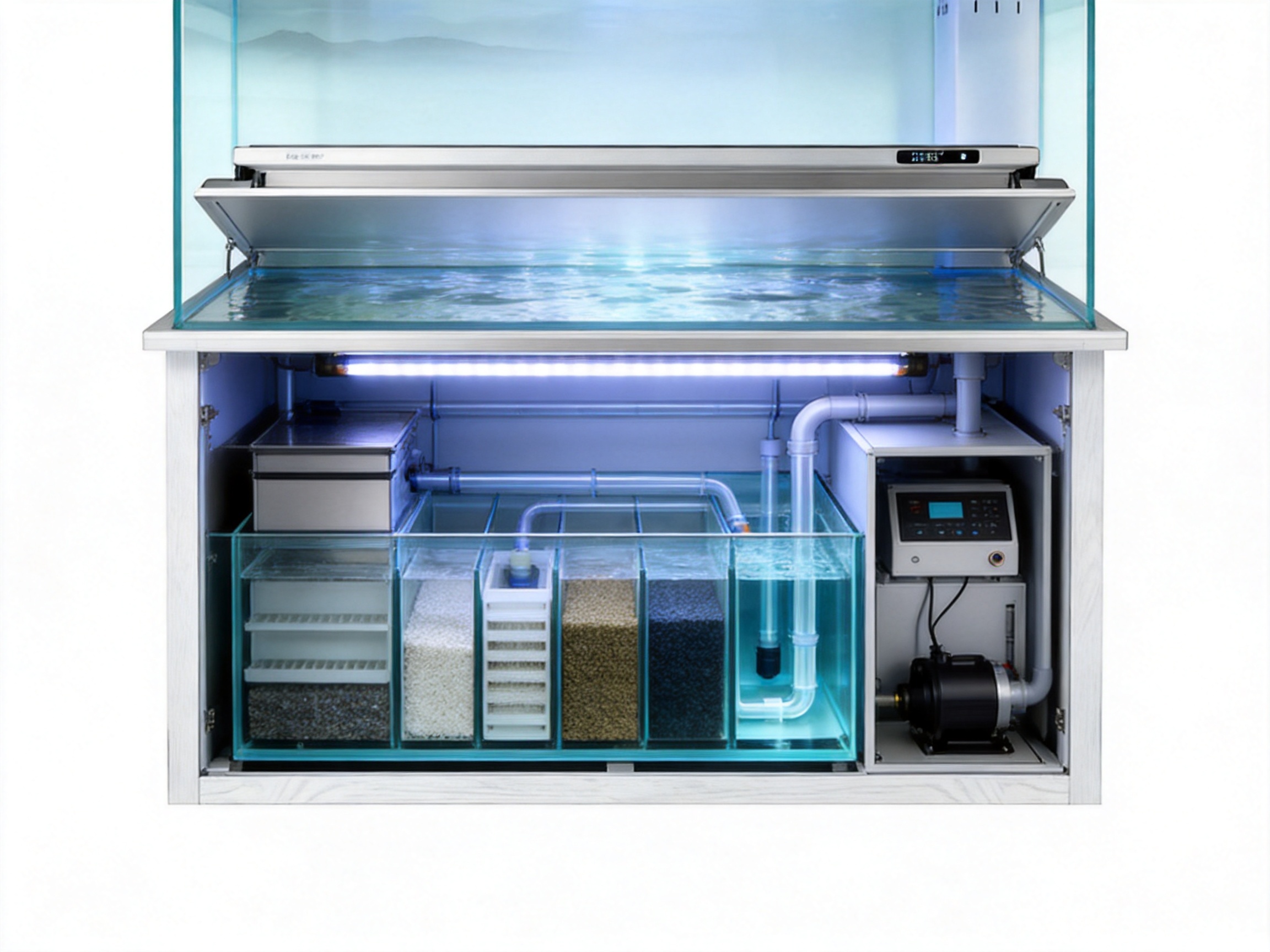
The central concept behind the HAT Series is bottom filtration. In a bottom-filter aquarium, water is directed from the display area through a concealed filtration section beneath or within the lower structure. The filtration area can contain mechanical media, biological media, baffles, and circulation equipment. After filtration, the pump returns treated water to the display tank. This arrangement keeps much of the technical equipment out of sight and helps preserve the clean visual character expected from a high-end aquarium.
A conventional aquarium installation may require external filters, exposed hoses, separate equipment cabinets, and improvised cable routing. Those additions can make the installation look unfinished and may create more points that require inspection. The HAT Series addresses this issue by coordinating the tank, lower cabinet, filtration design, water pump, lighting system, and cover construction. The result is a furniture-style aquarium that is intended to function as a unified product rather than as a group of disconnected accessories.
The filtration specification varies according to model size. The shorter ED models use a small four-way system with baffle, while the larger 1500 ED and 1500 ID models use a four-way system with baffle. A baffle helps separate water movement zones and can support more controlled flow through the filtration chamber. It may also reduce direct turbulence between sections, assist in retaining filtration media, and help create a more orderly route for water as it moves toward the return pump.
The integrated design is especially useful for users who want a large display without allowing technical equipment to dominate the room. A concealed lower system can provide a more polished appearance than an aquarium with multiple visible external devices. It also gives the installer a defined location for service access, water management, and pump-related maintenance.
The HAT Series uses ultra-white glass as one of its principal display features. Compared with standard glass, ultra-white glass is generally selected for its high visual clarity and reduced color distortion. This is valuable in an aquarium because the viewer should see the natural colors of fish, plants, rock, sand, and decorative materials rather than an unwanted green cast or muted tone caused by the glass itself.
Clearer glass can improve the impression of depth and make a carefully planned aquascape appear more vivid. It is particularly suitable for display-oriented installations where the aquarium will be positioned in a living room, reception area, showroom, hospitality space, or other location in which visual presentation is important. The glass is not merely a structural boundary; it is the viewing surface through which the entire aquatic environment is experienced.
High-clarity glass also supports more accurate observation. Aquarists can inspect fish condition, plant growth, water clarity, algae development, and equipment performance more easily when the viewing panels do not introduce unnecessary visual interference. This practical benefit complements the aesthetic advantage.
The lifting cover is another important feature of the product. The supplied information identifies an aluminum lifting-cover design intended to make operation more convenient. A lifting cover can simplify feeding, plant trimming, cleaning, water testing, and other routine tasks. Rather than removing a heavy or awkward top assembly, the user can access the aquarium through a designed opening mechanism.
Aluminum is suitable for a cover structure because it can offer a balance of low weight, rigidity, and resistance to everyday moisture exposure. In a high-humidity aquarium environment, the cover must be practical as well as visually compatible with the cabinet. A well-coordinated aluminum structure can help maintain a clean appearance while supporting repeated opening and closing during normal use.
The product information also describes the upper cover as including a small square cover with a computer board. This arrangement suggests that the upper assembly is designed to combine access and control functions in one organized area. The user can benefit from a more deliberate equipment layout rather than having controls attached randomly to the outside of the aquarium or cabinet.
The HAT Series is identified as a patented product with quality assurance. A patent designation does not replace the need for proper installation, maintenance, or responsible operation, but it indicates that the design includes proprietary elements recognized as distinct by the manufacturer. In a competitive aquarium market, product differentiation can be important because many tanks share similar basic dimensions and functions.
The value of a proprietary design is most apparent when it solves practical problems. A lifting cover that is easier to operate, a better-organized lower filtration system, a coordinated controller arrangement, or a more efficient use of cabinet space can create meaningful advantages over generic aquarium furniture. These details affect the experience of using the aquarium every day.
Every HAT Series model includes an LED lighting configuration designed for operation at 220 volts. The ED versions use one LED unit, while the ID versions use two LED units. Lighting power increases with tank length. The HAT-800ED uses one 9-watt LED configuration, the HAT-1000ED uses one 13-watt configuration, the HAT-1200ED uses one 20-watt configuration, and the HAT-1500ED uses one 22-watt configuration.
The ID series provides two lighting units for each listed model. The HAT-800ID uses two 9-watt units, the HAT-1000ID uses two 13-watt units, the HAT-1200ID uses two 20-watt units, and the HAT-1500ID uses two 22-watt units. This arrangement corresponds with the greater front-to-back depth and larger water volume of the ID models. Two light sources can also help distribute illumination across a broader viewing area.
LED technology is widely used in aquarium applications because it can provide efficient illumination in a compact format. It also permits a slim fixture design that is easier to integrate into a lifting cover. A coordinated LED system contributes to the appearance of the aquarium while avoiding the visual bulk of oversized lighting equipment.
Lighting should always be selected according to the aquarium’s intended inhabitants. Fish-only displays, planted aquariums, and specialized aquatic environments may have different light requirements. The supplied configurations provide a matched starting system, but aquarists should still consider plant species, photoperiod, water depth, decorative layout, and algae management when establishing operating settings.
The HAT-800ED, HAT-1000ED, HAT-1200ED, HAT-800ID, HAT-1000ID, and HAT-1200ID models are specified with a CQB-2000 pump rated at 35 watts. The HAT-1500ED and HAT-1500ID models are specified with a CQB-2500 pump rated at 45 watts. Matching the pump model to the aquarium size helps create a more coherent relationship between water volume, circulation, and filtration architecture.
The stated pump configuration is an important advantage over choosing an undersized pump after purchasing a tank. In an independently assembled system, the user must calculate flow requirements, hose compatibility, installation space, electrical load, and the relationship between pump performance and filtration capacity. With an integrated system, the manufacturer has already designated a pump configuration for each model family.
Actual water movement will depend on factors such as lift height, plumbing resistance, media loading, outlet arrangement, water level, and maintenance condition. For this reason, the model rating should be understood as part of a designed system rather than as a guarantee of identical flow under every installation condition. Correct setup remains essential for reliable operation.
The information provided for the HAT Series identifies AQ192H for the cover and AQ130 for the cylinder. This controller arrangement is intended to provide coordinated control of relevant aquarium functions. A dedicated controller can improve convenience by bringing system operation into a more organized interface.
Control integration is valuable in a high-end aquarium because the user normally manages several recurring activities. Lighting may need to follow a daily schedule, the pump may need to remain continuously active, and maintenance may require temporary equipment adjustment. A controller arrangement can help reduce the need to operate each device independently, improving consistency and reducing the chance of accidental oversight.
Electrical installation should be performed according to the applicable local requirements for wet environments and 220-volt equipment. Power connections should be protected from splashing, cables should be routed safely, and the aquarium should be positioned on a stable, level surface. The product’s integrated controller design can support orderly installation, but it does not eliminate the need for proper electrical safety practices.
The model range is designed to accommodate different space and volume requirements. The following table summarizes the principal specifications supplied for the eight listed configurations.
Model |
Dimensions |
Approximate Volume |
LED Configuration |
Water Pump |
Filtration System |
HAT-800ED |
796 × 345 × 818 mm |
160 L |
1 × 9 W |
CQB-2000, 35 W |
Small four-way with baffle |
HAT-1000ED |
990 × 345 × 818 mm |
202 L |
1 × 13 W |
CQB-2000, 35 W |
Small four-way with baffle |
HAT-1200ED |
1190 × 345 × 818 mm |
245 L |
1 × 20 W |
CQB-2000, 35 W |
Small four-way with baffle |
HAT-1500ED |
1508 × 345 × 818 mm |
313 L |
1 × 22 W |
CQB-2500, 45 W |
Four-way with baffle |
HAT-800ID |
796 × 415 × 818 mm |
197 L |
2 × 9 W |
CQB-2000, 35 W |
Small four-way with baffle |
HAT-1000ID |
990 × 415 × 818 mm |
248 L |
2 × 13 W |
CQB-2000, 35 W |
Small four-way with baffle |
HAT-1200ID |
1190 × 415 × 818 mm |
301 L |
2 × 20 W |
CQB-2000, 35 W |
Small four-way with baffle |
HAT-1500ID |
1508 × 415 × 818 mm |
385 L |
2 × 22 W |
CQB-2500, 45 W |
Four-way with baffle |
The ED models have a depth of approximately 345 millimeters. This relatively compact footprint can be useful where the aquarium must be positioned against a wall, placed in a narrow room, or installed in a location where circulation space around the furniture is limited. Despite the reduced depth, the models range from 160 liters to 313 liters, offering substantial display capacity in a space-conscious format.
The ED series may be appropriate for users who prioritize length and a slim profile. A long aquarium can create a strong horizontal visual effect, making it suitable for a feature wall or reception counter. The available lengths also allow buyers to select a model that fits the intended room without immediately moving to a deeper cabinet.
The ID models increase depth to approximately 415 millimeters. This creates a larger internal footprint and raises the listed volumes to between 197 liters and 385 liters. The additional depth can provide greater flexibility for aquascaping, allowing more room for layered hardscape, wider planting arrangements, and improved separation between foreground and background elements.
Greater depth can also create a stronger three-dimensional effect. Aquatic displays often appear more natural when the layout includes foreground, middle-ground, and background zones. The ID format gives the aquarist more room to establish these visual layers, although the final result will depend on the selected materials and livestock.
The 800, 1000, 1200, and 1500 designations indicate progressively greater tank lengths. A buyer should measure not only the available floor space but also the route through which the aquarium will be transported. Door openings, stairways, elevators, corridors, and turning areas should be checked before ordering. The completed installation must also leave enough space for opening the lifting cover and performing maintenance.
Volume is another selection factor. Larger aquariums may offer greater water stability because a given amount of waste or temperature change is distributed through more water. However, they also require more water, more substrate, more decorative material, and greater attention to floor loading. The building structure and cabinet support must be suitable for the filled aquarium.
The most immediate advantage of the HAT Series is the way the technical elements are incorporated into the furniture structure. A separate external filter, loose hoses, independent lighting fixture, and exposed control box can make an aquarium look improvised. By contrast, an integrated bottom-filter aquarium is designed to present a coordinated exterior, helping the aquarium function as an interior design element.
This distinction is especially important in commercial environments. A hotel lobby, restaurant, office reception area, retail showroom, or clinic may need an aquarium that looks professional from multiple viewing angles. An organized cabinet and concealed equipment can reduce distractions and support a more refined presentation.
A fragmented system places considerable responsibility on the buyer. The user must compare pump curves, filter sizes, lighting dimensions, cabinet capacity, cover compatibility, and electrical requirements. Even an experienced aquarist can spend significant time confirming whether separate products will work together.
The HAT Series simplifies this process by providing a defined combination of pump, lighting, filtration structure, cover, and cabinet. This does not remove the need for responsible planning, but it reduces uncertainty at the purchasing stage. Buyers can begin with the model specification and then focus on aquarium layout, livestock, installation, and maintenance.
Maintenance is a central part of aquarium ownership. Water changes, filter-media cleaning, glass cleaning, plant care, water testing, and livestock observation all require regular access. The lifting cover and dedicated lower structure are intended to make those activities more manageable than they might be with a fixed or poorly organized installation.
A well-planned maintenance area can also support better long-term care. When equipment is difficult to reach, users may postpone cleaning or inspection. When access is straightforward, routine tasks are more likely to be completed on schedule. This can improve the stability and appearance of the aquarium over time.
The specified relationship between aquarium volume, LED output, and pump model gives the range a clear internal logic. Smaller configurations use the CQB-2000 pump and lower lighting power, while the 1500 configurations use the CQB-2500 pump and higher lighting power. The ID models use two lighting units to suit their larger depth and display area.
Compared with purchasing components without a system plan, this matched approach can reduce the possibility of installing a pump that is too weak, a light that does not cover the display evenly, or equipment that does not fit inside the cabinet. System matching is a practical advantage even when the user later adds selected accessories.
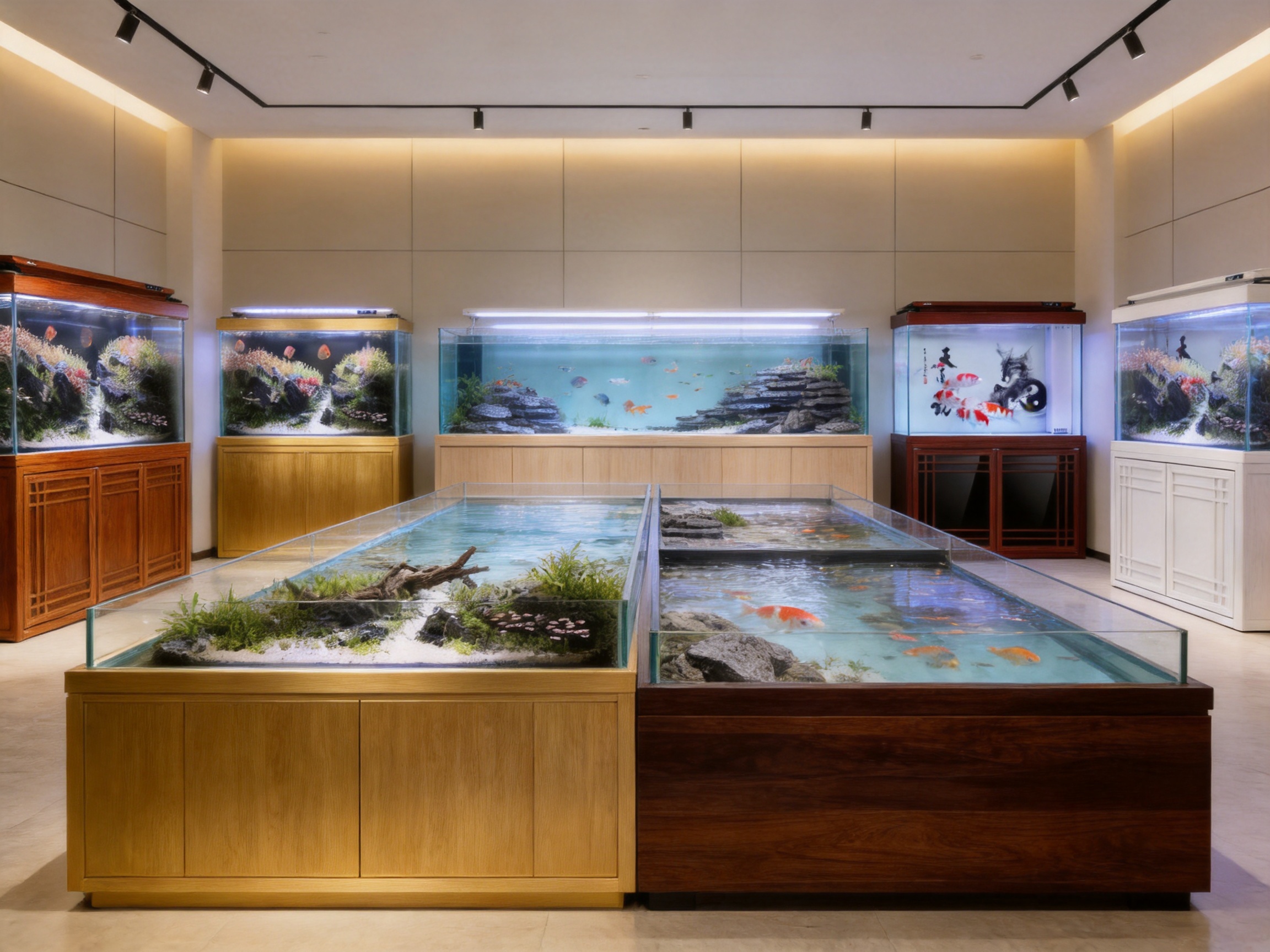
The product offers optional cabinet colors identified as Golden Apple, Light Wood, and Congo Teak. These choices allow the aquarium to coordinate with different interior styles. A dark or rich wood appearance may complement traditional furniture, while a lighter finish may suit contemporary or minimalist spaces.
Color selection is not only a matter of decoration. When an aquarium is installed in a visible room, the cabinet becomes part of the surrounding architecture. Offering multiple finishes gives buyers greater control over how the system contributes to the overall environment.
The HAT Series is associated with Sensen Group Co., Ltd., also known through the Sunsun brand identity in aquarium and equipment markets. The group was established in November 1985 and has developed through more than three decades of activity in aquarium products, aquaculture machinery, industrial equipment, and related fields. This long operating history provides an important foundation for product development and manufacturing experience.
The company information describes a broad organizational structure that includes research, quality control, education, personnel and administration, finance, and information functions. A business with dedicated research and quality-control responsibilities is better positioned to manage product development as a process rather than relying only on individual assembly experience.
The group also identifies several wholly owned subsidiary companies and an import and export company, together with holdings in multiple trading companies. This broader structure indicates experience in production coordination, domestic distribution, international business, and market servicing. For an aquarium product, these capabilities can support the supply of components, manufacturing continuity, packaging, export preparation, technical communication, and after-sales coordination.
A modern aquarium is a combination of mechanical, electrical, structural, and aesthetic requirements. Research and development must consider water movement, filtration access, lighting placement, cabinet strength, moisture exposure, user convenience, and visual proportions. The company’s stated research institute and ongoing innovation orientation provide a framework for addressing these requirements together.
The HAT Series demonstrates this integrated development philosophy. The product is not limited to a glass tank. It includes an aluminum lifting cover, ultra-white glass, dedicated lighting, a specified water pump, a bottom-filter system, controller references, and a base cabinet. Coordinating these elements requires attention to interfaces between parts. The cover must work with the lighting and control arrangement; the cabinet must accommodate filtration and pump access; the pump must correspond with the water route; and the overall dimensions must remain suitable for interior placement.
Quality control is particularly important for aquariums because the product must contain a heavy volume of water for long periods. Glass bonding, panel alignment, support structure, cabinet stability, cover operation, electrical insulation, and pump reliability all influence user safety and product life.
A dedicated quality-control function can help establish inspection procedures across manufacturing stages. These may include checking material specifications, verifying dimensions, testing electrical components, inspecting surface finishes, confirming packaging, and reviewing final assembly. The exact internal procedures are not specified in the supplied information, so buyers should request current technical documentation and installation guidance for their chosen market. Nevertheless, a formal quality-control orientation is a significant manufacturing strength.
The company information refers to a large production and marketing structure, a broad sales network, and multiple subsidiaries. Scale can provide several advantages when properly managed. It may support more consistent sourcing, specialized production departments, investment in tooling, standardized assembly practices, and the ability to distribute products across different markets.
Scale also creates the possibility of continued product improvement. Feedback from dealers, installers, aquarists, and international customers can be gathered across a large network. This information can help manufacturers identify recurring installation concerns, service requirements, preferred cabinet finishes, and changing expectations for aquarium control systems.
For buyers, manufacturing scale may also improve access to replacement components and technical support. Availability will depend on the destination market and the specific model, but an established international company is generally better positioned to organize parts and service than a small producer with limited distribution capacity.
The company describes a long-term strategy involving industrial technicalization, marketing globalization, and brand internationalization. This direction is relevant to the HAT Series because high-end aquarium products must satisfy users in different countries and commercial environments. International products require attention to voltage, labeling, packaging, documentation, logistics, and customer expectations.
The group’s activity in aquarium pets, aquaculture machinery, and industrial equipment also creates a broad technical context. Knowledge developed in water-management equipment can contribute to the design and production of aquarium pumps, filtration systems, and related machinery. Although each product must be evaluated on its own specifications, a diversified water-equipment background can support practical engineering competence.
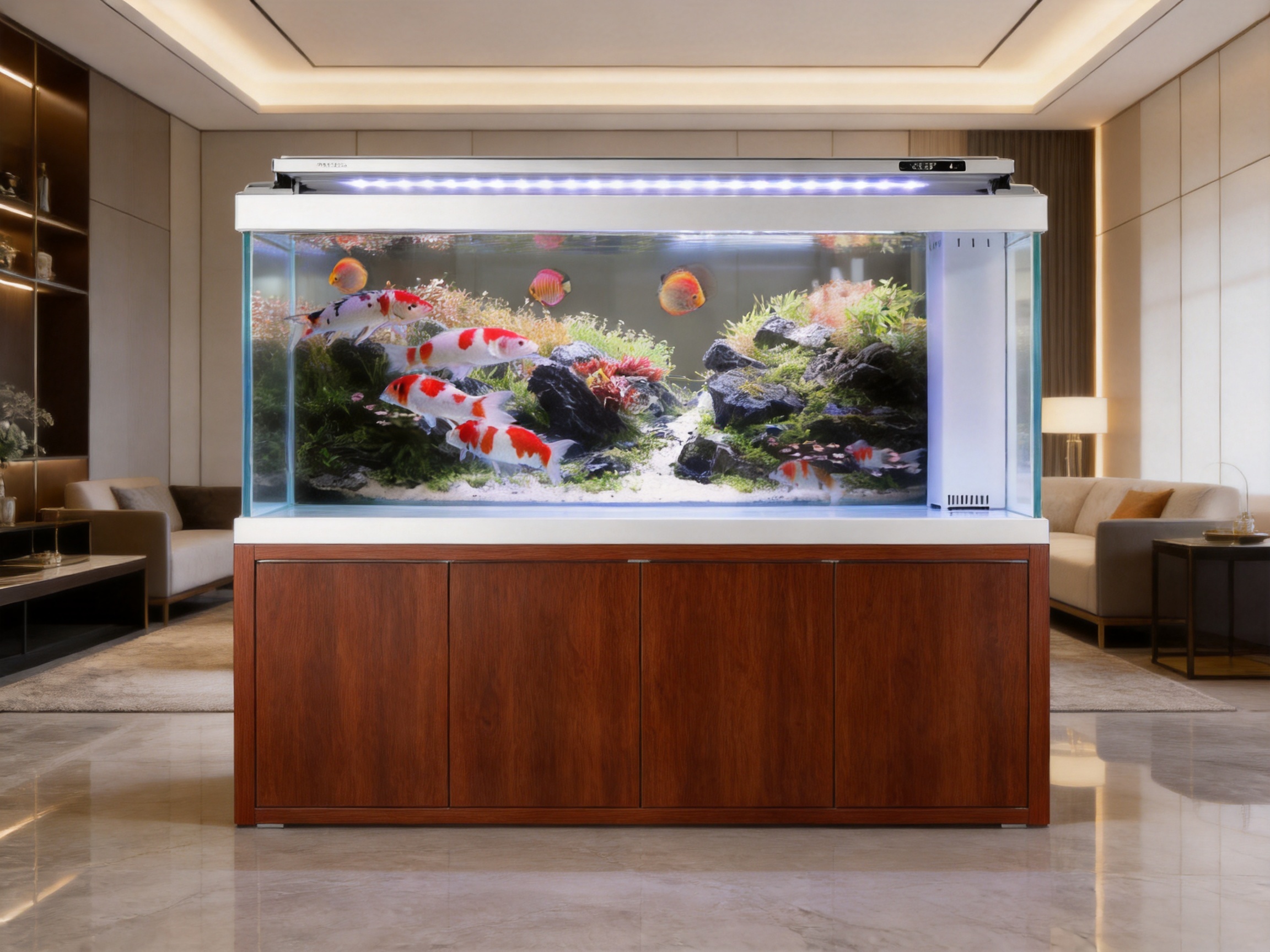
The HAT Series can be used in private homes where an aquarium is intended to serve as a major decorative feature. The range of lengths makes it possible to select a system for a living room, study, dining area, entrance hall, or dedicated hobby room. The integrated cabinet provides storage and conceals equipment, while the ultra-white glass emphasizes the display itself.
In offices, an aquarium can create a distinctive reception feature or a calming visual point in a waiting area. The furniture-style construction helps the system look intentional rather than temporary. In restaurants and hospitality venues, the aquarium can complement a design theme and offer guests an engaging focal point. Commercial users should pay particular attention to access for cleaning, the location of electrical connections, and the ability to protect the aquarium from accidental contact.
Retail stores can use a large model to demonstrate aquatic livestock, plants, or decorative materials. A well-presented display can help customers understand the possibilities of aquascaping and may support sales of related equipment. The larger ID configurations, with their additional depth, can be suitable for more dimensional layouts that show multiple layers of aquatic decoration.
For professional environments, planning should include service access, drainage, water supply, ventilation, floor loading, and staff training. An integrated aquarium is easier to present, but its long-term success still depends on an appropriate maintenance plan.
Before installation, the floor should be assessed for levelness, strength, and resistance to water exposure. A filled aquarium is substantially heavier than an empty tank because water, glass, cabinet structure, substrate, rocks, wood, and equipment all contribute to the total load. The selected location must be capable of supporting the completed system without excessive movement or uneven stress.
The aquarium should be placed away from direct sunlight, strong heat sources, and locations where it may be struck or repeatedly disturbed. Direct sunlight can contribute to unwanted algae growth and temperature fluctuation. A stable indoor environment helps the user maintain more consistent water conditions.
Enough space should be left above and around the aquarium for the lifting cover to operate properly. The user should be able to open the cover without hitting a ceiling, shelf, light fitting, or wall decoration. Space behind or beside the cabinet may be needed for electrical connections and service access, depending on the final installation arrangement.
The pump and filtration system should be inspected before filling. All connections should be secure, filter chambers should be arranged according to the recommended sequence, and the water level should be suitable for the circulation system. The system should be tested for leaks and abnormal noise before fish or other aquatic animals are introduced.
New aquariums should be cycled before stocking. Beneficial microorganisms need time to establish in the biological filtration media. The cycling method should be chosen according to the intended livestock and the aquarist’s experience. Water parameters should be tested regularly during this stage, and animals should not be added simply because the tank appears visually complete.
Routine maintenance should include glass cleaning, water testing, partial water changes, pump inspection, filter-media care, and observation of livestock. Mechanical media may require more frequent cleaning because it captures visible particles. Biological media should be handled carefully to preserve beneficial microbial populations. The pump intake and return path should remain unobstructed.
Lighting schedules should be consistent. Excessive lighting can encourage algae, while inadequate lighting may affect plant growth and visual presentation. A gradual operating schedule can help the aquarium stabilize. The controller arrangement identified for the HAT Series may assist with routine operation, but the user should confirm the exact control functions and programming instructions for the purchased configuration.
The choice between ED and ID models gives aquarists control over the relationship between length and depth. The ED format emphasizes a slim, elongated profile. This can be useful for layouts based on horizontal movement, schooling fish, long planting zones, or a panoramic view. The ID format offers more depth, making it easier to build a layered composition with foreground, central structure, and background vegetation.
Greater depth can also allow more natural spacing between fish and decorative objects. Instead of arranging every element along a single front-to-back line, the aquarist can create open swimming areas and visual pathways. This may help the display look less crowded and more natural.
The high-clarity glass supports aquascaping because it allows the viewer to appreciate subtle color relationships. Dark stones, green plants, pale sand, and colorful fish can be presented with less interference from the viewing panel. The cabinet finishes then provide a visual frame that can either contrast with or complement the aquascape.
Lighting placement is another consideration. The ID configurations use two LED units, which can help distribute illumination across the wider tank depth. Even lighting can reduce overly dark areas and improve the visibility of the entire display. Aquascapers should still arrange plants and hardscape according to the intensity and direction of the supplied light.
Select an ED model when floor depth is limited or when a long, narrow aquarium is preferred. The 345-millimeter depth can fit more easily in compact rooms and may leave additional circulation space in front of the cabinet. The ED range still offers capacities from 160 liters to 313 liters, so it can accommodate displays that are larger than many basic home aquariums.
ED models may also suit users who want the aquarium to act as a horizontal room divider or feature wall. Their proportions can create a clean linear appearance, particularly when installed against a long wall or beneath a carefully planned lighting arrangement.
Select an ID model when greater water volume and aquascaping depth are more important than the narrowest footprint. The 415-millimeter depth provides more room for decorative materials and layered layouts. The listed capacity ranges from 197 liters to 385 liters, giving the ID series a stronger position for larger fish displays, more complex plant arrangements, or installations where visual depth is a priority.
The ID format may be especially attractive to experienced aquarists who want to build a three-dimensional aquascape. It can also be useful in commercial locations where the aquarium will be viewed from several angles or where a more substantial visual presence is desired.
The 1500 models are the largest listed configurations in the series. The 1500 ED provides approximately 313 liters, while the 1500 ID provides approximately 385 liters. Both use the CQB-2500 pump rated at 45 watts, reflecting their larger capacity. The 1500 models require more floor length and should be selected only after confirming transport access, structural support, and maintenance space.
These models can create a strong centerpiece for a commercial interior or a dedicated home aquarium room. Their longer viewing area can support a more expansive composition and may be appropriate when the aquarium is intended to become a principal visual feature.
The HAT Series competes most directly with high-end integrated aquarium furniture and premium bottom-filter systems. Its main point of distinction is the combination of design, filtration, lighting, pump selection, cover access, and cabinet presentation. Many lower-cost aquariums focus primarily on the glass tank and leave the buyer to purchase technical equipment separately. The HAT Series instead presents a coordinated platform.
Another competitive advantage is the range of sizes. Buyers can choose between compact-depth ED models and larger-depth ID models without moving to an entirely different product family. This makes the selection process more flexible and allows dealers or designers to recommend a model based on room geometry rather than only on volume.
The use of ultra-white glass gives the product a display-oriented advantage over basic tanks that may use more heavily tinted or visually less clear glass. The aluminum lifting cover also addresses a practical weakness found in some conventional aquariums: difficult access to the water surface and equipment.
Manufacturing experience further strengthens the product’s market position. A company with a history extending from 1985, a research function, quality-control responsibilities, multiple subsidiaries, and international business operations has the organizational foundation to develop products for sustained distribution. The ability to combine engineering, production, marketing, and service resources is particularly valuable for a system product with several interdependent components.
Buyers should nevertheless compare current warranty terms, electrical certifications, spare-part availability, delivery conditions, installation requirements, and local service support before purchase. A premium aquarium should be evaluated not only by appearance but also by the complete ownership experience.
Aquarium ownership is more satisfying when routine tasks are predictable. The HAT Series is designed to make the system more orderly by placing filtration and equipment within a dedicated structure. A user can establish a maintenance routine around the lower filtration area, pump, controller, lighting, and lifting cover rather than searching for scattered equipment.
The lifting cover can be opened for feeding and observation without disturbing the entire installation. It can also provide access when trimming plants or repositioning ornaments. Because access is a frequent requirement, this feature can have a greater practical effect than a decorative detail that is seen but rarely used.
The filtration layout should be kept clean and unobstructed. Filter media should be checked according to the aquarium’s biological load. Aquariums with many fish or heavy feeding may require more frequent mechanical cleaning than lightly stocked displays. The pump should be observed for changes in sound or flow, as these may indicate blockage, air intake, wear, or the need for cleaning.
The cabinet exterior should be wiped with a soft, slightly damp cloth and dried promptly. Water should not be allowed to collect around electrical components, seams, or control areas. Harsh chemicals should be avoided unless specifically approved for the cabinet finish. The optional Golden Apple, Light Wood, and Congo Teak finishes should be maintained according to the care instructions supplied for the specific surface.
Sensen Group Co., Ltd. describes itself as an organization serving aquarium pets, aquaculture machinery, industrial equipment, and related markets. This broad product scope can support cross-disciplinary knowledge in pumps, water circulation, filtration, and equipment manufacturing. The company’s stated network includes research, quality control, business education, administration, finance, and information functions, reflecting an established corporate structure.
The group also reports a network of subsidiaries and trading-company holdings across several regions. Such a network can help coordinate manufacturing and market access. For international buyers, this may be relevant when considering product availability, export handling, documentation, and communication with distributors.
The company’s business description emphasizes continuous innovation and the development of domestic and international leisure and aquaculture machinery industries. The HAT Series fits within this direction by combining an attractive consumer-facing design with water-management components that require practical engineering.
For distributors, the product may be suitable for a premium aquarium portfolio because it offers clear model differentiation. Dealers can explain the distinction between ED and ID depths, compare capacities, and recommend a configuration based on the customer’s available space. For designers and project contractors, the specified dimensions and cabinet finishes provide a basis for planning the aquarium as part of a larger interior concept.
A bottom-filter aquarium uses a lower filtration section to receive, process, and return water from the display tank. The filtration area can include baffles and multiple flow paths. This helps conceal technical equipment and creates a more integrated installation than a tank that depends entirely on exposed external devices.
The main difference is depth. ED models are approximately 345 millimeters deep, while ID models are approximately 415 millimeters deep. The ID models therefore provide greater listed volume and more room for three-dimensional aquascaping. ED models are more suitable when a slimmer footprint is preferred.
The HAT-1500ID has the largest listed capacity at approximately 385 liters. It measures about 1508 × 415 × 818 millimeters and uses a CQB-2500 pump rated at 45 watts.
The HAT-800ED has the smallest listed volume at approximately 160 liters. Its dimensions are about 796 × 345 × 818 millimeters, making it a practical option for buyers who want an integrated aquarium in a relatively compact footprint.
The series uses LED lighting designed for 220-volt operation. ED models use one LED unit, while ID models use two. Lighting power ranges from 9 watts on the smallest configurations to 22 watts on the longest configurations.
Most models use a CQB-2000 pump rated at 35 watts. The HAT-1500ED and HAT-1500ID use a CQB-2500 pump rated at 45 watts. Actual operating flow can vary according to plumbing, lift height, filter-media condition, and installation details.
The product information specifies a base cabinet height of 740 millimeters and lists optional cabinet colors. Buyers should confirm the complete supply scope, cabinet construction, delivery method, and assembly requirements with the authorized seller before ordering.
The listed optional colors are Golden Apple, Light Wood, and Congo Teak. Availability may vary by model, market, production schedule, and order quantity.
The integrated LED system can provide a starting lighting arrangement for aquarium displays, but suitability depends on the plant species, depth, layout, photoperiod, and nutritional conditions. Buyers planning a demanding planted aquarium should confirm the lighting characteristics and consider whether additional equipment is required.
Buyers should confirm floor strength, levelness, transport access, electrical requirements, ventilation, maintenance clearance, water supply, drainage, and the ability to open the lifting cover. The aquarium should be installed on a suitable stable base and tested for leaks and equipment operation before livestock is introduced.
Cleaning frequency depends on stocking density, feeding habits, water quality, and the type of filtration media. Mechanical media generally requires more frequent attention than biological media. The pump intake, return path, baffles, and filtration chambers should be inspected regularly.
The HAT Series combines ultra-white glass, an aluminum lifting cover, integrated LED lighting, a specified water pump, bottom filtration with baffles, controller references, and a dedicated cabinet. This coordinated approach can provide a cleaner appearance and simplify equipment selection compared with assembling a basic tank and separate accessories.
The HAT Series high-quality high-end bottom-filter aquarium fish tank is designed for buyers who want an aquarium to function as both a reliable aquatic environment and a refined piece of furniture. Its principal strengths are integration, visual clarity, equipment matching, access convenience, model flexibility, and a manufacturing background associated with long-term aquarium and machinery experience.
The ultra-white glass supports a clearer presentation of fish and aquascapes. The aluminum lifting cover improves access for everyday care. The bottom-filter design helps conceal technical equipment and organize water movement. Model-specific LED and pump configurations create a practical relationship between tank size and system hardware. The ED and ID options give buyers the choice between a slimmer footprint and greater aquascaping depth.
The manufacturing context is also significant. Sensen Group Co., Ltd. reports a history beginning in 1985, ongoing innovation, research and quality-control functions, multiple subsidiaries, and international market experience. These capabilities provide a stronger foundation than a purely decorative furniture supplier would typically offer. The product reflects the need to coordinate glass construction, cabinet design, water circulation, filtration, lighting, and control into one system.
For the best result, buyers should select the model according to room dimensions, intended livestock, aquascaping goals, maintenance ability, transport route, floor capacity, electrical requirements, and local service availability. When correctly installed and maintained, the HAT Series can provide a visually impressive and technically organized foundation for a long-term aquarium display.
1. Product specification sheet for the HAT Series high-quality high-end bottom-filter aquarium fish tank.
2. Manufacturer-provided model information for HAT-800ED, HAT-1000ED, HAT-1200ED, HAT-1500ED, HAT-800ID, HAT-1000ID, HAT-1200ID, and HAT-1500ID.
3. Manufacturer-provided information regarding aluminum lifting covers, ultra-white glass, patented product design, controller configuration, cabinet height, and optional finishes.
4. Sensen Group Co., Ltd. corporate information concerning company history, research, quality control, subsidiaries, production, distribution, and international business development.
5. General aquarium installation and maintenance principles concerning filtration, water circulation, electrical safety, aquarium cycling, and aquatic livestock care.



 English
 русский
 España
 Portugal
 عربي
عربي
 No. 61-79, Baima Street, Maao Town, Dinghai District, Zhoushan City, Zhejiang Province, China.
 0086 580 8082088 / 8081168
 0086 580 8080978
 songhua@sunsun-china.com