A well-aerated aquarium is more stable, more attractive, and healthier for aquatic life, and the CIP Series Air Pump is designed to support that goal with dependable airflow, simple adjustment, efficient power use, and compact installation options for a wide variety of aquarium setups.
Content
The CIP Series Air Pump is an aquarium air pump product line created for users who need stable oxygen supply, reliable bubbling performance, and flexible airflow control in small to medium aquarium systems.
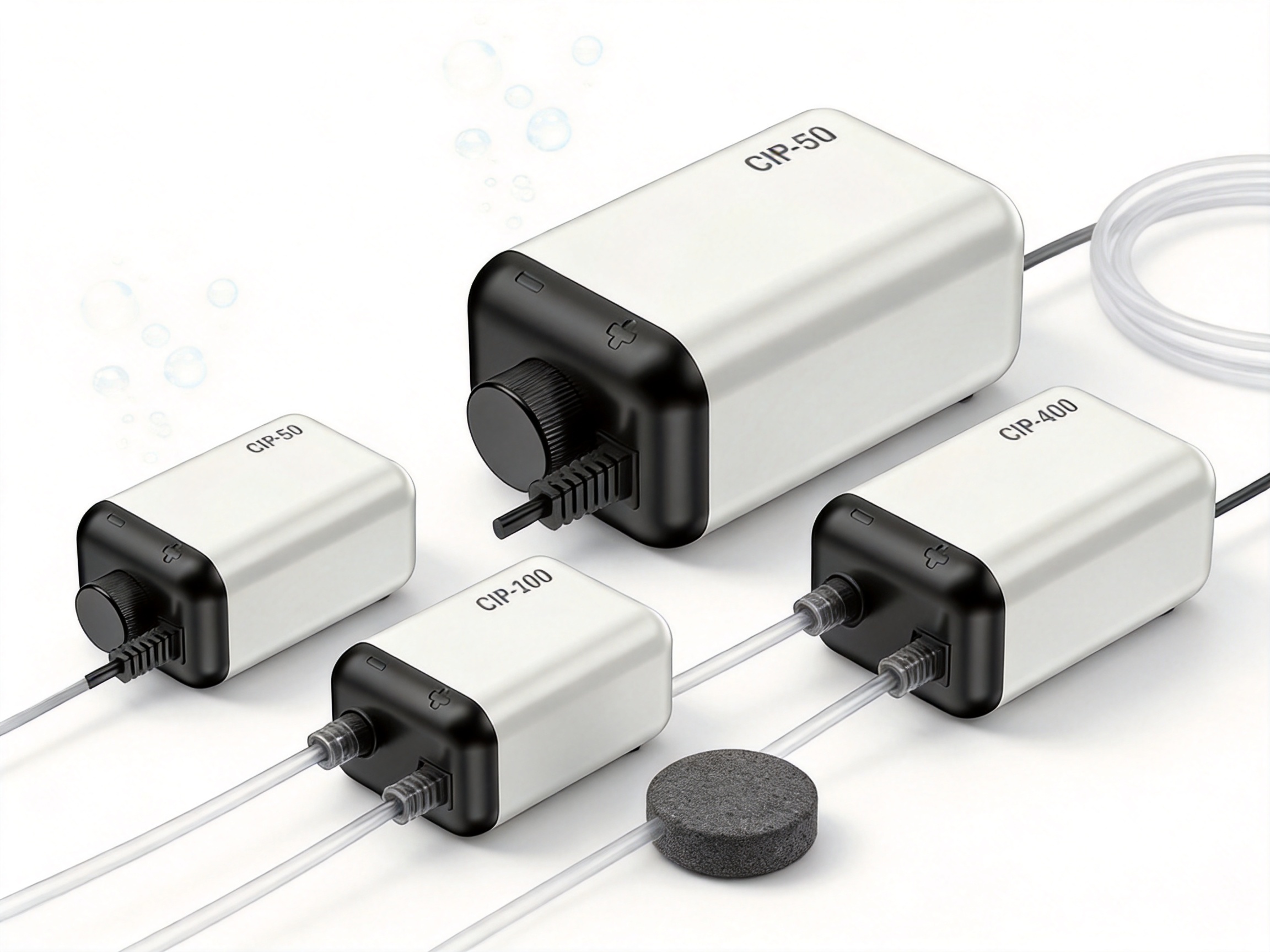
This series belongs to the Air Pump category and includes several model options, allowing users to choose a pump according to tank size, required airflow, outlet quantity, pressure demand, cable length, and installation space.
The available models include CIP-50, CIP-100, CIP-200, and CIP-400, each designed with a different combination of output, pressure, power consumption, and physical dimensions.
The core value of the series is practical aeration: it delivers air into the aquarium through tubing and air stones or compatible accessories, helping improve oxygen exchange, water movement, and the performance of biological filtration.
In aquarium keeping, aeration is not only about bubbles; it is about creating an environment where fish, shrimp, beneficial bacteria, and aquatic plants can remain stable under changing conditions.
The CIP Series Air Pump is built around this practical requirement, offering gas volume adjustment, strong air delivery, and model-specific design details that help match different aquarium needs.
For aquariums with a single air stone or small sponge filter, a single-outlet model can provide an efficient and uncluttered solution.
For aquariums requiring two air stones, dual sponge filters, or more balanced air distribution, the dual-outlet models provide a convenient option without requiring multiple separate pumps.
The CIP-400 model also includes a double sound insulation concept, using thickened chamber walls for improved sound insulation, making it especially suitable for environments where quiet operation is valued.
Because many aquariums are placed in living rooms, bedrooms, offices, reception areas, classrooms, and retail displays, low noise and compact design are meaningful advantages.
The product line also supports different performance levels while keeping energy consumption low, with listed power ratings ranging from 3 W to 5 W depending on the model.
This combination of airflow performance, compact structure, and economical power use makes the CIP Series Air Pump suitable for daily continuous operation in home and commercial aquarium applications.
Oxygen is one of the most important elements in aquarium management, yet it is often less visible than filtration, lighting, or decoration.
Fish and invertebrates consume dissolved oxygen continuously, and beneficial bacteria in biological filters also require oxygen to break down ammonia and nitrite.
When dissolved oxygen levels drop, fish may become stressed, gather near the surface, breathe rapidly, or show reduced activity.
A reliable air pump helps reduce these risks by encouraging gas exchange at the water surface and by driving devices such as air stones, sponge filters, moving-bed filters, and decorative bubble features.
Air bubbles themselves do not directly dissolve all their oxygen into the water; instead, they promote water movement and surface agitation, which help carbon dioxide leave the water and oxygen enter it.
This is why stable airflow is valuable in both heavily stocked aquariums and lightly stocked decorative tanks.
Aeration also improves water circulation in areas that may otherwise become stagnant, especially in tanks with complex decorations, plant clusters, or limited filter flow.
In breeding tanks and fry tanks, gentle aeration can help maintain oxygen without creating excessive current.
In hospital tanks or temporary holding tanks, an air pump can provide essential emergency support when filtration is simplified.
In warm weather, aeration becomes even more important because warmer water holds less dissolved oxygen than cooler water.
In aquariums using medication, supplemental aeration is also commonly recommended because some treatments can reduce oxygen availability or increase fish stress.
For these reasons, a dependable air pump is not an accessory of minor importance; it is a core life-support component for many aquatic systems.
The CIP Series Air Pump addresses this requirement through a product family that gives users several airflow levels and outlet configurations rather than forcing all users into a single universal model.
One of the main features of the CIP Series Air Pump is gas volume adjustment, allowing users to adjust the airflow according to the actual aquarium requirement.
This is important because not every aquarium needs the same bubbling intensity.
A small shrimp tank may require gentle airflow, while a fish tank with higher stocking density may need stronger aeration.
Some fish species prefer calm water, while others tolerate or benefit from more vigorous circulation.
Adjustability gives the user greater control and reduces the need to compensate with clamps, splitters, or oversized accessories.
Compared with many basic air pumps that deliver a fixed output, adjustable airflow offers a more refined user experience.
It allows the pump to be tuned for comfort, noise reduction, energy balance, and visual preference.
For example, reducing airflow at night may lower bubbling intensity in quiet rooms, while increasing airflow during hot weather may help strengthen oxygen exchange.
Adjustable gas volume also supports accessory compatibility because different air stones, sponge filters, and bubble ornaments may require different pressure and flow levels.
The CIP Series Air Pump is promoted with strong gas output and an atmospheric volume designed to produce a good aeration effect.
In practical aquarium use, strong air delivery means the pump can drive air through tubing and accessories with consistent bubbling performance.
The series includes models with outputs ranging from 1.5 L/min to dual outputs of 2 × 2.5 L/min, providing options for different tank setups.
The maximum pressure also increases across the series, from 0.01 MPa in the CIP-50 to 0.02 MPa in the CIP-400.
This graded performance allows users to select a pump based on real requirements instead of relying on guesswork.
Good aeration improves oxygen exchange, supports biological filtration, helps avoid dead zones, and enhances the dynamic appearance of the aquarium.
For users who operate sponge filters, stable airflow is especially important because the sponge filter depends entirely on airlift movement.
Weak or inconsistent airflow can reduce filtration efficiency, while stable airflow helps keep water moving through the sponge media.
The CIP Series Air Pump therefore supports both oxygenation and filtration functions when connected to suitable aquarium equipment.
Space around an aquarium is often limited, particularly in apartments, offices, classrooms, retail counters, and cabinet installations.
The CIP Series Air Pump offers compact dimensions across the model range, helping users place the pump near the aquarium without occupying unnecessary space.
The CIP-50 measures 123 × 63 × 54.5 mm, making it suitable for compact aquarium setups.
The CIP-100 and CIP-200 share dimensions of 134 × 70 × 66 mm, providing increased functionality while remaining compact.
The CIP-400 measures 190 × 90 × 72 mm, reflecting its higher output and enhanced sound insulation structure.
Compact design also helps simplify cable and tubing management.
A pump that is too large may be difficult to place safely above the waterline or inside an aquarium cabinet.
A properly sized pump is easier to install, easier to inspect, and easier to maintain.
For stores and wholesalers, compact packaging and product dimensions can also help with storage, shelf display, and logistics efficiency.
Aquarium air pumps often operate continuously, sometimes twenty-four hours a day.
For this reason, power consumption matters not only to individual users but also to retailers, breeders, laboratories, schools, and facilities with multiple tanks.
The CIP Series Air Pump offers efficient power ratings: 3 W for CIP-50 and CIP-100, 3.5 W for CIP-200, and 5 W for CIP-400.
These low wattage values support economical long-term operation.
Even when used continuously, the power demand remains modest compared with many other aquarium devices.
Low energy use can be an advantage over oversized or less efficient competing pumps, especially when multiple units are used in one facility.
Energy efficiency also contributes to lower heat generation, which can be helpful in small spaces or enclosed cabinets.
While airflow performance is essential, achieving that performance with restrained power consumption is a practical advantage for modern aquarium care.
The CIP Series Air Pump includes both single-outlet and dual-outlet models.
The CIP-50 and CIP-100 are single-outlet models, suitable for a single air stone, one sponge filter, or a simple bubbling accessory.
The CIP-200 and CIP-400 are dual-outlet models, suitable for two air-driven devices or two positions in the same aquarium.
This flexibility reduces unnecessary equipment purchases.
Instead of buying two small pumps for two air stones, a user can choose a dual-outlet model when appropriate.
Dual outlets also allow more balanced aeration in longer aquariums, where one bubbling point may not circulate the entire tank evenly.
In divided breeding tanks, dual outlets can support two compartments from one pump.
In retail or small breeding operations, this can simplify installation and reduce cable clutter.
Compared with competitors offering only one outlet type in a single product tier, the CIP Series provides a more complete selection.
Noise is one of the most common concerns when choosing an aquarium air pump.
The CIP-400 model addresses this need with double sound insulation and thickened chamber walls for better sound insulation.
This design approach is especially valuable for users who need higher airflow but still want a more comfortable acoustic environment.
Higher-output pumps are often more likely to produce noticeable vibration or mechanical sound, so sound-control construction is a meaningful advantage.
In bedrooms, offices, hotels, restaurants, waiting rooms, and display aquariums, quiet operation contributes to a better overall user experience.
A pump that delivers sufficient air while managing sound can be more desirable than a high-output pump that becomes distracting.
The CIP-400 therefore stands out within the series as a stronger model designed with acoustic comfort in mind.

The following specification table summarizes the available CIP Series Air Pump models and their key performance parameters.
Model |
Voltage |
Power |
Maximum Pressure |
Output |
Outlet Number |
Cable Length |
Dimensions L × W × H |
CIP-50 |
220-240 V / 50 Hz |
3 W |
0.01 MPa |
1.5 L/min |
1 |
1.1 m |
123 × 63 × 54.5 mm |
CIP-100 |
220-240 V / 50 Hz |
3 W |
0.012 MPa |
1.5 L/min |
1 |
1.1 m |
134 × 70 × 66 mm |
CIP-200 |
220-240 V / 50 Hz |
3.5 W |
0.015 MPa |
2 × 1.5 L/min |
2 |
1.1 m |
134 × 70 × 66 mm |
CIP-400 |
220-240 V / 50 Hz |
5 W |
0.02 MPa |
2 × 2.5 L/min |
2 |
1.4 m |
190 × 90 × 72 mm |
The CIP-50 is the most compact model in the series and is suitable for users who need basic, efficient aeration from a single outlet.
With a 3 W power rating, 0.01 MPa maximum pressure, and 1.5 L/min output, it is appropriate for smaller aquarium applications where simple and steady airflow is required.
Its compact dimensions make it easy to place near a desktop aquarium, small home fish tank, shrimp tank, or temporary holding tank.
The 1.1 m cable length provides practical positioning flexibility for many standard installations.
Users who need to operate a single air stone or one small sponge filter can consider the CIP-50 as a straightforward and economical choice.
The CIP-100 provides the same listed output of 1.5 L/min as the CIP-50 but with a higher maximum pressure of 0.012 MPa and a slightly larger body.
This makes it suitable for users who want a single-outlet air pump with a little more pressure capacity in a compact format.
It is a practical option for aquariums that use standard air stones, basic sponge filters, or decorative bubbling ornaments.
The 3 W power rating remains energy-conscious, supporting continuous daily use without excessive power draw.
For users who want a compact single-outlet model but prefer a more substantial pump body than the smallest model, the CIP-100 offers a balanced solution.
The CIP-200 introduces a dual-outlet configuration with 2 × 1.5 L/min output, 0.015 MPa maximum pressure, and 3.5 W power consumption.
This model is suitable for aquariums that need two aeration points or two air-driven accessories.
It can be used to power two air stones, two small sponge filters, or one aquarium with aeration at two separated locations.
The dual-outlet design can help improve distribution in longer tanks and may reduce the need for additional pumps.
Because it shares the same dimensions as the CIP-100, it provides more outlet flexibility while remaining compact.
The CIP-400 is the highest-output model in the listed series, offering 2 × 2.5 L/min output, 0.02 MPa maximum pressure, and a 5 W power rating.
It is suitable for users who need stronger dual-output aeration and better sound insulation.
The model includes double sound insulation with thickened chamber walls for improved acoustic performance.
Its 1.4 m cable length also provides more installation flexibility than the smaller models.
The CIP-400 is appropriate for larger home aquariums, more demanding dual-accessory setups, and commercial display environments where strong aeration and quieter operation are both important.
Many competing air pumps are offered in limited configurations, forcing users to choose between a pump that is too small and a pump that is unnecessarily large.
The CIP Series Air Pump reduces this problem by offering a graduated model range with different outputs, pressure ratings, outlet numbers, and body sizes.
This helps users select the correct product for the actual aquarium rather than overpaying for excess capacity or struggling with insufficient airflow.
Better matching can improve user satisfaction, reduce return rates, and support more professional aquarium system design.
Fixed-output pumps may be acceptable for simple use, but they are less flexible when tank conditions change.
The gas volume adjustment feature of the CIP Series gives users greater control over bubbling strength and accessory performance.
This is a competitive advantage in mixed-use environments where one pump may be used with different tanks, fish species, air stones, or filtration accessories over time.
Adjustability also helps reduce excessive bubbling, splashing, or surface disturbance when a gentle flow is preferred.
Another competitive advantage is the efficient power range of 3 W to 5 W.
For products that may run continuously, low power consumption is important for long-term operating cost and practical sustainability.
Some lower-quality pumps may consume more electricity without offering proportionally better airflow or durability.
The CIP Series combines practical output with restrained wattage, making it suitable for both individual consumers and multi-tank operators.
The availability of dual-outlet models is a strong advantage over single-outlet pumps that require splitters or additional units for multi-point aeration.
Using a purpose-built dual-outlet model can simplify setup, improve appearance, and reduce cable clutter around the aquarium.
It also helps users maintain more balanced aeration in aquariums where a single bubble point is not enough.
Noise is a major purchase factor for aquarium air pumps.
The CIP-400 model’s double sound insulation concept helps it compete with pumps that focus only on output but overlook acoustic comfort.
For many users, a quiet air pump is not a luxury; it is necessary for maintaining a pleasant living or working environment.
A product line that offers higher output with attention to sound control can stand apart in a crowded market.
The company behind the product has a long history that began in 1985 and has developed across aquarium pets, aquaculture machinery, and industrial equipment.
This broad experience is valuable because air pump manufacturing benefits from mechanical design knowledge, electrical product control, material selection, assembly discipline, and long-term reliability testing.
A manufacturer with decades of accumulated experience is better positioned to understand user needs, production consistency, product categories, and global market expectations.
This is an important advantage over small or short-term suppliers that may lack mature production systems, quality control procedures, or stable supply capability.
The value of an aquarium air pump depends not only on its catalog specifications but also on the manufacturing system behind it.
A product intended for continuous operation must be produced with consistency, tested with care, and supported by a company capable of long-term supply.
The manufacturer of the CIP Series Air Pump has developed through more than thirty years of continuous innovation and now operates across multiple related industries, including aquarium pets, aquaculture machinery, and industrial equipment.
This industrial foundation supports product development from concept to production, quality management, distribution, and after-sales service.
The company has established a research institute as part of its headquarters structure, indicating a commitment to product development and technical improvement.
For an air pump, research and development may involve airflow structure, diaphragm performance, vibration control, sound insulation, motor efficiency, heat control, material durability, and user-friendly adjustment mechanisms.
Even small improvements in these areas can lead to meaningful gains in daily use.
A pump that runs more quietly, vibrates less, maintains output more consistently, and uses energy efficiently offers better long-term value to the user.
The CIP Series Air Pump reflects this type of application-oriented thinking by combining adjustable airflow, model selection, and sound insulation features in the higher-output model.
The company structure includes a Quality Control Department, which is essential for products such as air pumps that must operate reliably over long periods.
Quality control for an aquarium air pump typically includes inspection of electrical components, housing fit, airflow output, pressure performance, noise level, vibration, cable integrity, and appearance.
Consistent quality helps ensure that customers receive the performance described in the specifications.
It also reduces failures, improves retailer confidence, and supports long-term brand reputation in domestic and international markets.
Compared with competitors that rely on inconsistent subcontracting or limited inspection, a manufacturer with a dedicated quality control function can provide more dependable product consistency.
The company has expanded into multiple subsidiaries and related business operations, supporting a large production and marketing network.
Large-scale industrial organization can provide advantages in component sourcing, process standardization, worker training, tooling management, and production scheduling.
For air pump products, stable production capacity helps maintain consistent availability for wholesalers, distributors, retailers, and project customers.
It also supports product line continuity, which matters for customers who need repeat purchasing or replacement units over time.
Manufacturing scale can reduce supply interruptions and improve the ability to respond to market demand.
An air pump may appear simple from the outside, but its performance depends on precise internal relationships among the motor, diaphragm or air compression mechanism, valves, housing, outlet structure, and vibration-damping components.
If assembly alignment is poor, the pump may become noisy, inefficient, or unstable.
If materials are inconsistent, airflow may decline or vibration may increase over time.
If housing fit is weak, sound insulation and mechanical stability may be compromised.
Advanced manufacturing therefore requires process discipline: controlled assembly procedures, component inspection, stable tooling, and final performance checks.
The CIP Series Air Pump benefits from being produced by a company with established industrial experience and an internal quality management structure.
The company’s product categories include fish tanks, aquarium lighting, controllers, water pumps, air pumps, aquarium equipment, garden equipment, plant wall products, pet products, and aquarium accessories.
This broad product ecosystem creates useful synergy.
A manufacturer that understands aquariums as complete systems can design air pumps with real installation scenarios in mind.
For example, an air pump may need to work with aquarium accessories, tubing, filtration devices, lighting cabinets, display tanks, or retail aquarium systems.
Knowledge across these categories helps the manufacturer create products that fit naturally into the broader aquarium environment.
Compared with suppliers that only produce isolated components, an integrated aquarium equipment manufacturer can better understand user expectations and system compatibility.
The company has built a broad sales network and continues to serve both domestic and foreign markets.
International market experience is important because different regions may have different aquarium habits, voltage expectations, stocking styles, retail packaging standards, and customer service requirements.
A product intended for export must be understandable, stable, and practical for varied users.
The CIP Series Air Pump’s clear model structure, standard voltage listing, compact size options, and simple functional benefits make it suitable for distribution in markets that value dependable aquarium equipment.
The CIP Series Air Pump is designed for straightforward installation with common aquarium air tubing and compatible air-driven accessories.
A user typically positions the pump in a dry location, connects airline tubing to the outlet, attaches the tubing to an air stone or sponge filter, and adjusts airflow as required.
For safety and performance, the pump should be placed above the aquarium water level when possible, or used with a suitable check valve to prevent back-siphoning.
Simple installation is a practical advantage because many aquarium users are hobbyists who want reliable equipment without complicated setup.
The listed cable length is 1.1 m for CIP-50, CIP-100, and CIP-200, and 1.4 m for CIP-400.
This provides practical flexibility for placement near common aquarium stands and cabinets.
The longer cable of the CIP-400 is especially useful because higher-output models may be used in larger setups where placement options require more reach.
Good cable length helps reduce unsafe stretching, awkward positioning, and excessive reliance on extension arrangements.
The series balances physical size with performance requirements.
Smaller models remain compact for small tanks, while the larger CIP-400 provides stronger output and sound insulation in a larger body.
This balanced design prevents the product line from becoming either too weak for demanding use or unnecessarily bulky for simple use.
It also supports clear purchasing decisions: users can move up the model range as their airflow needs increase.
The CIP Series Air Pump can support many common air-driven aquarium accessories when matched appropriately.
These may include air stones, sponge filters, undergravel filter lift tubes, bubble curtains, breeder box aeration, and decorative bubbling ornaments.
Because different accessories create different airflow resistance, the availability of multiple pressure and output levels is useful.
A user with a simple air stone may choose a smaller model, while a user with two sponge filters may prefer a dual-outlet model.
This flexibility gives the series broader application value than a single-purpose pump.
For home aquarium users, the CIP Series Air Pump can provide steady aeration for everyday fishkeeping.
It can help maintain oxygen exchange, support filtration accessories, and improve water movement.
Its compact appearance and low power consumption make it suitable for home environments where space and operating cost matter.
The adjustable airflow also allows users to fine-tune bubbling strength according to fish behavior and personal preference.
In bedrooms and offices, noise level is especially important.
Users who need stronger airflow but want better acoustic comfort can consider the CIP-400 because of its double sound insulation structure.
For smaller tanks, proper placement on a stable surface and airflow adjustment can help reduce vibration and bubbling noise.
A quiet and stable air pump contributes to a more peaceful environment while keeping the aquarium healthy.
Breeding tanks and fry tanks often use sponge filters because they provide gentle filtration and protect small fish from being drawn into strong intake systems.
The CIP Series Air Pump can be paired with sponge filters according to the required airflow.
Single-outlet models may serve individual breeding tanks, while dual-outlet models may support two sponge filters or two tank compartments.
Adjustable airflow is useful because fry and small aquatic animals often require gentle water movement.
Aquarium stores and pet product retailers often operate multiple display tanks that require stable aeration.
The dual-outlet models can reduce equipment clutter and simplify aeration for paired tanks or multiple devices.
Reliable airflow helps maintain livestock condition and improves the visual appeal of display aquariums.
The manufacturer’s large-scale production and market network also support retail supply needs.
An air pump is valuable as emergency support during filter maintenance, temporary livestock holding, medication treatment, or hot weather.
Keeping a reliable air pump available can help protect aquatic life when normal circulation is reduced.
The compact models in the CIP Series are practical for backup use because they are easy to store and deploy when needed.
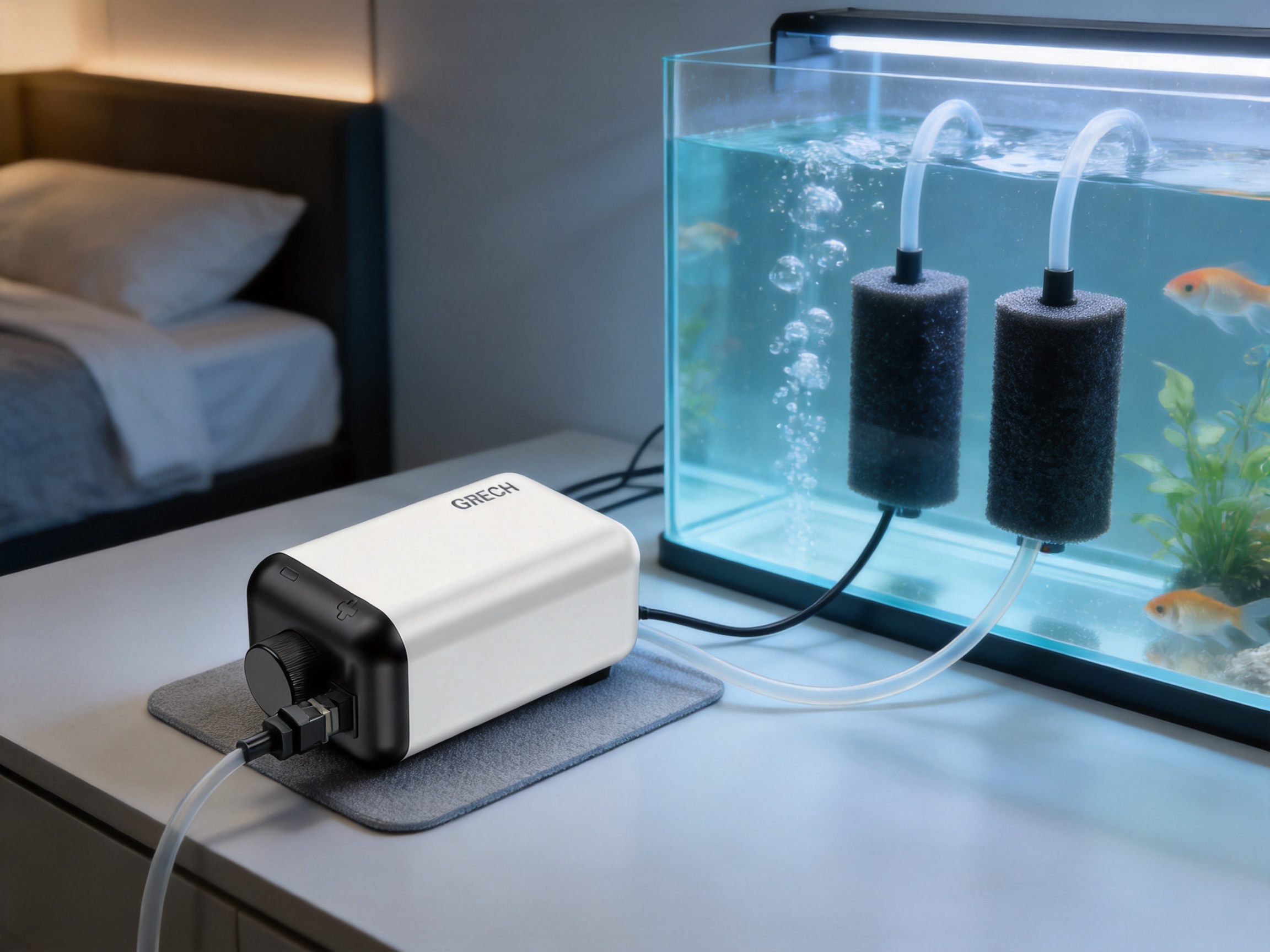
The air pump should be placed in a dry, stable, and well-ventilated location near the aquarium.
Whenever possible, it is recommended to position the pump above the water level to reduce the risk of water backflow into the pump.
If the pump must be installed below the water level, a suitable check valve should be installed in the airline tubing.
The pump should not be placed where it can fall into water or be exposed to splashing.
A stable surface can help reduce vibration noise and improve operating comfort.
Airline tubing should be firmly connected to the pump outlet and to the selected accessory.
Loose connections can reduce airflow, create noise, or cause accessories to stop working.
If a dual-outlet model is used, each outlet should be connected appropriately, and airflow should be adjusted to match the connected devices.
When using air stones, it is helpful to soak some stones before use according to accessory instructions, as this can improve bubble distribution.
After installation, the user should observe the bubble output and fish behavior.
If the bubbling is too strong, the airflow can be reduced.
If the bubbling is weak or the accessory is not operating effectively, the airflow can be increased or the tubing and accessory can be checked for blockage.
Adjustable gas volume is a major advantage because it allows practical fine-tuning after the pump is installed.
Most air pump noise comes from mechanical vibration, resonance with the surface below the pump, or bubbling sound in the water.
To reduce noise, the pump should be placed on a stable and level surface.
Users may also place the pump on a soft vibration-damping pad if appropriate and safe.
Airline tubing should not be pulled tight, because tension can transmit vibration to the aquarium or cabinet.
The air stone or accessory should also be selected carefully, as some accessories create more bubbling noise than others.
The CIP-400’s enhanced sound insulation is especially helpful for users who need higher output while managing acoustic comfort.
Regular inspection helps maintain air pump performance.
Users should check airline tubing for kinks, blockage, hardening, or loose connections.
Air stones may become clogged over time and should be cleaned or replaced when airflow becomes weak.
The pump should be kept dry and free from dust accumulation around ventilation areas.
If airflow declines significantly despite clear tubing and accessories, the pump should be inspected according to the product guidance provided by the supplier.
Good maintenance extends service life and helps maintain stable oxygenation.
Choosing the right CIP Series Air Pump model depends on tank size, number of air-driven devices, desired airflow strength, noise expectations, and installation location.
For a small tank with one air stone, the CIP-50 may be sufficient.
For a single accessory requiring slightly higher pressure, the CIP-100 may be suitable.
For two air stones, two sponge filters, or two aeration points, the CIP-200 offers dual outlets with moderate power consumption.
For stronger dual-output aeration and enhanced sound insulation, the CIP-400 is the premium option in the listed range.
Users should avoid choosing only by tank volume because accessory resistance, water depth, tubing length, and desired bubble intensity also affect performance.
It is often wise to choose a model with enough capacity and then adjust the airflow downward if needed.
This approach provides flexibility while avoiding underpowered operation.
The CIP Series Air Pump is not only valuable for end users but also attractive for distributors, wholesalers, and aquarium retailers.
The series offers a clear product ladder, making it easy to explain model differences to customers.
Retail staff can recommend models based on outlet number, output, pressure, and noise preference.
The compact dimensions support convenient shelf display and inventory management.
Low power consumption and practical features create straightforward selling points that customers can understand quickly.
The backing of a large manufacturer with a long operating history supports confidence in supply continuity and product category development.
Because the company also operates in related aquarium categories, retailers may benefit from broader product sourcing opportunities across fish tanks, lighting, pumps, controllers, accessories, and pet products.
This category breadth can improve procurement efficiency and support coordinated product offerings.
Sensen Group Co., Ltd. is located in Zhoushan City, Zhejiang Province, China, and has developed from a company established in 1985 into a large enterprise involved in aquarium pets, aquaculture machinery, industrial equipment, and related categories.
The company’s long development history reflects continuous innovation and accumulated manufacturing experience.
Its organizational structure includes functional departments such as a research institute, business school, quality control department, personnel and administrative information department, and financial department.
This structure supports product development, staff training, quality management, business administration, and sustainable operations.
The company also has multiple subsidiary corporations and trading companies, creating a broad production and marketing foundation.
For buyers, this means the product is supported not by a small isolated workshop but by an enterprise with established industrial capacity and market experience.
The company has built a broad sales network and promotes an integrated online and offline retail model.
This market orientation helps the manufacturer understand consumer feedback, channel needs, and product improvement opportunities.
In the aquarium equipment industry, long-term success depends on product reliability, innovation, supply stability, and service awareness.
The CIP Series Air Pump benefits from this environment because it is part of a broader product system and supported by experienced production and quality management capabilities.
An aquarium air pump must perform reliably because aquatic life depends on stable oxygenation.
While appearance and size are important, the true value of the pump is shown through continuous operation, consistent output, and user trust.
The CIP Series Air Pump addresses reliability through practical engineering choices: efficient power ratings, model-specific output levels, adjustable airflow, compact bodies, and sound insulation in the higher-output model.
These features reflect a product designed for real aquarium conditions rather than only for catalog presentation.
Practical engineering also means avoiding unnecessary complexity.
An air pump should be easy to install, easy to adjust, easy to place, and easy to understand.
The CIP Series follows this principle by offering clear model names and understandable specifications.
For a consumer, this reduces confusion.
For a retailer, it simplifies recommendation.
For a distributor, it supports product positioning across different price and performance levels.
Energy efficiency is increasingly important in aquarium equipment, especially because many devices operate continuously.
The low wattage of the CIP Series helps reduce operational cost and supports responsible energy use.
Although each individual pump consumes only a small amount of power, the total effect becomes meaningful in facilities with many aquariums.
Efficient products also help reduce heat production and can contribute to more stable aquarium room conditions.
By providing usable airflow at 3 W, 3.5 W, and 5 W levels, the series offers a practical balance between performance and energy demand.
The main purpose is to provide airflow for aquarium aeration and air-driven accessories such as air stones, sponge filters, bubble ornaments, and similar equipment.
The listed models are CIP-50, CIP-100, CIP-200, and CIP-400.
The CIP-50 and CIP-100 have one outlet, while the CIP-200 and CIP-400 have two outlets for operating two air-driven devices or two aeration points.
The CIP-400 has the strongest listed output at 2 × 2.5 L/min and the highest listed maximum pressure at 0.02 MPa.
Yes, the series features gas volume adjustment, allowing users to adjust airflow according to different aquarium needs.
The CIP-400 includes double sound insulation with thickened chamber walls, making it the sound-conscious option in the series, especially for users who need stronger airflow.
Yes, the pump can be used with compatible sponge filters when the model output and pressure are suitable for the filter size and water depth.
Aeration promotes oxygen exchange, supports beneficial bacteria, improves circulation, and helps maintain a healthier environment for fish and other aquatic life.
The pump should be placed in a dry, stable location, preferably above the aquarium water level, or used with a suitable check valve if installed below the water level.
Users can place the pump on a stable surface, avoid tight tubing, select suitable air stones, adjust airflow properly, and choose the CIP-400 when higher output with improved sound insulation is needed.
Not always. The best airflow depends on fish species, tank size, accessory type, water depth, and desired circulation. Adjustable airflow helps users find the right balance.
A strong manufacturer with long industry experience, research capability, quality control, and large-scale production can provide better consistency, supply stability, and product support.
The CIP Series Air Pump is a practical and flexible aeration solution for modern aquarium users who need stable airflow, adjustable gas volume, compact installation, and efficient continuous operation.
With four model options, the series covers single-outlet and dual-outlet applications, basic and stronger airflow demands, and different installation spaces.
The CIP-50 and CIP-100 provide compact single-outlet aeration, the CIP-200 offers dual-outlet convenience with moderate power use, and the CIP-400 delivers stronger output with enhanced sound insulation.
Compared with many competing air pumps, the series stands out through adjustable gas volume, efficient power consumption, multiple model choices, dual-outlet availability, and sound-conscious design in the higher-output model.
Behind the product is a manufacturer with decades of development, broad aquarium equipment experience, research and quality control functions, large-scale production capacity, and a wide market network.
This combination of product practicality and manufacturing strength makes the CIP Series Air Pump a strong choice for home aquariums, breeding tanks, retail displays, office installations, and general aquarium aeration needs.
For users, it offers healthier water conditions and easier control.
For retailers and distributors, it offers a clear and reliable product line with strong category relevance.
For the aquarium industry, it represents the value of combining engineering simplicity with manufacturing discipline and long-term product experience.
Spotte, S. Fish and Invertebrate Culture: Water Management in Closed Systems.
Timmons, M. B., Ebeling, J. M., Wheaton, F. W., Summerfelt, S. T., and Vinci, B. J. Recirculating Aquaculture Systems.
Wedemeyer, G. A. Physiology of Fish in Intensive Culture Systems.
Hargreaves, J. A. Photosynthetic Suspended-Growth Systems in Aquaculture.
Boyd, C. E. Water Quality: An Introduction.
Company product specification materials for the CIP Series Air Pump.



 English
 русский
 España
 Portugal
 عربي
عربي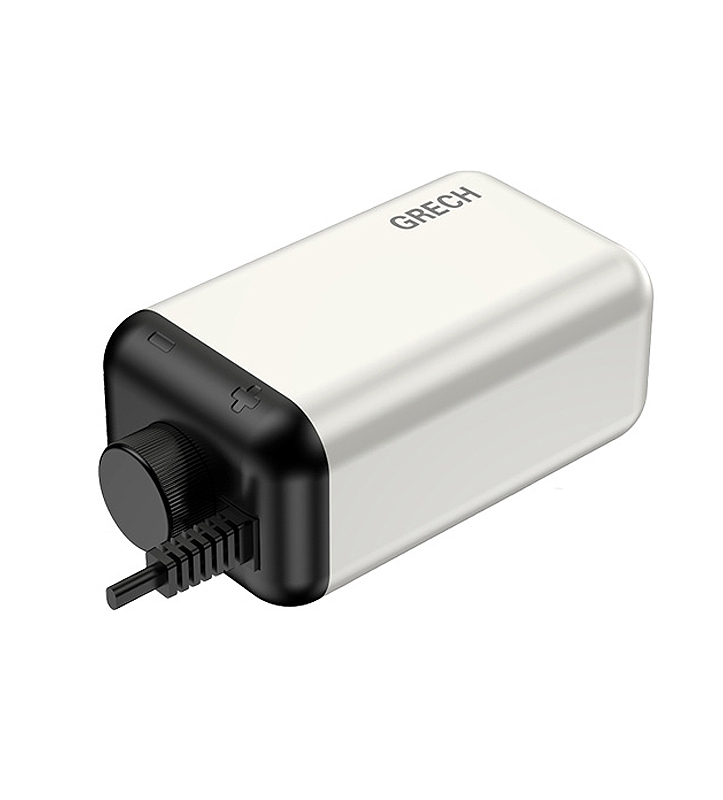

 No. 61-79, Baima Street, Maao Town, Dinghai District, Zhoushan City, Zhejiang Province, China.
 0086 580 8082088 / 8081168
 0086 580 8080978
 songhua@sunsun-china.com